Reserve restores '168 football pitches' of land

 Andy Hay/RSPB
It's the size of 168 football pitches and – if utilised correctly – could provide the perfect place for threatened species to thrive once more.
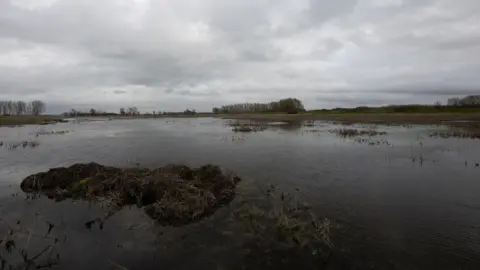
But, for hundreds of years, a 296-acre (120-hectare) plot of former arable farmland in The Fens has been the antithesis to a wildlife paradise, having long been drained dry.
That was until the Royal Society for the Protection of Birds (RSPB) decided to reinvigorate the soil site by rewetting it, creating a new nature-friendly peatland at Lakenheath Fen, in Suffolk.
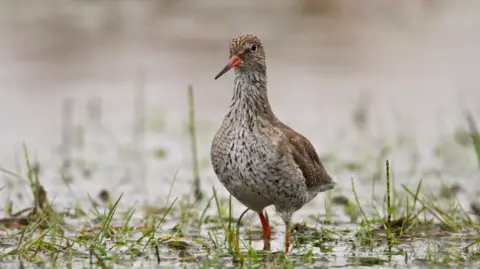
As a result, species at risk of extinction have been thrown a lifeline – and some are already said to be repopulating the once barren area.
 Dave Rogers
"We know it's just a matter of time until we see threatened wildlife species reappear here," said nature reserve manager, Dave Rogers.
"And the red-listed lapwing bird that has already been seen on the peatland has proven that point."
 Ben Andrew/RSPB
Covering parts of Cambridgeshire, Lincolnshire, Norfolk and Suffolk, The Fens were formed some 10,000 years ago, as post-Ice Age sea levels rose across low lying land.
Over time, the movement of the water slowed, due to the deposited clay and silt, and the area became flooded and boggy – the perfect ecosystem for wildlife.
That was until much of the peatlands were drained over the last 400 years to create farmland, with less than 2% of the original 988,421-acre (400,000 hectares) wetlands remaining, noteably at Wicken Fen in Cambridgeshire.
 George King/BBC
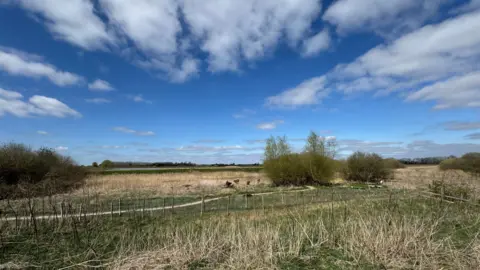
In a bid to reverse this, Lakenheath Fen Nature Reserve was created in 1995 by the bird charity, when it was mainly arable fields.
The 1,235-acre (500-hectare) spot now boasts a mix of reed beds, marshes and woodlands, giving different species the habitats they need to breed and increase in number.
Its latest rewetting project, funded by Natural England, the Esmee Fairbairn Foundation and the Morgan Sindall Group, is expected to accelerate that by restoring shallow water habitats.
 Ben Andrew/RSPB
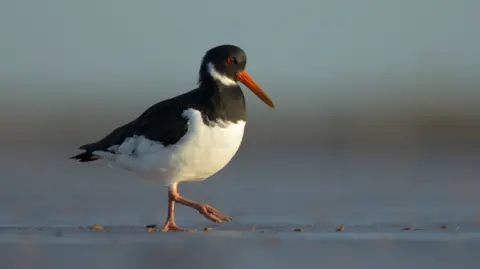
Birds they are hoping to encourage include the red-listed lapwing, whose UK breeding population is down by 63%, and the amber-listed redshank and oystercatcher, whose breeding populations have decreased by 45% and 21% respectively.
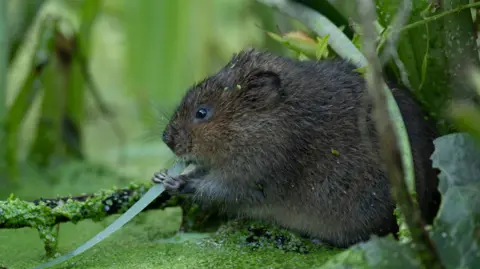
The reinvigorated land will also help water voles, which are one of the fastest declining mammal species in Britain with population numbers down by 97% since the 1970s.
It was essential the RSPB takes "action for nature", says Rogers.
"The reserve will work hard to boost population numbers by providing a protected place for these species to live, feed and breed in," he added.
"We can't wait to see it."
To rejuvenate the land, a network of dams, ditches, water-control sluices and a water pump have been installed, making it easier to retain rainfall and maximise water levels.
The efforts of the RSPB already appear to be working, with lapwing, marsh harrier, cattle egret, little egret, great egret and grey heron having already been spotted on site.
'Win-win all round'
But not every part of the UK is fortunate enough to have wetland on which wildlife can bloom.
According to the RSPB, 80% of the country's peatlands are no more – having either been damaged or destroyed.
"These peaty soils will all be lost in The Fens in the next 50 years unless we re-wet them," said Rogers.
"Their benefit to us and wildlife is huge.
"They are brimming with potential to help threatened wildlife and are a natural solution for storing carbon. So, it's a win-win all round."
Follow Suffolk news on BBC Sounds, Facebook, Instagram and X.
