How winter storms are rapidly reshaping our coastline

 Peter Ganderton/University of Plymouth
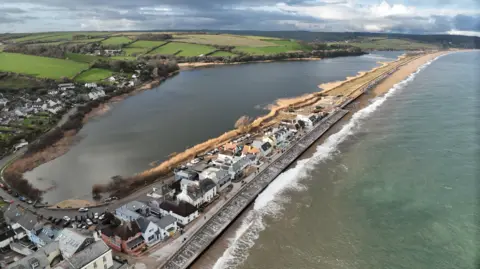
Powerful winter storms in south-west England have stripped away sand, eaten into beaches - reducing some by as much as 2m (6.6ft) in height - and left some worried their homes could eventually "crumble into the sea".
Experts, residents and researchers explain what is happening to the coastline here - and whether more communities could face the same future.
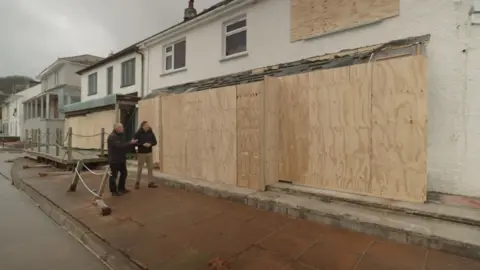
"It's very upsetting" said Peter Walton who returned to his seafront property in Torcoss, Devon, to find it badly damaged by Storm Ingrid, which lashed the region a week ago.
"We lost the front windows. The shutters that should protect them were on the lounge floor," he explained.
"When we bought the place, we knew we were vulnerable but we didn't realise just how vulnerable, although the sea defences withstood the majority of it."
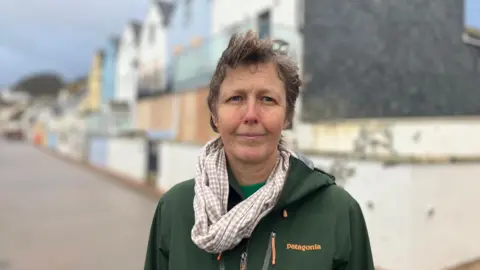
"We're on the front line here," said Gail Stubbs, who runs the Start Bay Inn pub and has lived in Torcross for most of her life.
She said she was worried that eventually the village would "crumble into the sea".
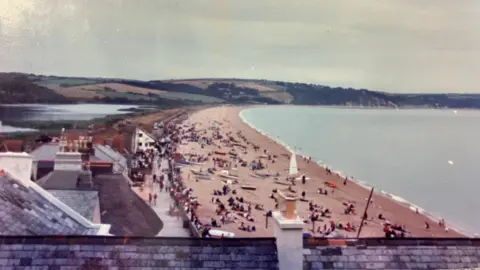
"The beach is always changing. It was enormous as I was growing up and now it's almost disappeared.
"This time, this feels different," she added of the damage the village had experienced.
How do you measure the impact of storms?
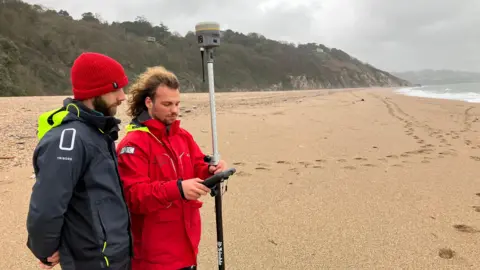
"We're measuring the elevation of the beach to see how it's shifted after the storm," said Joseff Saunders, one of the University of Plymouth researchers assessing the damage.
He is using digital GPS-connected kit to monitor beach levels, taking measurements at five points every 200m (660ft) or so.
"The idea is to get an indication over the longer term of how this beach is changing.
"Then we can start to model how the beach will look in the future, looking at different conditions, particularly sea-level rise," he said.
It is this team of researchers who say - following Storm Ingrid - the beaches at Torcross and Slapton have seen a reduction in height of 2m (6.6ft) .
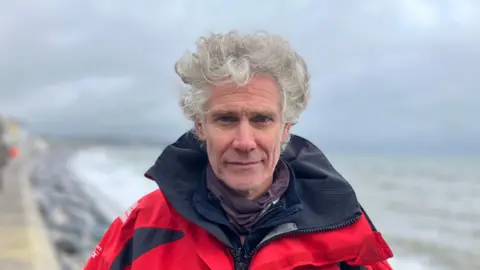
Why did Torcross beach lose 2m (6.6ft) in height?
"It's the biggest change that's happened here in the last 10 years," said Gerd Masselink, professor of coastal geomorphology at the University of Plymouth and an expert in how our coastline is evolving.
"It is very significant but it's part of an ongoing trend at beaches along the south coast, of gravel and sand being moved from the western end, to the eastern end."
"That's because we're seeing more south-westerly wave events than easterly wave events," he added.
The latest dropped level follows a fall of about 6m (20ft) in the beach height over the past 20 years or so, according to Masselink.
 Gail Stubbs
How will climate change play its part?
"This is going to become increasingly common," Masselink said of the erosion seen at Torcross and Slapton beaches.
"We have climate change and rising sea levels, which is making the impact of storms more pronounced.
"So, we're going to see increased flooding, we're going to see erosion on beaches that used to be stable. We're going to see increased erosion at beaches that are already eroding."
"We can't keep defending coastlines for the next 20, 30, 40 years.
"Unless we start casting the whole coast in concrete, we have to start retreating."
A Department for Environment, Food & Rural Affairs spokesperson said: "We're committed to supporting coastal communities, including in the South West, through our record investment of £10.5bn in protecting against flooding and coastal erosion by 2036, benefitting nearly 900,000 properties.
"In addition, having inherited flood defences in the worst condition on record, we have reprioritised more than £100m into urgent maintenance works to make sure defences are properly maintained."
Follow BBC Devon on X, Facebook and Instagram. Send your story ideas to spotlight@bbc.co.uk.
