Walks spark new interest in city's once-toxic canal

 Charles Heslett/BBC
Living along the Bradford Canal during the Industrial Revolution was a very dangerous thing to do. It was so polluted with human waste and effluent that death rates soared, especially among the young - and that ultimately led to its closure.
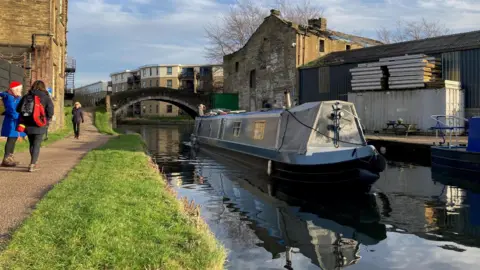
But in 2025, the picture there could not be more different, with guided walks having taken place along the once-toxic waterway, celebrating its history as part of Bradford's City of Culture year.
The walks along the little-known three-mile spur off the Leeds and Liverpool Canal, run by the Canal & River Trust, have proved so popular, in fact, that they are now going to continue into 2026.
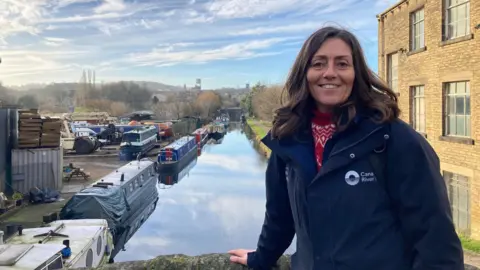
Sharron Bright, the charity's community engagement coordinator who has led the monthly walks, said it was an astonishing turnaround for a stretch of canal once "destined to fail".
 Charles Heslett/BBC
Ms Bright said that back in the 18th Century, the canal was at one point intended as "a crucial arm to bring a waterway into Bradford".
"Everything in the 1770s was moved around by the waterways, so this was the one way that the local businesses, the local industries, could get their goods transported to those really golden ports of Goole and Liverpool."
Bradford Canal was only three miles (5km) long when it officially opened in 1774.
Ms Bright explained: "It was fed by Bradford Beck. At the time in a lot of Bradford the sewerage wasn't in place, so a lot of that sewage ended up in that water supply.
"It then got re-circulated through this canal and it became the leading cause of cholera and typhoid across the city.
"In this area, people had to live with their windows shut and there was a huge spike in infant mortality and the general death rate because of the canal.
"It was actually declared as a public nuisance, at its peak, and was destined to fail."
Bradford Canal finally closed in 1922 and only a small section remains, where it meets the Leeds & Liverpool Canal in Shipley at the old canal basin.
Ms Bright said: "In the 1950s it was shut completely and infilled, and in the 1990s we lost all sight of it.
"Things were built on top of it and all evidence of it disappeared."
 Charles Heslett/BBC
But fast forward to 2025, and interest in the city's "lost" canal has been reignited by the guided walks, and with help from research by local author Colin Sidaway, who wrote a book called The Bradford Canal back in the 1990s.
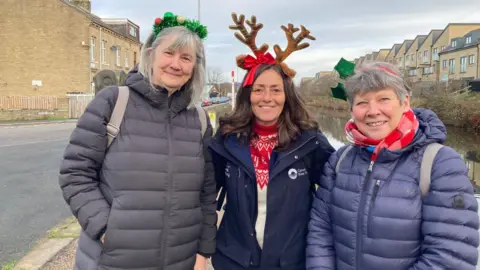
Kath Spillane, 67, from Shipley, one of those taking part in 2025's final guided walk along the remaining stretch of the Bradford Canal, said it had been an eye-opener.
"I've lived on Shipley all my life and I've seen parts of the canal, and the river, that I've never seen before," she explained.
"The history of it is really interesting - and what you see as well.
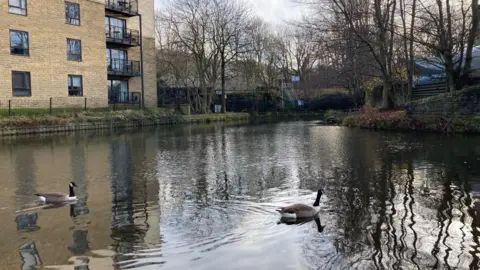
"We've seen the kingfishers, various birds. Another group saw a mink when they were walking."
As well as the nature she observed, Ms Spillane said the trips along the Bradford Canal were a good way to socialise.
"When you retire, it's nice to meet people from different walks of life and chat as you go," she said.
 Charles Heslett/BBC
Meanwhile, Veronica Snowden, 66, also from Shipley, said her main reasons for taking part were "fresh air, exercise and companionship".
"Sharron is really knowledgeable, her interpersonal skills are amazing and she's a very warm person," Ms Snowden said.
"She's just encouraged so many people to be part of these walks, which she needs to be praised for."
Ms Bright said: "What started as part of the BD25 City of Culture celebrations meant that we ended up with a really well-signed-up walk.
"It was meant to be every other month, it went to every month, so we added a lot of extra ones.
"The story's grown and because of that we wanted to continue into next year."
Listen to highlights from West Yorkshire on BBC Sounds, catch up with the latest episode of Look North.
