Sunbed ads spreading harmful misinformation to young people

 Getty Images
Harmful misinformation claiming sunbeds offer health benefits in winter is being spread by tanning companies on social media, the BBC has found.
We have identified hundreds of adverts on TikTok, Instagram and Facebook saying sunbeds can boost energy and treat skin conditions or mental health problems.
One suggested that going on a sunbed for "eight minutes" could prevent colds and flu, while another claimed that UV rays could "stimulate the thyroid gland" to help someone lose weight.
Claims like these are "irresponsible" and "potentially dangerous", the government told us - while an NHS dermatologist described the amount of sunbed misinformation on social media as "genuinely terrifying".
Our findings come after the Advertising Standards Authority (ASA) banned six tanning adverts for making irresponsible health claims or suggesting sunbeds were safe.
Cancer charities and doctors are clear about the risks of using sunbeds - and say the machines are linked to higher rates of melanoma and other skin cancers.
Using a bed before the age of 35 increases the risk of melanoma by 59% later in life, according to the World Health Organization (WHO).
The Sunbed Association, which represents half the UK's tanning shops, says the ASA and WHO are using "outdated data", but encourages its members not to use medical claims in advertising.
Young people are by far the biggest sunbed users in the UK - about one in seven 18-to-24-year-olds say they used one in the past year, double the average for all age groups, according to a 2025 YouGov survey.
Other data suggests nearly a quarter of under-25s wrongly believe sunbeds actually reduce the risk of getting skin cancer.
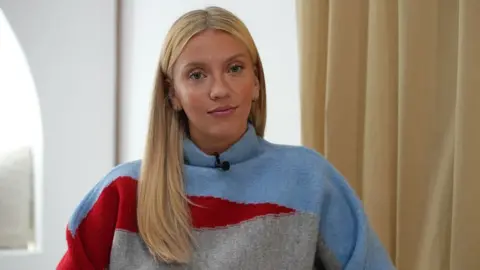
Kass Barker was told she had melanoma at the age of 22 after she had a suspect mole checked on her wrist.
Although she can't know for sure what caused her cancer, she thinks sunbeds increased the risk.
She and her friends would tell themselves they were using the beds, she says, to get "a few minutes of vitamin D".
The NHS says sunbeds should never be used for that reason.
Cancer charities are concerned that harmful health messages are being allowed to go unchecked and unchallenged online.
"So many videos on social media are just repeating misinformation and encouraging the use of something that has been proven to cause cancer," says Rosie Vare, health information manager at the Teenage Cancer Trust.
"We would really encourage young people to think about where your information is coming from, who is creating this information, and whether you can trust them."
'Genuinely terrifying' claims of health benefits
During January, the BBC searched TikTok, Instagram and Facebook for videos about winter tanning and examined online accounts of sunbed companies in the UK.
We identified more than 200 separate ads appearing to make unsubstantiated health claims, most of which had been posted by individual salons or smaller chains.
One video, liked 18,000 times on TikTok, claimed - wrongly - that "doctors prescribe sunbeds" for issues including "vitamin D deficiency, seasonal depression and skin disorders". Those claims are all strongly disputed by health experts.
Vitamin D is made in the body by exposure to the sun or by eating certain foods.
While some sunbeds may technically emit UVB rays, which the body can convert into vitamin D, the WHO says they are not an efficient way to make the nutrient. The NHS says it is safer to just eat a healthy diet or take supplements.
The British Association of Dermatologists and other specialists strongly advise against using commercial sunbeds to treat skin conditions.
Some light therapies are used in hospitals for eczema, psoriasis and acne, but those are very different, delivering precisely targeted UV rays under strict medical supervision.
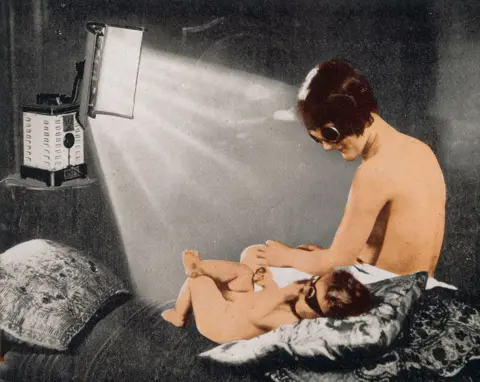
We found other Instagram videos claiming sunbeds could reduce body weight and "increase serotonin levels" to treat mood disorders and depression.
The Obesity Health Alliance told us it is outrageous to suggest tanning beds can trigger weight loss, while claims that they can treat anxiety or seasonal affective disorder are "irresponsible and harmful", according to mental health charity, Mind.
 Getty Images
"The amount of misinformation on social media is genuinely terrifying," says Dr Amy Perkins, an NHS dermatologist from Stirling who has complained to the advertising watchdog about some of the online material.
"And it's so important because the numbers being diagnosed with skin cancer are rising year-on-year, with a staggering impact on our health services."
Downplayed cancer risks
Other online adverts we saw suggested the health risks of sunbeds were exaggerated or they promoted tanning sessions as safe or low risk.
About 23% of 18-25-year-olds wrongly believe sunbed use actually decreases the risk of skin cancer, a survey by the charity Melanoma Focus suggests.
Yet the WHO has put tanning beds in the highest cancer-risk category alongside smoking, asbestos and alcohol.
Almost nine out of 10 melanoma cases in the UK can be prevented by staying safe in the sun and avoiding sunbeds, according to Cancer Research UK.
And the British Association of Dermatologists, which would like to see a complete ban on the devices, says sunbeds are responsible for 100 deaths a year.
Since the early 1990s, UK melanoma cases have risen by about 250%.
The increase is mainly in older age groups but roughly 1,000 people a year under 30 are diagnosed with some form of skin cancer, with rates higher in young women.
'We are selling a tan - we are not doctors'
The ASA is now drawing up new guidance for tanning salons, due to be published in March.
"Our main message to anyone in the industry is, don't claim that sunbeds are safe, don't claim they provide health benefits, and don't claim they can be used to treat medical conditions," says the ASA's regulatory projects manager, Jess Tye.
Sunbeds are legal and regulated in all parts of the UK, with limits on the strength of the UV light the beds can emit and a ban on under-18s using the devices.
The government said last month it was looking at tightening some of the rules in England with stricter ID checks and mandatory health warnings in salons, something already in place in other parts of the UK.
According to the Sunbed Association, its members train staff to screen out high-risk customers with very fair skin and, under its guidelines, no individual should be allowed to buy more than 60 sessions a year.
Chairman Gary Lipman says he would "encourage members not to make health claims".
"Tanning salons are selling a tan - we are not doctors. I think some of these claims are going too far," he adds.
But the association argues health bodies and the ASA overstate sunbed risks, as stricter regulations better protect customers.
It cites studies, including from University of Edinburgh researchers in 2024, that suggest UV-ray exposure, from sunshine or sunbeds, can be linked to a lower chance of dying from heart disease or cancer.
However, dermatologists and cancer specialists have criticised the way the industry has interpreted that research, and the ASA ruled last year it should not be used to give the impression that sunbeds have health benefits.
In a statement, TikTok said it removes posts from its platform that violate its policies on harmful misinformation, while Meta, which owns Instagram and Facebook, said it would investigate videos brought to its attention by the BBC.
