Winter storms trigger mineshaft collapses

 BBC
BBCBeneath Cornwall's towns and countryside lies a vast network of historic mine shafts, many of which are unrecorded and unmapped. This winter after weeks of heavy rain, some have started to reopen.
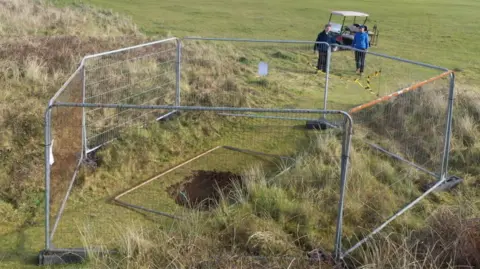
A section of a golf course collapsed while holes have appeared in roads and on open land. The weather is exposing workings first dug centuries ago with some extending hundreds of feet underground and lined with timber supports that are now giving way.
There are thought to be about 20,000 mineshafts across the county, but according to Cornwall Mining Consultants only about a fifth have been capped, leaving thousands whose exact condition - and in some cases location - is uncertain.
When one fails, it can pose a risk to property and public safety and carry significant financial consequences.
Unlike former coal mining areas, where a government-backed authority helps cover the cost of historic mine workings, in Cornwall the bill falls to the landowner - a situation described in Parliament as an "injustice".
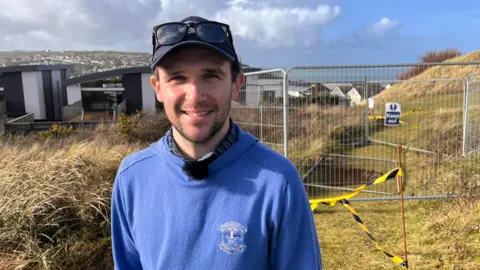
Perranporth Golf Club has always had 18 holes - until a 30ft (9m) mining shaft opened a few yards off the second fairway.
A walker spotted it last month, at the end of the wettest January on record in Cornwall and the following Storm Chandra, the third named storm in two weeks.
Club general manager Nathan Gilpin says dealing with a mine shaft is beyond the club's expertise: "We can fill in a bunker or cut grass - but not look after a mine like this."
The club has commissioned a survey to assess whether other parts of the course may be vulnerable and to look at options for making the hole safe.
In recent months, similar holes have opened elsewhere. In Redruth, a man's Mini became stuck when a shaft gave way beneath a parking space. In Beacon, a collapse under the main road, effectively cut residents off from Camborne.
Chris Rogers, principal mining geologist with Cornwall Mining Consultants, says he has been dealing with more incidents than usual.
"Without a doubt there has been an increase in collapses and subsidences recently and I would most certainly put that down to the rainfall we have had," he says.
Cornwall Council said it was "currently seeing an increase in reported voids and subsidence incidents due to changing weather patterns and ground conditions".
"We want to reassure local communities that safety remains our top priority. We are actively monitoring the situation and addressing concerns as they arise."
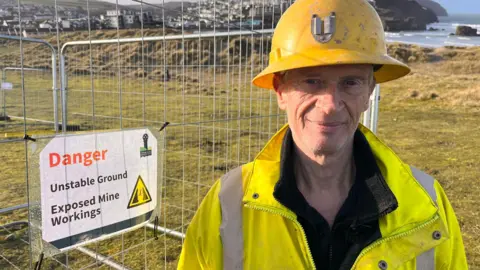
A few hundred metres from the golf club, near Perranporth beach, three more holes appeared in sand dunes and have been fenced off.
They are the legacy of Wheal Ramoth mine, which reached about 300ft (91m) underground, but responsibility for making the shafts safe now rests with Perranzabuloe Parish Council - work that can cost between £5,000 and £250,000 depending on the complexity.
The parish council has secured the area with fencing and signs, and said it will be continuing to monitor it "over the coming weeks while the land and weather settle, to determine whether there is any further movement or subsidence".
"A full assessment and next steps will then be made depending on developments," it added.
 Dale Foster courtesy of Wheal Jane Consultancy
Cornwall has a history of mining that goes back to the Bronze Age, with most activity in the 18th and 19th centuries.
From 1872, a law required owners to submit abandonment plans when closing a mine, but earlier closures mean many shafts and workings were never recorded.
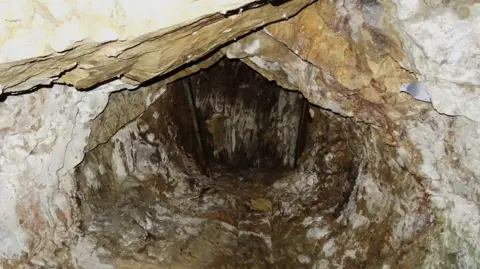
Rogers says shafts were often covered with wooden boards.
"They probably thought they would last 150 years... and they were right," he says.
"Now unfortunately that time has come through and you've got wooden boards that have failed and rotten away, that has left a friction over the top of them and then the water comes along there are collapses.
"I would say 95% of subsidences are caused by water."
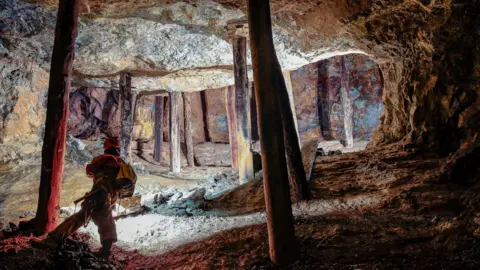
Disused mines are described as "extremely dangerous" by Cornwall Council, which advises that only trained experts should enter them.
The Carbis Bay Crew knows the inside of Cornwall's mines better than most and sometimes report underground conditions to landowners and authorities.
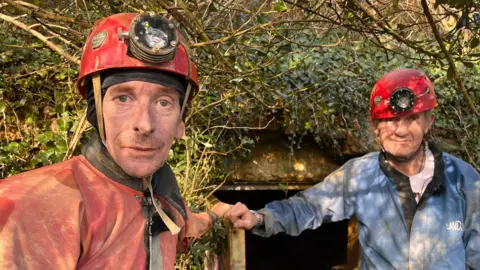
"The wood is starting to rot big time... you can grab handfuls of the timber and pull it off with your hand," says Tim Clarke, who has just climbed a 50m (164ft) ladder from a disused copper mine on Cornwall's north coast.
"It's usually a dry mine but with all the rain we've had it has got really wet. It's all taken a beating."
The timbers, in place since the 1800s, are rotting and cracks are appearing underground.
He is with fellow Carbis Bay Crew member Pat Moret - both are trained in confined space working, rope access, and technical rescue skills.
On the surface, metal, concrete and grill caps dot the landscape, designed to prevent people or animals falling into shafts.
"There's a shaft over here that is starting to open up - that's a new one," Moret says.
The area is remote but on public land, and the hole is wide enough for someone to trip or fall. Some shafts here are known to be 300m (984ft) deep.
"Where there is one hole, there could be another one ready to open up nearby," Moret adds.
 Tim Clarke
There have been attempts to bring historic tin mining in Cornwall under the same type of scheme as coalfield areas, where the government-backed Mining Remediation Authority helps meet the cost of subsidence linked to past mining.
In 2019, former Camborne and Redruth MP George Eustice introduced the Tin Mining Subsidence Bill and said in Parliament: "Given Cornwall's great contribution to the wealth of our nation and to the industrial revolution, I believe that the least we could do in this House is correct this historical oversight, prejudice and injustice."
He told the BBC he believes the proposal could be revived, but for now the position remains unchanged.
A spokesperson for the Mining Remediation Authority says it manages "the effects of past coal mining" but it will also "continue to provide support and expertise on wider aspects of mining to emergency services and other partners as needed".
Cornwall Council said mining subsidence on public land should be reported through its website, and recommended landowners or homeowners with concerns contact a local mining consultancy for guidance.
Cornwall is home to the globally-recognised, Camborne School of Mines, based at the University of Exeter's Penryn campus.
Looking at a geological survey map of mid-Cornwall, Dr Sam Graham a lecturer in environmental engineering, points to large areas covered in short black lines, each marking a mineral seam once targeted by mining companies.
"I do not want to put the frighteners on people in Cornwall but excessive water will have an effect on how old mines behave," he says.
"The workings aren't being structurally maintained since they were closed, and the heavy rainfall we have had can redistribute material within the mines. It can cause voids to move and then eventually work up towards the surface."
Mining may be part of Cornwall's past, but it also has a future, with plans to get South Crofty, the last tin mine to close in 1998, operational again by 2028.
China clay mining continues near St Austell, and Cornwall is also home to the UK's greatest source of lithium - a key component in rechargeable batteries, which is expected to be produced commercially by 2029.

For many in Cornwall, living above former mine workings is routine, and mining surveys are a regular part of buying or selling a house.
Jill Tonkin regularly walks her two dogs in Perranporth dunes, metres from where the latest holes have been fenced off.
She says: "You get to know roughly where they are. I remember them opening up before. It's just part of living in Perranporth.
"They've had them open up on Wheal Leisure, had them open up next to the boating lake, on the main road.
"It is part and parcel of living in Cornwall."
Follow BBC Cornwall on X, Facebook and Instagram. Send your story ideas to spotlight@bbc.co.uk.
