Silence and inaction - how audio helped prove captain guilty of North Sea tanker crash

 PA Media
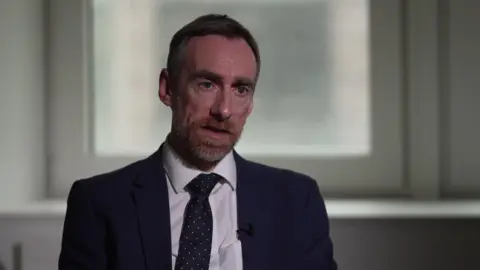
The 30 minutes of inaction from a cargo ship captain in the lead-up to a fiery North Sea tanker crash and his "striking" silence in the aftermath made it clear to police he was at fault, the chief investigator has said.
The jury saw two very different reactions to the collision when they were shown footage from the Stena Immaculate, the ship that was anchored 14 nautical miles off the Humber estuary, and footage from the Solong, the cargo ship captained by Vladimir Motin that ploughed into it, Detective Chief Superintendent Craig Nicholson said.
The force of the collision created a huge fireball and blazes on both ships, but the Humberside Police chief superintendent told the BBC it was "really, really telling" that audio from the bridge of the Solong suggested "63 seconds post-collision of abstract silence".
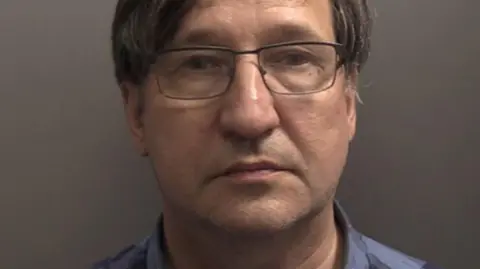
Motin, on Thursday, was sentenced to a six-year prison term for gross negligence manslaughter.
'Just silence' on the Solong
Nicholson described audio from the Solong's bridge, where Motin was stationed as "just silence...with some background noises that could be muffling, or it could be the wind" in the lead-up to and in the immediate aftermath of the collision.
On the Stena Immaculate, the audio was very different.
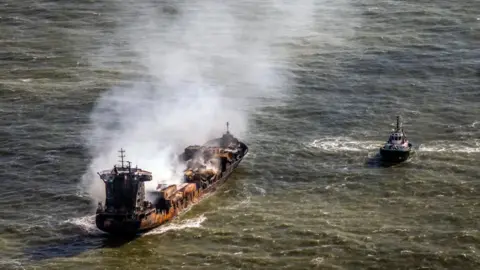
Video footage showed a fireball erupting after the Stena Immaculate's hull is ripped open by the Solong and its cargo of jet fuel ignited by the force. Audio from the bridge tallies with the chaotic scenes.
"You hear the collision and then immediately you have an unfiltered human reaction. One of the crew swears," the policeman said.
"And then immediately... the alarms are sounded, they're talking about what's happened. They're starting the fire pumps, they're doing everything you would expect them to do."
Nicholson said audio recording played in court showed the Stena Immaculate's captain was "immediately concerned about his crew, getting his crew to the muster station and making sure his crew is safe".
During this same time audio from the bridge of the Solong told the court there were some footsteps and then a voice on the radio.
"When you overlay those two things, it's striking."
Changing accounts from the captain
In its investigation following the 10 March 2025 collision, Humberside Police questioned Motin multiple times to try and account for the inaction on the bridge.
"Vladimir Motin's account has evolved over time. his initial account, when he's spoken to prior to his arrest, is quite vague," Nicholson said.
In subsequent hours-long interviews after Motin's arrest, Nicholson said the Solong captain still couldn't account for the silences or lack of response to the unfolding disaster.
"He couldn't explain or wouldn't explain what he was doing," the detective said.
Motin also couldn't explain why other safety tools at his disposal, such as radar and electronic systems, weren't used and a crew notification system was turned off, "all of which would have helped to identify that risk and prevented a collision," Nicholson said.
As the case proceeded through the justice system and the Solong captain saw and heard all of the evidence in the months prior to court, the Humberside detective said a new account was "constructed to suit the evidence, but still makes very little sense".
Nicholson summed it up: "I don't believe Vladimir Motin's ever given a truthful account about the events.
"His account has changed throughout the course of the investigation and throughout the course of the criminal trial."
 Reuters/Humberside Police
A crucial 30 minutes
In the trial, Motin's defence lawyer argued that his client, although at fault for the crash that left a crewman presumed dead, his actions did not reach the bar for gross negligence manslaughter.
Defence barrister James Leonard KC argued that "human error" did not amount to gross negligence.
Motin, the defence argued, had tried to alter the path of the Solong so that it would avoid the Stena Immaculate, but the automatic controls were faulty and wouldn't disengage.
After the Solong was one nautical mile away from the Stena Immaculate, Leonard told the jury Motin was "utterly convinced he's got manual control", but "that is the big mistake, he has pressed the wrong button."
The defence lawyer said even an emergency stop at that point in time would not have stopped a crash and could have even impacted the Stena Immaculate's accommodation area, putting more lives at risk.
Nicholson and the prosecution said they didn't believe there was any mechanical failing to blame, and called the auto-pilot story "ludicrous", but even if there was a steering fault Motin never contacted ship engineers to report an issue.
"He could have firstly called an engineer or called for assistance, but the obvious thing to do would have been to slow the vessel down," he said.
And the detective told the BBC that corrective action could have been taken by Motin well before that point, because the Stena Immaculate wasn't moving.
"You have a large ship at anchor [the Stena Immaculate]...around about 170 metres in length. It's been at anchor for over eight hours. It's visible on radar," he said.
"You then have Captain Motin who acknowledges that he sees that vessel on his radar. At the very least he sees it at 9 miles.
"He knows it's on a collision course, but he doesn't alter his heading and he doesn't alter his speed...at 3 miles he says he can see the vessel out of his window, but he still doesn't take any action whatsoever."
Nicholson said at the very least, Motin "should have sounded an alarm" to his crew and to the Stena Immaculate.
"That would have prevented the death of Mark Pernia, who was in the bow of the vessel at the point of collision," he said.
Mark Pernia, 38, was a Philippine national working on the Solong and last seen on the ship's bow. The court heard how the strength of the fire from the collision hampered the search for him in the immediate aftermath.
He is missing, presumed dead.
The detective said the conviction should help give closure to Pernia's wife and two young daughters, and that the presumed death of the crewman was a crucial element of getting a conviction over the collision.
"Mark Pernia is the investigation. Our entire investigation revolves around Mark Pernia and Mark Pernia's death," Nicholson said.
