Captain switched off alarm system before crash

 PA Media
The captain of a cargo ship that collided with a tanker has told an Old Bailey trial that he broke international maritime rules by switching off an alarm system on his vessel.
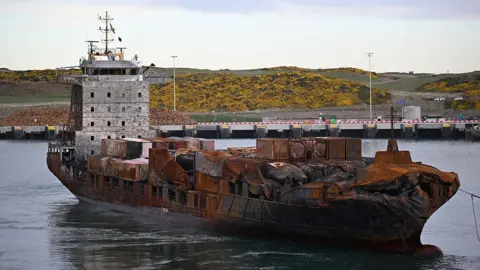
Vladimir Motin was the only person on watch duty on the Solong when it hit US tanker Stena Immaculate off the East Yorkshire coast on 10 March 2025, leaving Mark Angelo Pernia, 38, missing presumed dead.
Prosecutor Tom Little KC asked Motin why the Bridge Navigational Watch Alarm System (BNWAS) had been deactivated and if it posed a "significant risk" to the crew.
Giving evidence on Tuesday, the captain admitted it was a risk and said when he was alone sometimes the BNWAS was turned on and other times it was not.
The BNWAS is designed to ensure there is somebody on duty on the bridge, it requires a button to be pressed at regular intervals or an alarm is triggered.
Motin added the BNWAS would be turned off when the bridge of the ship was manned with two people.
The 59-year-old accepted he had broken the International Convention for the Safety of Life at Sea (SOLAS) regulations, but that it did not relate to the collision, although he accepted he had breached SOLAS "in this part".
He added that the alarm was switched off because "I trusted myself".
Little asked Motin whether the point of BNWAS was that you did not have to trust yourself, to which he agreed.
When asked if BNWAS was an effective way to avoid marine accidents, Motin also agreed.
Little suggested not using BNWAS was an extremely dangerous state of affairs for the Solong, to which Motin replied: "No, I don't agree with it."
The prosecutor asked Motin if one person was on the bridge of the vessel, and they were asleep with no BNWAS activated, if there was a risk of collision, Motin agreed.
Motin was questioned why he had failed to spot the "massive anchor" that was coming out of the Stena Immaculate and if he had seen it.
Motin replied he did not remember and could not recall if he had seen an anchor chain. He argued it may have been hidden by a silhouette or could have been on the other side of the vessel.
 Humberside Police / Reuters
The defendant was asked by Little why he did not use a navigation system, which could have detected that the Stena Immaculate was at anchor in the sea and then avoided the collision.
Motin said that he had data in his mind and was making various calculations to "calculate and plot precisely" adding this was not prohibited.
Little moved on to ask Motin why he had not slowed his speed, which he said would have been a sensible option. The captain answered his speed was safe for the corresponding conditions.
Motin, from Primorsky in St Petersburg, Russia, denies a charge of gross negligence manslaughter.
The trial continues.
Listen to highlights fromHull and East Yorkshire on BBC Sounds, watch the latest episode of Look Northor tell us about a story you think we should be coveringhere.
Download the BBC News app from the App Storefor iPhone and iPad orGoogle Play for Android devices
