The 'very strange' Christmas dish always eaten in silence

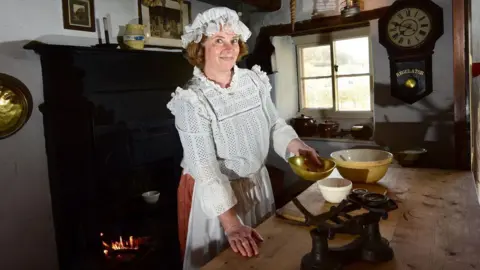 Anthony Chappel-Ross
Turkey, pigs in blankets and sprouts are among the festive food staples you would expect to make an appearance on any Christmas dinner plate.
Less common, perhaps, but with a long history stretching back into the Middle Ages, is the tradition of eating frumenty on Christmas Eve.
The dish played such an important part of celebrations in the North Yorkshire town of Kirkbymoorside that there was even a frumenty bell, which was rung to signal it was time to tuck into the meal.
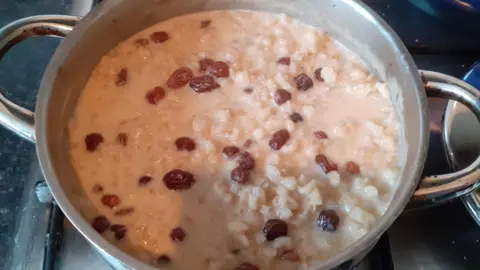
Frumenty, which can be spelled and pronounced in a variety of ways depending on region and dialect, including frumentee or fermenty, is typically a wheat-based dish, similar to porridge.
Its origins can be traced back to the medieval period and it was often eaten by poorer people as a cheap but filling meal.
Rosie Barrett, from Ryedale Folk Museum, a social history museum in Hutton-le-Hole, says frumenty seems "a very strange dish to have lingered for a very long time".
"I'm sure many people have a special meal, but frumenty is quite an unusual one, really," she says.
 Jane Bowes/BBC
Ms Barrett explains research discovered in Kirkbymoorside shows the whole town appears to have eaten frumenty every Christmas Eve, but only after a bell was rung at 18:00.
"Bells are very special, because they serve really practical purposes when people didn't necessarily know what time it was," she says.
"They're also often used to create a sense of a holy space - and that something very special is happening."
While frumenty would typically be served with spices and treacle to add flavour, the not-so-festive twist was that it would be eaten in silence, Ms Barrett says.
'Magical and special'
Though the exact date of origin for this unusual shared tradition in Kirkbymoorside is unknown, it was "still within living memory in the 1970s" when research was conducted.
"The people being interviewed would have been older people, in their 70s or 80s, and it was spoken about in the past tense in 1972," she says.
"It could have been taken easily back to the Victorian times, but we don't know when it began."
With this strange Christmas dish now a mere memory for most, the fate of Kirkbymoorside's frumenty bell - which is thought not to have been a regular church bell - is unknown.
"All of these rituals, all of these behaviours, are a trying to create sacred and holy spaces," Ms Barrett says, adding the history of frumenty is "very magical and special".
"It's part of what it is to be human really. In these dark winter months, we're looking for a bit of magic."
Listen to highlights from North Yorkshire on BBC Sounds, catch up with the latest episode of Look North.
