Teen had to tell deaf mum her dad might die

 Family handout
Hospital staff asked a teenage boy to tell his deaf mother that her father might die, according to the findings of an ombudsman.
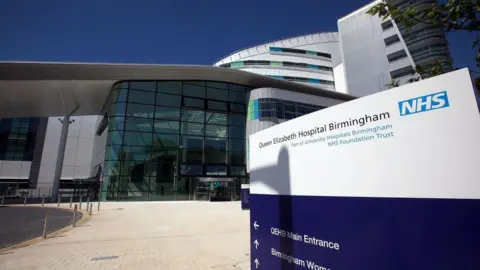
The Parliamentary and Health Service Ombudsman said University Hospitals Birmingham (UHB) NHS Trust failed to follow national guidance, by repeatedly using children to interpret critical medical information for their deaf family members.
Alan Graham, who was born deaf and used British Sign Language (BSL) as his first language, died in September 2021 after being treated at the Queen Elizabeth Hospital.
His daughter, Jennifer Petty, who is also deaf, complained about her father's care. The NHS trust apologised adding "we did not get things right".
The 52-year-old also raised the issue of hospital staff using her children as interpreters.
The investigation by the ombudsman found the concerns she raised caused significant distress and affected the family's ability to grieve.
The ombudsman investigates complaints about government departments, other public organisations and the NHS in England.
Their inquiry discovered clinicians asked Petty's son, who was 16 at the time, to explain that his grandfather might not survive the night and CPR should not be attempted if his condition worsened.
The 75-year-old died the following day.
 Getty Images
During an 11-week period in hospital, professional BSL interpreters were provided on only three occasions, the ombudsman found.
Instead staff regularly relied on Petty's son and daughter, who was 12, to translate complex medical information, including details about the 75-year-old's condition.
The 52-year-old said the situation was deeply upsetting for the whole family and it was "totally unacceptable" that her children were placed in the position of delivering bad news about their grandfather's condition.
"My children just wanted to visit their grandad and be there for him as family members but they were constantly being asked to translate by the staff," she said.
"Having to deliver the bad news about my dad's prognosis was extremely upsetting for all of us."
The ombudsman said the trust did not consistently make reasonable adjustments for a deaf patient and his family, despite clear requirements set out in national guidance.
Worry and stress
Rebecca Hilsenrath KC, chief executive of the ombudsman, said public services must be accessible to everyone.
She said deaf patients and their families should not face extra barriers when getting healthcare.
By failing to provide BSL interpreters consistently, the trust caused unnecessary distress in the weeks before Graham's death, she added, and NHS leaders needed to learn from the case.
The former furniture maker and keen fisherman, originally from Dundee, had moved to Birmingham to be closer to his grandchildren.
He was first admitted to hospital in June 2021 following a fall and was diagnosed with heart failure.
But, after being discharged in August, he was readmitted the following month with similar symptoms and died two weeks later.
The ombudsman found that the lack of interpreters did not affect the medical treatment he received but did cause worry and stress to his family and limited his daughter's ability to communicate with clinicians.
The trust was told to draw up an action plan, apologise to the family and make compensation payments of £900 to each grandchild and £750 to their mum.
A spokesperson for UHB said: "We offer our sincere apologies to [the family] for their experience, at what was a very difficult time for them.
"We recognise that we did not get things right and understand the impact this had on them."
Since 2021, actions have been introduced to help deaf patients, including strengthening awareness and accessibility arrangements to ensure patients' communication needs are better met, they added.
Follow BBC Birmingham on BBC Sounds, Facebook, X and Instagram.
