'I have to bum-shuffle down the stairs in the subway'

 BBC
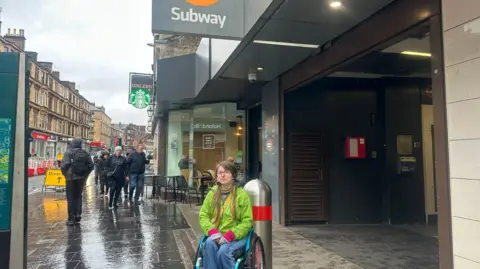
BBCGlasgow's subway has 15 stations but just two have lifts to the platforms.
For full-time wheelchair user Rae, this is a problem.
"The way I use the subway independently is I bum-shuffle down the stairs with my chair in front of me," Rae says.
"My chair has a bar at the back and I hold on to that and I slowly like go down on its back wheels while I bum-shuffle behind it.
"It's exhausting, but it's what I have to do."
Rae says they are not embarrassed by taking such drastic measures but it is not at all dignified.
"People do stare at me," Rae says.
"They think it's strange.
"It's like I'm in a zoo sometimes and I don't like that."
It was a trip to London that convinced Rae more needed to be done to improve the subway access for disabled people in their home city.
"I came back from that trip experiencing a not-perfect, but much more accessible underground," Rae says.
In London more than a third of the 272 Tube stations - 94 in total - have step-free access.
As a result, the 18-year-old launched their campaign 'Access2Transport' via Instagram in which they are calling for an "accessible underground" for wheelchair users.
The Glasgow Subway is the third oldest underground metro system in the world, with about 13 million passengers making journeys every year.
It still operates in a Victorian tunnel system that is almost 130 years old.
The subway has undergone a number of modernisations in recent years including a new fleet of trains which came into service last year with designated wheelchair spaces.
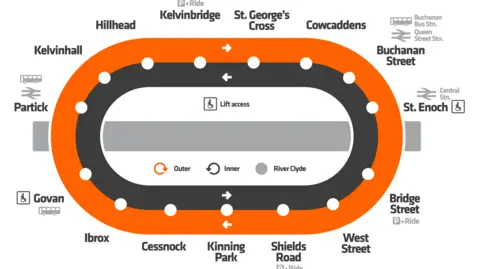
However, just two stations - St Enoch and Govan - are wheelchair accessible.
 Strathclyde Partnership for Transport
An SPT spokeswoman said the current modernisations had to fit within the restrictions of the small Victorian tunnel system it had inherited.
The current work to modernise the subway was agreed back in 2010, she said, and the brief was to overhaul the entire system with new ticketing, new trains, new signalling and to refurbish all 15 stations on the network for a cost of £288m.
The spokeswoman said the possibility of introducing lift access at all stations was looked at but it quickly became clear that this was not possible at stations which had a single "island" platform, which ruled out nine of the stations.
On the double or "flank" platform stations, there was a need to be able to run a lift vertically from the concourse to each platform, which was only possible at Govan and St Enoch, SPT said.
The size of the lifts is dictated by the space available, she said.
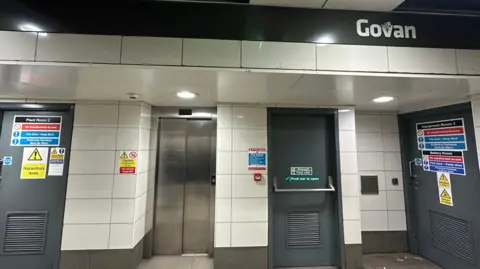
The spokeswoman said SPT would continue to look for ways to introduce more step-free access at its stations.
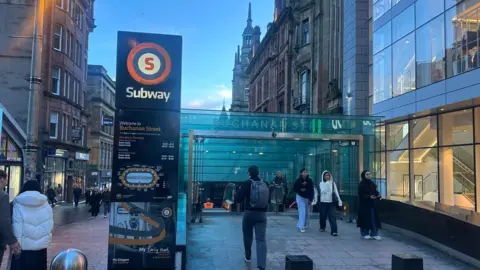
She said there was an opportunity to look at lift access from street level to the platform on one circle at both Buchanan Street and at Hillhead and a contractor had been appointed to look at possible designs.
"We also take our responsibilities to help those who require extra assistance to travel with us, for whatever reason, very seriously," she said.
"We welcome all our disabled passengers on our service, while also recognising and working within its limitations."
"At this moment, the only safe way for wheelchair users to access the system without endangering themselves or others is to use Govan or St Enoch stations."
Deputy Lord Provost Bailie Christy Mearns is a Scottish Green's Councillor for Anderston/City/Yorkhill Ward and is also on the board for SPT.
Mearns said: "For many, including people with disabilities and families with babies and young children, public transport can be extremely challenging to use.
"The lack of lifts in subway and train stations is raised most often, so I am pleased that two new subway stations are being investigated for step-free access improvements."
'I can't rely on them anymore'
However for Rae, the issue goes further than just the subway.
Accessibility for wheelchair users on other forms of transport such as buses is also a pressing concern.
Rae says they only catch a bus "occasionally" and only if "every other option isn't available".
Bus companies such as First have dedicated wheelchair spaces on the bus but these spaces can also be used for prams.
For a wheelchair user like Rae these spaces aren't always available, for example if another wheelchair user or a pram is on the bus, there is no space.
Rae says: "If I'm on my own at a bus stop, buses often just drive past even when I've put my hand out.
"They park really far away and then don't get the ramp out, but let all the other able-bodied people on."
"It's more of a systemic issue rather than a one-off situation."
"I can't rely on them anymore."
