Greenhouse gas emissions decrease in NI

 Getty Images
Greenhouse gas emissions in Northern Ireland have decreased slightly.
Latest figures from the Department of Agriculture, Environment and Rural Affairs show emissions in 2022 fell by 3% compared to 2021.
Northern Ireland is the slowest nation in the UK to reduce emissions, with a decrease of 26.4% since the base year of 1990.
That compares to a cut of 52.6% in England, 51.2% in Scotland and 36.4% in Wales.
Domestic transport was the only sector to show a very small increase in its contributions compared to 2021, rising to 18.1%.
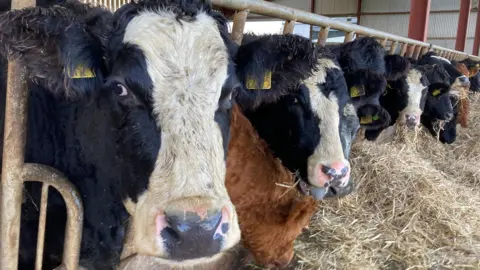
Agriculture remains the biggest contributor, at 29.1%.
Its emissions compared to 2021 fell largely due to less favourable growing conditions leading to a reduction in the use of off-road machinery.
But overall, agricultural emissions have risen by 14.9% since the base year of 1990.
 Getty Images
In 2022, buildings and product uses accounted for 15.3% of emissions, and electricity supply 14.0%.
The most produced greenhouse gas was carbon dioxide, with methane the second highest.
Compared to the base year of 1990, agriculture and domestic transport are the only sectors to have shown increases in their emissions.
