Surprise sighting of pine marten in Cornwall

 Kernow Conservation/Trewithen Estate
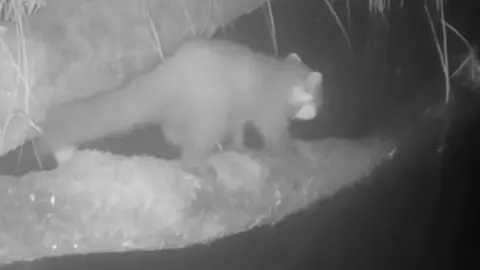
A pine marten has been caught on camera in Cornwall in what conservationists hope could be the start of a comeback in the county.
Kernow Conservation recorded the creature during routine monitoring on the Trewithen Estate, near Truro, where staff have been working to restore native wildlife.
The footage was captured on a camera which was set up to track reintroduced water voles.
Nellie Kottler, from the estate, said the team had been "utterly staggered" by the discovery.
 PA Media
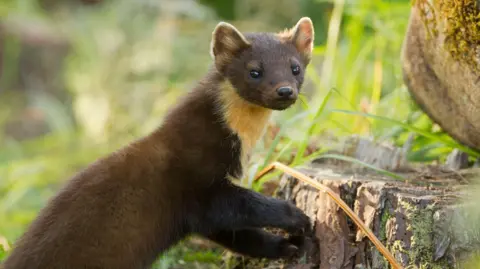
Pine martens were once common in the South West, but a loss of their woodland habitat and human persecution caused their extinction, conservationists said.
The animals can be found in Scotland and Ireland, with reintroductions in Cumbria, the Forest of Dean, Dartmoor and Exmoor.
"We have been utterly staggered to see one," said Kottler.
"At this stage, we don't yet know whether the animal is a transient visitor or resident to the area.
"We'll be continuing monitoring in the coming weeks to better understand its presence, potentially even whether it could be part of a breeding pair."
Kernow Conservation said pine martens' "gradual recovery across the UK means moments like this could become more common, but seeing one here, now, is something truly special".
Five facts about pine martens
- Pine martens are mustelids, meaning they are related to weasels, badgers, otters and polecats
- They like eating bilberries, rowan berries and blackberries
- Length: 18.1–21.3ins (46-54cm)
- Weight: 1.98-4.85lb (0.9-2.2kg)
- Average lifespan: up to eight years
- They are exceptional climbers, living in tree holes, old squirrel dreys or even old bird nests
- Source: Cornwall Wildlife Trust
Follow BBC Devon on X, Facebook and Instagram. Send your story ideas to spotlight@bbc.co.uk.
