Army volunteers join paramedics as co-responders

 BBC
BBCFrom next month 20 volunteers from an Army unit will join paramedics and respond to emergency callouts from their base.
The men and women from St George's Barracks, near Peterborough, will work alongside the East of England Ambulance Service NHS Trust (EEAST) as co-responders, as part of a scheme to encourage joint working.
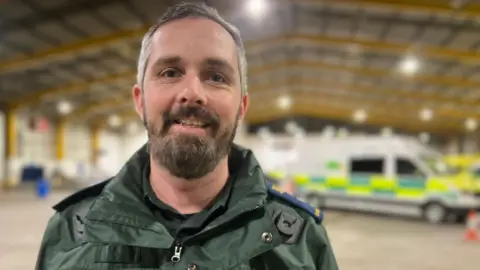
L/Cpl Jack Frame said his experience as a combat medical technician would help him in his new role, adding: "I think we have some really beneficial skills that we bring over from the military, whether that's keeping calm or being resilient.
"We're also generally quite good at some of the bigger scenes and extrication jobs."
Tom Barker, from EEAST, said the additional staffing was not a response to winter pressure and St George's Barracks was the fifth unit to work with the EEAST, along with RAF Wyton, Cambridgeshire, RAF Marham, Norfolk, RAF Henlow, Bedfordshire and RAF Honington, Suffolk.
The team from St George's Barracks began working with EEAST in November and answered 999 calls from the ambulance service's depot in Peterborough.
Yet from February, the unit will get its own vehicle based at the barracks in North Luffenham, Rutland.
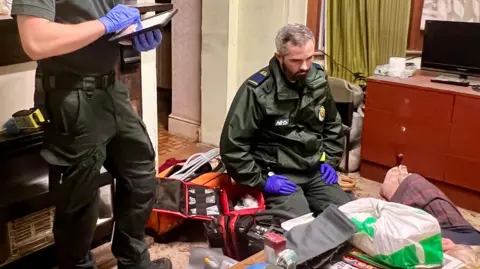
L/Cpl Frame and Cpl David Berresford recently attended a callout to a woman in her eighties who had a fall.
When they arrived at the property there was no sign of the patient and after repeated attempts to locate her, L/Cpl Frame said he saw her through a window.
"I can see her glancing up at us, but she doesn't seem to be able to get up," he recalled.
Cpl Berresford, a military dog trainer, said he shouted reassurance at the woman while L/Cpl Frame requested back-up to help gain entry to the house
Once they had entered the property they were able to assess and treat the patient, checking for breaks, bruises and possible dementia.
"It's work that's tough," says Cpl Berresford, but "rewarding".
"You're going to them in their time of need.
"To them, it's an emergency and to provide actual life-saving treatment in some cases, it makes a massive and significant difference. And you know what, I love it."
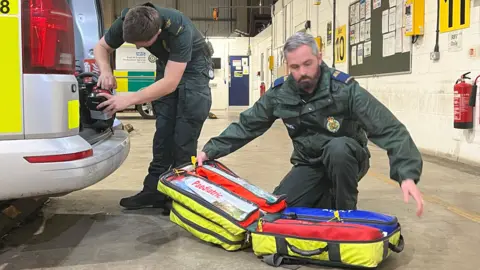
Cpl Berresford and his colleagues typically work eight-hour shifts on top of their day jobs, seeing an average of four patients a day.
The callouts are predominantly category one life-threatening emergencies, which do not include maternity or mental health incidents.
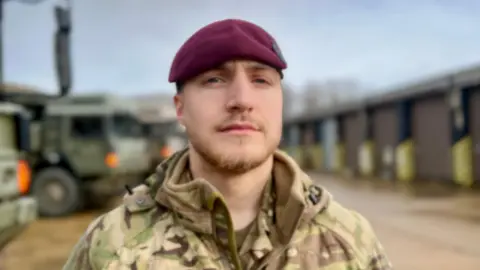
Tom Barker, the EEAST's head of co-response, said the military has "a long history of supporting ambulance crews".
"They are there 365 days of the year. Last year, our military co-responders volunteered almost 6,000 hours of their own time to help patients in their time of need," he said.
The intervention meant last year across the East of England, 390 ambulances were stood down as a direct result of the efforts of the military volunteers.
"The teams often arrive ahead of the ambulance response, so that means we can really start to provide care swiftly to patients in their time of need," Barker added.
Follow Peterborough news on BBC Sounds, Facebook, Instagram and X.
