Critical time for puffins after deadly storms

 PA Media
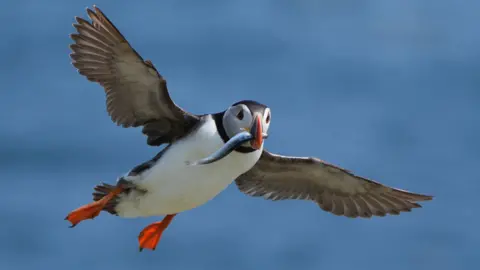
Marine wildlife experts in the Channels Islands are hoping conservation measures will boost the puffin population after thousands died in storms earlier this year.
Gabriella Stewart of Alderney Wildlife Trust said an estimated 40,000 seabirds had washed up dead on European beaches in late February and early April following severe storms.
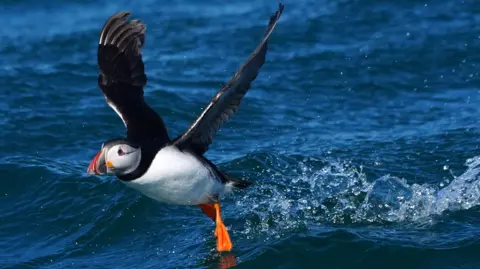
She said puffins had been starved as they had not been able to feed in the rough seas because they relied on their eyesight and needed clear water to find food.
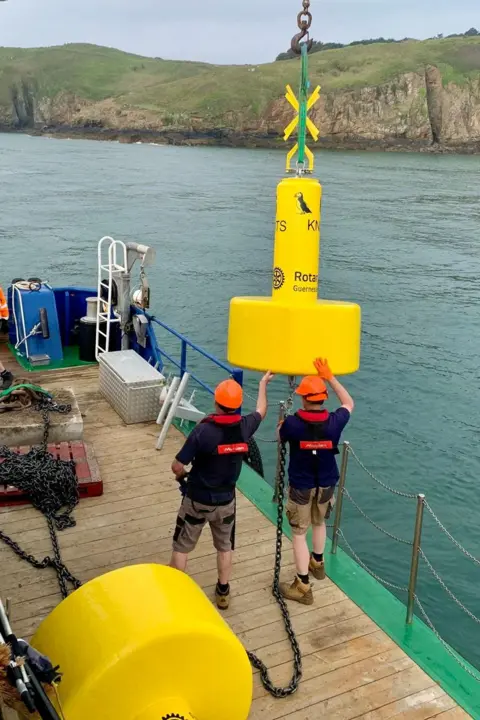
Stewart said watercraft users could help protect the birds by respecting the puffin awareness buoys deployed off Herm, puffin friendly zone off Alderney and seabird protection zone in Jersey.
 PA Media
Stewart, a seabird ecologist, said 56 seabirds had been found washed up dead in Alderney, of which 44 had been puffins, as they were "particularly vulnerable during prolonged, rough weather".
"Rough seas make feeding difficult and prolonged bad weather can leave birds exhausted and weak.
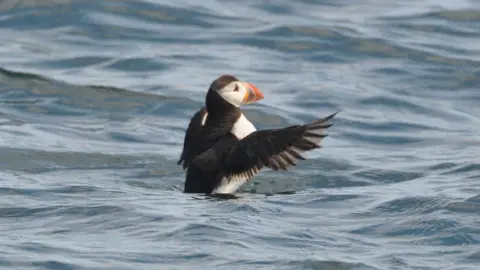
"Puffins spend the winter months out on the sea and return every year to breed.
"If they have had a particularly rough winter, seabirds may fail to breed at all or have insufficient energy to raise chicks," she explained.
Stewart said puffins did not sexually mature until they were five years old and if many of those which had died were juveniles, it would likely mean the full effect of the seabird wreck on breeding populations would not be seen for several years.
 Ben Chapple
Atlantic puffins are listed by the International Union for Conservation of Nature as an endangered species in Europe.
The organisation said rapid declines in their populations were likely due to threats including human disturbance, climate change, renewable energy production, pollution and diseases including avian influenza.
Stewart said: "Such threats, combined with their low breeding rates - one chick per pair per year - make puffins a very sensitive species."
 PA Media
Jon Carter of the British Trust for Ornithology said it was hard to tell the impact of the catastrophic effects of Storm Goretti on this year's puffin colonies as field work and surveying was only just getting underway in many places.
However, he was more hopeful for the population in the longer term.
"We do know that in some cases, after large fatalities of adult birds, younger birds which may not normally breed until they are around five years old will occupy 'vacant lots' in the colony sooner, and breed at a younger age," said Carter.
"So, sometimes colonies may appear unaffected due to the numbers of birds present.
"Puffins can also live an extraordinarily long time - the oldest exceeding 41 years, though the average is about 18 years - so it can often take several years for the true impacts to be seen."
'A truly tough time'
Carter pointed out a record number of puffins were counted in April for the second year running on a small island off Pembrokeshire.
The Wildlife Trust of South and West Wales, said 52,019 puffins were documented on Skomer Island this year - 8,000 more than in 2025.
Despite such reports, Carter said puffins and other seabirds were suffering multiple challenges.
"It's pretty tragic, many of our birds are having a truly tough time in this modern age.
"Climate change is resulting in more unseasonal and dramatic weather events and causing the fish and sandeels that the puffins need to feed their chicks to move northward, so they are harder to find."
"The reality is, that anything that we can do to help these and other struggling seabird species can only be a good thing," he added.
'Impact on breeding'
Sailors, jet-skiers, kakayers and paddleboarders are asked to avoid certain areas from March to July in the Channel Islands to protect breeding seabirds from disturbance.
Alderney's puffin friendly zone, introduced in 2018, is aimed at protecting the puffins on Burhou.
Buoy markers are not possible due to the island's large range of tides so the area, a bay with two obvious headlands, is shown on information boards on the shore and is marked on sailing charts.
Off Herm two puffin awareness markers have been placed adjacent to Puffin Bay to remind those using boats and jet skis of the six knot speed limit.
The seabird conservation zone in Jersey, first put in place in 2009, is an invisible line 65ft (200m) from the shore straight out to sea between Plemont and Greve de Lecq.
Cristina Sellarés, the Birds on the Edge project leader for the National Trust for Jersey, said markers were not deployed as the island's tides were so strong, buoys would drag and damage the seabed.
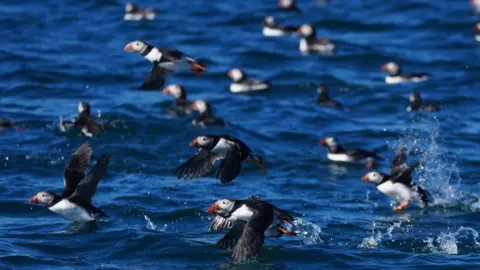
She said boaters and paddlers entering the zone lead to rafting puffins becoming anxious and taking flight, which used up vital energy, and being distracted from vital activity such as resting, preening, feeding and sitting on eggs.
Alderney Wildlife Trust's Stewart agreed: "This disturbance can have a significant impact on breeding success."
Follow BBC Guernsey on X and Facebook. Follow BBC Jersey on X and Facebook. Send your story ideas to channel.islands@bbc.co.uk.
