Medieval manuscript that inspired Bagpuss returns

 Reading Borough Council
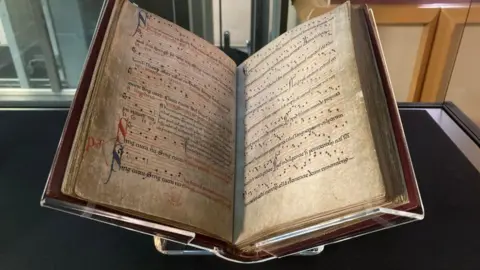
A medieval music manuscript has gone on display in the town where it was created for the first time in nearly 500 years.
Sumer Is Icumen, also known as the 'Reading Rota' is thought to have been composed at Reading Abbey in the mid-13th Century. With lyrics greeting the arrival of summer, it has the earliest known example of a six part polyphonic round.
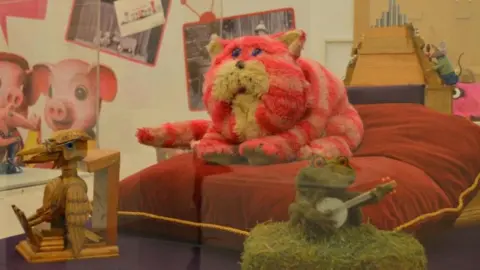
The music has inspired many compositions, appearing in pieces such as The Adventures of Robin Hood, The Wicker Man, and The Mouse Organ Song in the 1970s children's TV series, Bagpuss.
On loan from the British Library, it can be seen at Reading Museum until 9 May - its first return to the town since the abbey was dissolved in 1539.
Adele Barnett-Ward, lead councillor for leisure and culture at Reading Borough Council, said it was a "delight and privilege" to welcome the Reading Rota home after nearly five centuries.
She added: "This extraordinary manuscript is not only one of the jewels of medieval English music, but a powerful reminder of Reading's international significance in the Middle Ages.
She described having the original manuscript in the town where it was created as "a truly special moment".
Its lyrics - translated from Middle English - include "Summer has come in, loud sing cuckoo" and heralds in the warmer seasons.
It was also sped up for runners taking part in the Reading Fun Run in a contemporary 12-saxophone version in 2016 by a professor of music at Oxford University.
A copy of the manuscript in stone relief is displayed on the wall of the ruined chapter house of Reading Abbey.
