The town where people kept voting against pubs

 Historic England
A town whose inn was famously called "the pub without beer" features in a new book about buildings in the temperance movement.
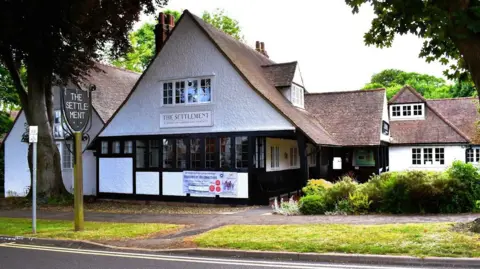
The former Skittles Inn in Letchworth Garden City, Hertfordshire, was one of hundreds of alcohol-free venues across England in the early 20th Century.
Author Andrew Davison said his research has "revealed one of the most remarkable but forgotten chapters in English social and architectural history".
Letchworth Local History Research Group said although the garden city was "not a dry town as some think", residents repeatedly voted against introducing pubs.
"It wasn't until the 1960s that the vote – which included women - went in favour of licensed premises; then the Broadway Hotel was built," said the group's leader Philippa Parker.
 Historic England
Millions of people signed the temperance pledge in the 19th Century, promising to abstain from alcohol.
The social movement tried to combat drunkenness and many in the movement promoted complete abstinence from alcohol, rather than just giving up for a month during dry January.
"The temperance movement created a parallel world that touched every aspect of Victorian life, yet the origins of these buildings have become invisible to us," said Davison, who is an inspector of ancient monuments with Historic England.
"Every surviving temperance building connects us to ancestors who believed passionately that they could change society for the better."
At the movement's height between 1880 and 1914, there were as many as 500 temperance hotels nationwide, according to Historic England.
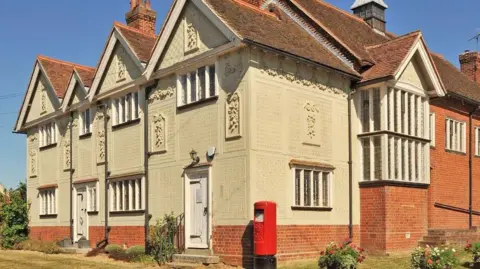
The Reading Room in Radwinter, near Saffron Walden in Essex, is also featured in Davison's book. It was once a temperance hall, but is now the village hall and post office.
 Getty Images
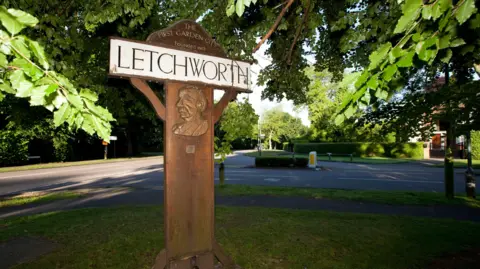
Work to build Letchworth Garden City began in 1903.
Ebenezer Howard, who dreamed up the garden city model, believed it was up to residents as to whether or not they wanted drinking establishments.
Parker said the lack of pubs was driven more by the town's commercial leaders than by Howard.
"There are a lot of myths about Letchworth, including the idea that it was a dry town and Quaker town.
"People could still have alcohol delivered or get it from neighbouring towns.
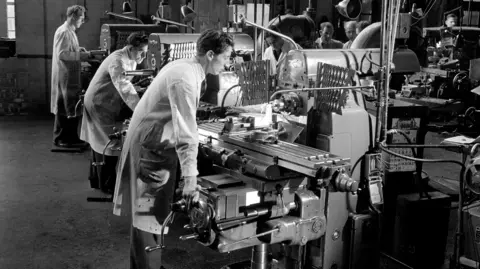
"The reason there were no licensed premises was because the manufacturers were trying to dissuade their staff from dissipating their wages in the pub.
"It wasn't particularly the temperance movement per se."
She added that women, who were able to vote on the matter in a series of about six polls, had a similar view.
"Wives were keen for that to continue, as they didn't want the menfolk to go to the pub and drink; they wanted them home to dig the garden and so on," she said.
 Walter Nurnberg/Getty
The Skittles Inn was designed by Letchworth Garden City architects Barry Parker and Raymond Unwin and built in 1906-07.
Features included a billiard room and a bar specifically designed for serving temperance drinks.
Since 1925, it has been the Settlement Adult Education Centre and it is Grade II listed.
It is one of many survivors featured in Davison's new book Built Heritage of the Temperance Movement: The Way Out of Darkest England, published by Historic England and Liverpool University Press.
So since the 1960s, when the floodgates opened - has there been a boom in Letchworth watering holes?
"Not really. The town centre is swamped by cafes, not public houses," said Parker.
Follow Beds, Herts and Bucks news on BBC Sounds, Facebook, Instagram and X.
