The local roots of iconic Brief Encounter clock

 Getty Images / Network Rail
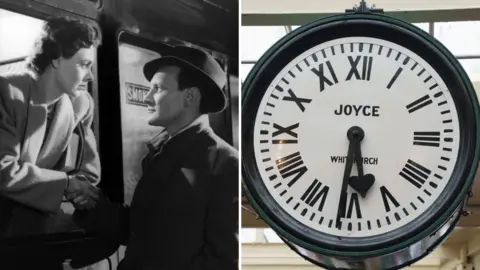
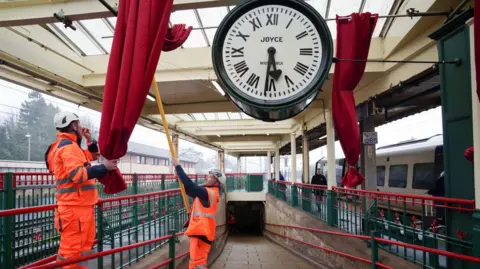
The clock made famous by the 1945 film Brief Encounter has returned to its home at Carnforth railway station. But its origins lie some 100 miles south, in a Shropshire market town.
The timepiece, first installed at the station near Lancaster in December 1895, was manufactured by JB Joyce & Co of Whitchurch.
It was removed in August 2020 for restoration and has now been reinstalled more than 80 years after the film's release, with a ceremony attended by the niece of star Celia Johnson.
But while much of the attention has focused on the clock's return to Lancashire, the name stamped on its face - Joyce - points to a Shropshire story stretching back more than 300 years.
JB Joyce & Co claims to be the oldest tower clock manufacturer in the world.
According to the firm's current owner Smith of Derby, the Joyce family began making longcase clocks in the Shropshire village of Cockshutt in 1690. The business was passed from father to son and moved to Whitchurch High Street a century later.
 Network Rail
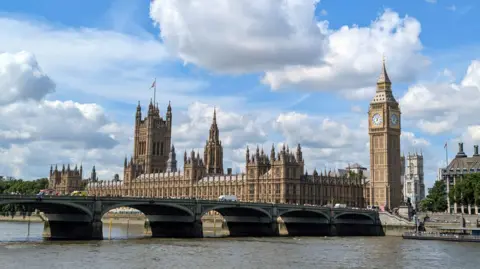
By 1834, Thomas Joyce had turned his attention to large public clocks for churches and civic buildings. His company later manufactured an escapement mechanism which was used in the Great Clock at the Palace of Westminster, otherwise known as Big Ben.
The firm's reputation spread and it won contracts across Britain and overseas. Joyce clocks were installed at railway stations across the country including Carnforth.
According to Smith of Derby, its most ambitious project came in 1927.
That was the year the company built the clock mechanism for Shanghai's Customs House on the Bund. To this day, it remains the largest mechanical clock in Asia.
 Getty Images
Joyce clocks can still be found around Whitchurch, including at St Alkmund's Church. The town's heritage centre celebrates the firm's legacy.
Bob Betts, managing director of Smith of Derby, said the company had always been proud to keep the Joyce name alive since acquiring the firm in 1965.
"From the famous Brief Encounter clock at Carnforth Station to the iconic Eastgate Clock in Chester, as well as the impressive 18-foot dials at the Customs House in Shanghai, it's a JB Joyce & Co legacy that we feel very privileged to be the custodians of," he said.
"We're proud to carry that history forward, maintaining these historic public clocks and ensuring their stories continue to be shared and appreciated by communities for generations to come."
 Getty Images
The last member of the Joyce family, Norman, retired in 1964 and sold the business to Smith of Derby, which maintains the brand today.
According to Network Rail, the Carnforth clock itself has had a turbulent history.
In the 1980s, the station fell into disrepair and the timepiece was thought lost until Alan Smith tracked down its original workings at a dealer in Twickenham.
He paid for a full restoration and the clock was rehung in July 2002, before being removed again in 2020.
The clock now belongs to his son Mike, who said this week: "My father worked really hard to see this clock restored to its rightful place once again here on the platform, and it is an honour to be able to represent him."
Brief Encounter, directed by David Lean and starring Celia Johnson and Trevor Howard, was filmed at Carnforth during World War Two as the station was considered remote enough to be safe from attack.
Follow BBC Shropshire on BBC Sounds, Facebook, X and Instagram.
