Is this Italian Madonna a medieval Ipswich statue?

 Phil Roberts
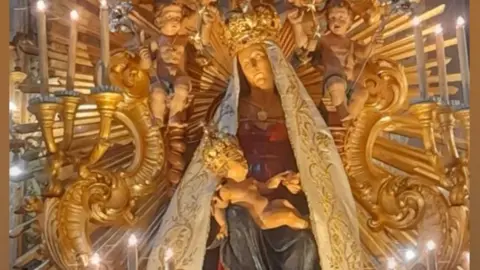
Every May, a colourful procession wends its way through an Italian seaside town, pausing at its harbour to remember the day English sailors landed with a statue of the Virgin Mary.
The shipwrecked men told the residents of Nettuno this was the "English Lady from Ipswich", somehow saved from the bonfires of the Reformation a few years earlier.
The statue was given a place of honour in its church and today it is at the centre of annual events that pay homage to the town's patron saint, Our Lady of Grace.
Just how likely is it that this 6ft (1.8m) wooden effigy was once at the heart of the Suffolk town's medieval shrine? The BBC has been finding out.
 Phil Roberts
"There are civil and ecclesiastical accounts in Nettuno which say there was a great storm in 1550 and a shipwreck of an English ship," said Tudor and Stuart historian Dr Phil Roberts, who is also the Ipswich Society's education officer.
"The sailors were so concerned about what they had on board, saying, 'We have Our Lady of Grace of Ipswich on our ship'."
Relieved to have survived the storm, they gave the statue to people of Nettuno.
Roberts said: "Now it beggars belief doesn't it, what advantage would there be gained from saying it was from Ipswich?"
In the 1530s, Henry VIII destroyed shrines like the one in Ipswich, after he broke with the Roman Catholic church over its refusal to allow him to divorce his first wife, Catherine of Aragon.
By 1550, his son Edward VI was on the throne, a precocious youth known for his Protestant zeal.
This placed the Bible at its heart and rejected pilgrimages and the cult of saints.
The shrine of Our Lady of Grace
 Tiger/Geograph
The Ipswich shrine is believed to have been in existence since at least 1152, said Roberts.
"Then in 1327, Pope John XXII, hearing about miracles taking place at the shrine, gave a substantial amount of money for a new shrine to be built," he said.
"It was a huge draw for pilgrims, second only to the shrine of Our Lady of Walsingham in Norfolk."
It also attracted royalty, ranging from Edward I's daughter, who got married in the town in 1297, and even Henry VIII and Catherine of Aragon in 1528.
Shrines to Mary were usually dedicated to one of her virtues and Ipswich had the only one in England to take the title Our Lady of Grace, added Roberts.
What was the shrine like?
 Phil Roberts
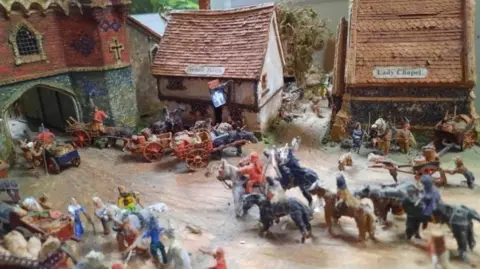
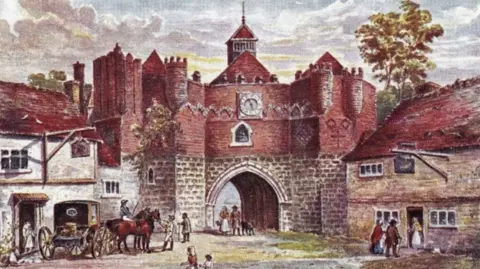
It was part of a vast site, about a mile square (1.6km), just outside the town's West Gate, and included a chapel and hospital, used by poor pilgrims of the dying.
Mary was especially venerated by medieval people as the mother of Jesus Christ and pilgrims came to pray for help or healing or to atone for sins at the statue, which was placed in its own shrine building.
Roberts said it was "popular because of miracles, right up to its dissolution".
This included the story of the teenage Maid of Ipswich, from Thaxted in Essex, who visited in 1516, seeking to be healed of convulsions.
"This drew in more and more pilgrims who heard she was healed and then would have convulsions again and be healed again," he said.
The day it was destroyed
 Phil Roberts
The shrine came to an abrupt end in 1538, when Thomas Cromwell, Henry VIII's leading minister, sent men to close it down.
He was known to have been a loyal servant of Cardinal Wolsey, Henry's previous chief minister, who came from Ipswich.
Roberts, who recently published a biography of the cardinal, speculates that Cromwell "may have wanted to save the statue in memory of his master".
A letter mentions it was sent to Cromwell's London house, reports say he was present when statues, including the Ipswich one, were burnt, while others say he was not present.
The trail goes cold until the shipwrecked sailors arrive in Nettuno, which is on the west coast of Italy, south of Rome.
What do experts say?
 Phil Roberts
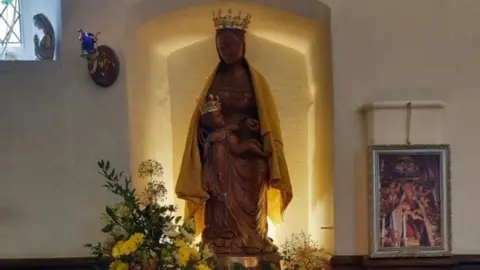
Tests have confirmed it was made from English oak, while an expert in medieval shrines, Martin Gillett, said "it was definitely an English statue" after examining the style of the carving of Mary's robes, according to Roberts.
The statue's head is believed to be a more recent addition, while the infant is probably newer still.
During restoration after World War Two, a sign in medieval English was found on its back which translates as "Thou art gracious".
Roberts said: "So these words on the reverse of this statue could refer to her being the Lady of Grace of Ipswich."
Finally, Cromwell's men noted that the shrine's figure had silver slippers, as worn by the Nettuno Madonna.
"So while it is not concrete evidence, it's still substantial evidence, and I personally think the statue in Nettuno is the medieval statue from the shrine of Ipswich," said Roberts.
'You should see how beautiful she is'
 Phil Roberts
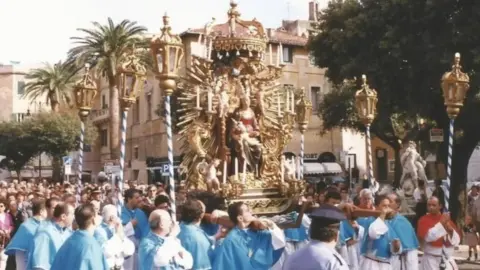
This year's Nettuno procession took place on 2 May, during which the statue was taken from its home in the basilica to a church in the old town, watched by 20,000 people, said Silvano Casaldi, a retired curator from the town, who has also translated for pilgrims from Ipswich.
"A few days before, they made a reconstruction of how the ship arrived from the sea," he said about the event, which is organised by the Confraternity of Nettuno.
"You should see how beautiful it is when she is dressed with gold."
The Madonna remained at St Giovanni's Church for a week and was processed back to the basilica on 10 May.
Casaldi said people in the town knew little about the Ipswich link until the 1970s, when a priest at St Giovanni's published a book about the research.
"All we knew about Ipswich was football, because of a [UEFA Cup] game played in 1973 between Lazio and Ipswich Town," he said.
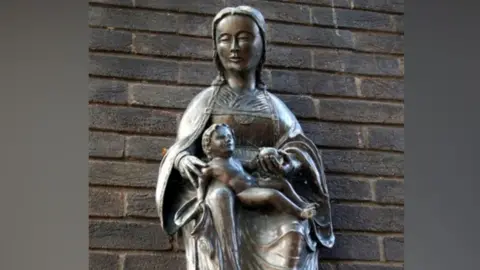
There are now three replicas of the statue in Ipswich, one in the Anglican church of St Mary at the Elms, one on Lady Lane, close to the former shrine, and a more recent one in the Roman Catholic St Pancras church.
Do you have a story suggestion for Suffolk? Contact us below.
Follow Suffolk news on BBC Sounds, Facebook, Instagram and X.
