I want justice for pigeons and bird netting banned

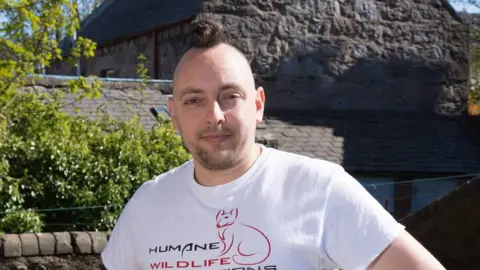 Kevin Newell
"Of all the people in the country the Mercure Hotel could have upgraded and put in the room next to the bird netting, with 10 dead birds rotting in it, I was just the worst person."
Kevin Newell was travelling for work when he looked out of his hotel window in Nottingham and saw the very thing he has been campaigning against - bird netting.
He has been a pest controller for 13 years but only uses non-lethal methods. He tried using bird netting himself but noticed birds became trapped in it, and vowed never to use it again.
Since then he has been collating data on birds killed by netting and wants it to be banned - as do many other campaigners.
Warning: This story contains images some readers may find distressing.
"When I opened my window I could smell the decaying bodies of those pigeons," he said of his stay at the Mercure Hotel.
"I was absolutely furious. And the reason why I was furious is because these birds had got stuck in this bird netting and had been left to starve and die."
Kevin began filming a livestream of the dead pigeons and also contacted police and the RSPCA, as did others after seeing his footage and photos on social media.
It got a lot of attention online, but Kevin said this case represented just one among thousands.
In fact, the RSPCA said it receives more than 1,000 calls about wild birds trapped in or behind netting every single year.
But is the hotel's use of bird netting illegal? And can bird netting be used humanely?
What did Kevin see?
 Kevin Newell
Kevin, who runs Humane Wildlife Solutions, is based in Glasgow but was travelling for work and stayed in Nottingham on 4 March.
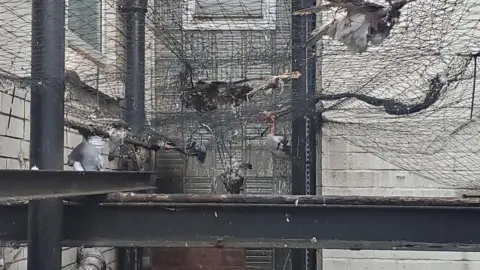
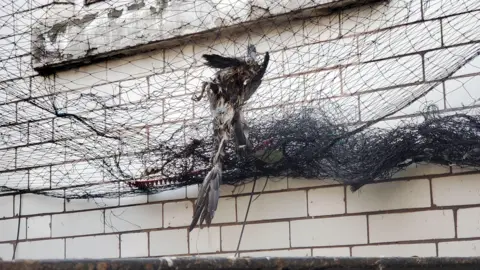
When he looked out of his window he counted the remains of 10 dead pigeons in bird netting.
"They have died and suffered a slow, long, painful death in bird netting," he said.
Kevin also said he counted five live adults and said he could hear at least two chicks.
He looked on Tripadvisor and found a review which suggested pigeons had been dying in the netting since at least August 2025.
The reviewer said: "Looking out of our window, we noticed trapped pigeons (some alive, some not), which was quite unpleasant."
There was an accompanying photo showing the remains of several dead pigeons.
A reply from a manager suggested the hotel was aware of the issue too.
"As explained at check out, our team is trying to find a solution for the pigeons and we hope to have it sorted soon," the reply on 31 August 2025 said.
What has the hotel said?
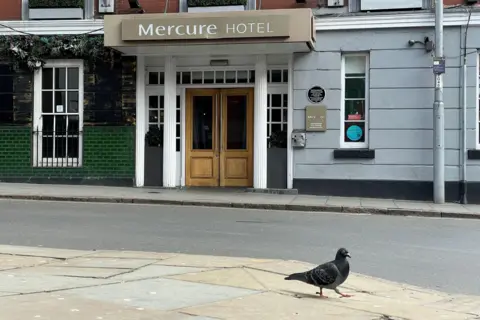
The Mercure Hotel told the BBC that birds becoming trapped was a "temporary issue".
"We have taken immediate action to ensure that no further animals can become trapped by cutting a large hole in the netting and continuing to closely monitor the area," it said.
"We have taken advice from Environmental Health and the RSPCA and are acting in line with relevant guidance. The welfare of animals is taken very seriously, and we are actively working with specialist advisors to identify and implement a permanent solution as quickly as possible.
"The netting has been in place for 18 months as a legitimate and established way of preventing pigeons from perching and nesting on buildings, but these issues have only intensified very recently."
Is it illegal to trap birds in netting?
 Getty Images
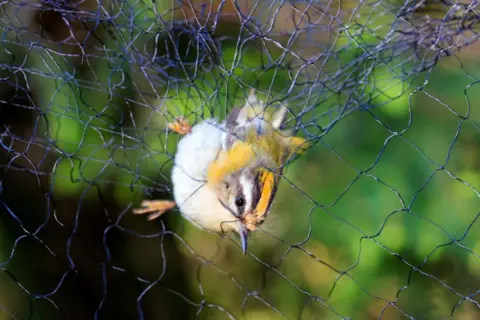
The RSPCA said that while the use of netting to prevent birds nesting on properties is legal, it "could become illegal if birds are trapped and necessary steps to release them are not taken".
Edie Bowles, a solicitor who founded Advocates for Animals, said one piece of relevant legislation is the Animal Welfare Act 2006.
"Once a bird becomes trapped in a human-made structure, the provisions of the Animal Welfare Act 2006 apply, as the bird is under the control of a human," she said.
"This means the welfare needs of the animal must be met and they must be spared unnecessary suffering."
She believes there is a "clear lack of understanding and widespread confusion" surrounding the law on bird netting, "particularly regarding the responsibilities of those who install and maintain it".
"Under animal law, anyone responsible for netting, and by extension, the birds or other wildlife that may become trapped within it, has a positive legal duty to ensure the welfare of those animals," she said.
"This means taking proactive steps to prevent unnecessary suffering, regularly inspecting netting, and addressing any entanglements promptly."
What is the RSPCA doing?
 Getty Images
So far, there have never been any prosecutions in the UK over the deaths of birds trapped by netting.
The RSPCA said it was "challenging" to prove if a building owner has "intentionally broken the law and if suffering prior to death can be proven in a court of law under the Animal Welfare Act 2006".
The charity said it instead encourages building owners - or the pest control or maintenance company responsible for the netting - "to take remedial steps".
"It is better to try to resolve the situation rather than try to launch a prosecution, although that remains an option in appropriate circumstances, but would always be a last resort," the RSPCA said.
The RSPCA said its wildlife department has contacted the hotel via letter and they are "awaiting a response but we will be following up".
What types of birds are dying?
 Getty Images
Kevin has been collating data about incidents where birds have died after being trapped in netting, and has recorded 314 cases involving 924 "victims".
Of these, 124 were species on the Red List.
"So these are birds which are in decline, high conservation status, that we should be protecting at all costs," said Kevin.
Cases include three peregrine falcons that died in netting on top of a University of Leeds building.
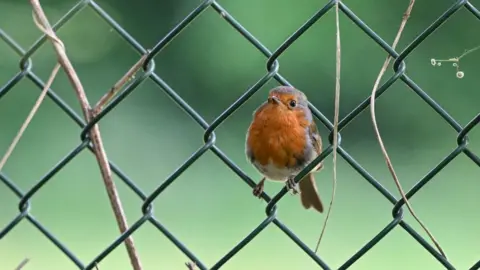
"We're talking birds that people have relationships with in their gardens, like robins, and pied wagtails, and blackbirds," said Kevin.
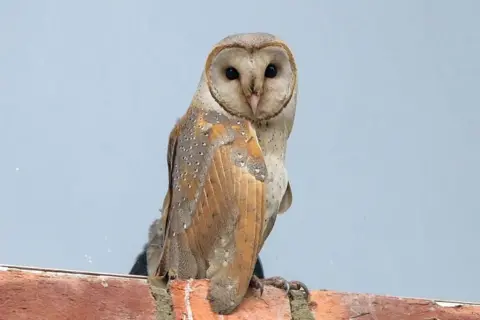
"We're talking barn owls, tawny owls, kestrels and sparrowhawks.
"These are birds which are protected under law yet are still being caught and killed in netting across the entire UK."
Can bird netting be used humanely?
 Kevin Newell
The BBC spoke to a pest controller who fits bird netting, and coincidentally was asked for a quote to replace the Mercure Hotel's bird netting.
He said it had been "badly fitted" and should have been replaced a long time ago.
"It was just really bad, I think it's the worst netting I've ever seen," said the pest controller, who asked not to be named.
"I can't believe the state it's in, and that's because it's been left.
"Whoever has had the net fitted should be keeping an eye on it themselves and make sure it's not a threat."
The BBC has asked the hotel to comment on these claims.
The pest controller said he sees birds trapped in netting "a lot", but not in nets that he has fitted.
"I was at a train station recently and there was a pigeon behind the netting trapped in, and it breaks me if I see a bird trapped in a net," he said.
He said badly-fitted netting can become loose and rip, which allows birds to become tangled, or alternatively birds get through the holes and then cannot get out again.
However, he believes bird netting can be "the best thing for keeping birds out of certain areas" provided it is fitted well, but it needs to be monitored and maintained, and replaced if necessary.
The National Pest Technicians Association said netting can be necessary on buildings to prevent pigeons from nesting.
"City centres give feral pigeons easy access to abundant food sources," said technical manager Mark Wenman.
"The commensal behaviour of this species means that we may come into close contact with the pigeons and their fouling."
He said appropriate netting will not trap or harm birds provided it is "installed and properly maintained by a fully trained company".
What have bird and animal groups said?
 Getty Images
The RSPB said it urges property owners to use alternatives to netting, such as nesting boxes, or if netting is used it should be "installed in such a way to ensure birds cannot be trapped and it should be checked at least once a day".
"Geotextile netting and solid metal mesh may be safer alternatives to flimsy wide-mesh nylon. Even then, frequent checks must still be conducted each day," said the RSPB.
"It is utterly heartbreaking to learn that wild birds have died after becoming caught in netting installed to deter them from nesting on buildings here in Nottingham."
Brinsley Animal Rescue, based in Nottinghamshire, said it gets multiple calls every week in spring and summer about birds trapped in netting.
"Sometimes, the fire brigade have to come out and rescue the birds," he said.
"To any company who thinks about putting these nets up – please don't."
Charlotte Smith, a campaign manager at Protect the Wild, said she was in "disbelief" when she saw the photos from the Mercure Hotel.
"My jaw hit the floor," she said.
"It wasn't just one dead bird, it was multiple birds.
"There were so many opportunities for staff to see them, and those birds were just left."
Listen to BBC Radio Nottingham on Sounds and follow BBC Nottingham on Facebook, on X, or on Instagram. Send your story ideas to eastmidsnews@bbc.co.uk or via WhatsApp on 0808 100 2210.
