Doctor turned dinosaur hunter who rewrites history

 BBC
BBCJeremy Lockwood didn't play golf.
He wasn't a fan of gardening either.
So when the former Midlands GP retired after 30 years of medicine he needed something to do.
Little did he know his chosen hobby on the Isle of Wight would help rewrite history.
It was a fascination which began in childhood. Growing up Jeremy spend hours searching for fossil shells and trilobites – ancient marine creatures that predate the dinosaurs by millions of years.
"We lived in an area rich in prehistoric treasure," Jeremy remembers. "As a small boy the prize was finding trilobite fossils. That sense of wonder never left me."
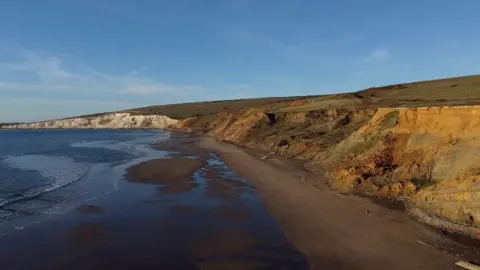
Jeremy was a frequent visitor with his own children to the Isle of Wight. It was his finds of dinosaur bones on the island which really sparked his interest and awoke his childhood curiosity.
Taking his discoveries to the local museum he was told the bones he had found belonged to the same species. But his medical background triggered a recurring thought that the variation from a human point of view appeared too great.
It was that observation that would change his life.
To pursue his hunch Jeremy decided to study Paleontology at the University of Portsmouth.
"I thought it would be a good discipline to do a PhD. It would help me focus and give me the expert advice that the people supervising me would be able to give me. I'm not sure my wife was a hundred percent happy with me taking retirement and working 12 hours a day on a thesis."
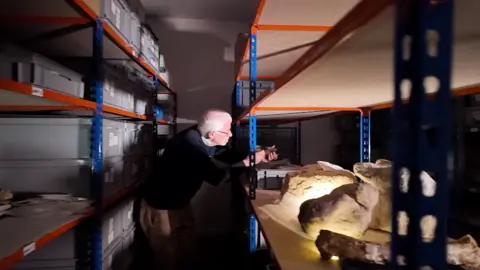
Determined to test his theory Jeremy began sifting through thousands of fragments of dinosaur bones at the Dinosaur Museum on the Isle of Wight and the Natural History Museum in London.
At first, his research focused on understanding variation within Mantellisaurus atherfieldensis, a herbivorous dinosaur closely related to Iguanodon
"It seemed a good bet that there was probably more than one species of these. So I started sort of looking at the bones. Hundreds and hundreds of them – measuring them, photographing them and making a huge catalogue of virtually everything that had been found in the last 200 years."
 John Sibbick
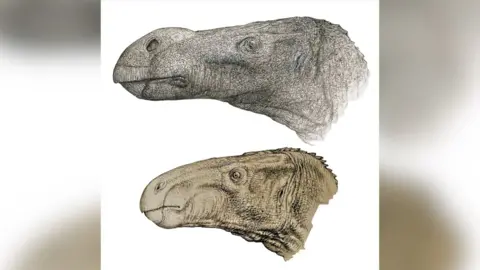
While piecing together a skull thought to belong to Mantellisaurus, the former GP noticed something extraordinary.
"I was trying to reconstruct a skull by putting it all together to take a photograph of it. Once you got it into the right angle you could see there was a definite bulge – this animal had a bulbous nose." he recounts.
'And Mantellisaurus, which for the previous hundred years everyone had thought was the only one, had a very straight nose. So this was clearly a very different thing. I remember calling in the curator of the museum and saying – come here – it's not just me, is it?"
It was a eureka moment. The first of three new species that Jeremy would go on to discover.
It was Jeremy's medical background which drove his discoveries.
"As a doctor, you learn that human bones look remarkably similar. But in dinosaurs, I kept finding bones that were supposedly from the same species yet looked completely different. It was difficult to make sense of it all."
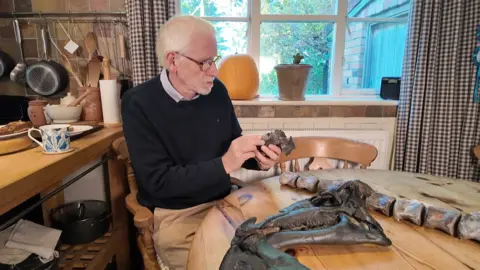
Jeremy's discoveries show much still remains to be learned about dinosaurs from the thousands of specimens sit in museum.
"There's so much material that hasn't been fully examined," says Jeremy. "Sometimes, the most remarkable discoveries are hiding in plain sight."
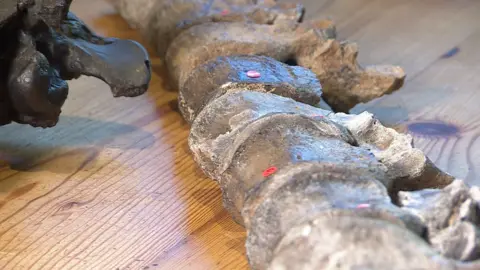
Jeremy's forensic study of dinosaur bones continues. From sifting through the archives to studying specimens where it all began – on his Isle of Wight kitchen table.
"There are definitely other species out there and we're working on a couple of those at the moment.
The retired GP's work has been recognized worldwide – his part on solving the puzzle of an ancient and diverse ecosystem. But come the winter months – there's just one place he'd rather be – on a windswept beach on the Isle of Wight.
"It's lovely publishing and writing. But there's nothing as exciting as being out in the field and finding something new."
