'Solving a cold case rape from 1985 was such a proud moment'

 BBC
BBCFor decades, David Hill thought he had escaped justice for the rape of a woman at knifepoint in an underground car park in Sheffield.
He was never arrested or interviewed about the 1985 attack, but more than 40 years later the 75-year-old is beginning a 15-year prison sentence after modern DNA testing linked him to the crime scene.
"Cold case" officers from South Yorkshire Police praised the diligence of their predecessors in an era when DNA analysis was in its infancy to enable them to finally make a breakthrough after preserved samples were retested.
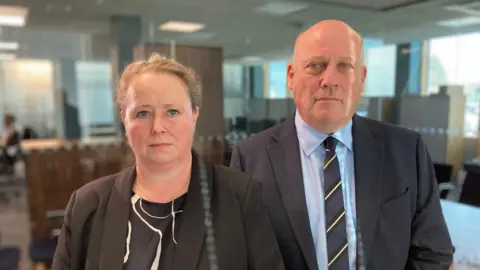
"Officers were almost accidentally taking DNA," says Dave Stopford, who heads up the force's major incident review team.
Evidence gathered at the time was for much more basic forensic testing of material such as hair and fibres, but police did not have access to modern techniques.
Forces would not widely adopt DNA testing for several more years, but the samples collected from the rape scene were stored in a laboratory fridge.
"They had the foresight to store everything in an archive and that's where we apply for whatever samples remain from the case," Stopford adds.
Rachel Morton, an investigations officer who works with Stopford, says: "We looked at this case in 2018 and decided it needed a forensic review."
Their team, made up of former detectives, revisit historical cases, to see if new technology or techniques can help to secure long-awaited convictions.
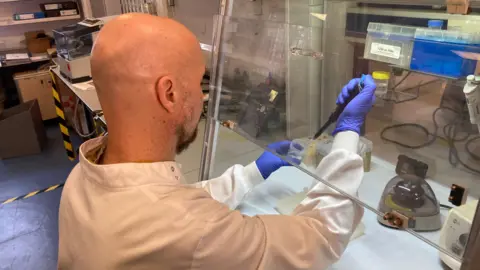
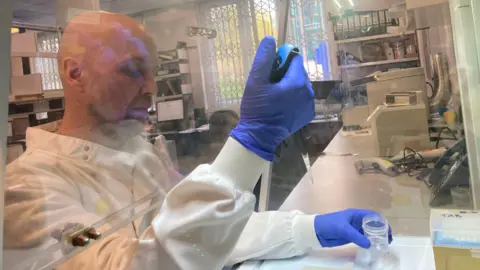
A year later, as part of periodic testing of old samples, a forensic scientist managed to pull a full DNA profile from the clothing the victim was wearing on the night of the attack.
Prof Jon Slate, from the University of Sheffield, says: "From DNA, you can get a unique genetic profile, or people sometimes call them a barcode of the person who left the stain."
 South Yorkshire Police
Slate's work is similar to that of police forces and he uses the same techniques and technology.
"Genetic profiling in the 1980s and 1990s wasn't as accurate as it is now," he says.
"It required more DNA then than it needs now, so it's now possible to work with poorer quality, deteriorated samples."
The genetic profile, or barcode, was only half of the puzzle to find the suspect.
In 1995, police forces established the UK National DNA Database to store profiles.
Hill had never been arrested in the years since the rape, but in 2021 a breakthrough came when he was detained for a public order offence and his sample was taken.
Stopford says: "When we first tried to find the DNA barcode that we'd got from the crime scene it came back negative."
"It was only when his DNA was taken that we were able to match the crime scene samples."
Morton adds: "In 2021 we got the email that a match had been made to David Hill in Rotherham," Morton says.
A file was prepared and a charge of rape was authorised against Hill, who had been living as a free man.
Robert Varey was the detective sergeant on duty when the victim attended the now-closed West Bar police station to report the attack, and he says the case stuck with him throughout his 40-year career.
"I can always remember the case, the distinctive turquoise dress she was wearing and how distressed she was," he says.
"Rapes committed by a stranger are thankfully rare so this was investigated as a major incident."
Varey was responsible for recovering the victim's clothes, which contained the attacker's DNA.
He says: "Throughout the investigation or trial the way the original exhibits were handled was never questioned.
"I retired in 2012, but when I was contacted by the investigation team I knew I had a public duty to assist the enquiry and the other witnesses who gave evidence also were crucial."
The victim, who was 27 at the time of the rape, died in 1997, 12 years after the attack, before she could see Hill brought to justice.
Stopford previously said: "We, alongside the Crown Prosecution Service, applied to the court to have her original police statement read as 'hearsay' evidence, which is when evidence is provided in a manner other than as firsthand, direct testimony."
Work from scientists, former police officers and friends of the victim helped to fill in the gaps, with a jury finding Hill guilty of rape.
The judge who sentenced him at Sheffield Crown Court on Friday said he had shown "not a shred of remorse" for what he had done.
His Honour Peter Hampton also called the attack "nightmarish" and the woman "brave".
Her brother told the court that she was "never the same" after the rape. Although the anonymity automatically granted to victims of sexual offences lapses upon their death, her name has not been used at her family's request.
Hampton also praised Morton's contribution to the "complex" investigation during the hearing, and highlighted the work of police officers who had kept extensive notes about the case that were able to be presented to the court.
Morton says: "It was a proud moment and it makes all the frustrations and the stress and some of the sleepless nights worthwhile.
Stopford adds: "We don't have a huge success rate. We get a lot more failures than we get successes. But we've got lots and lots of cases and we're systematically reviewing those.
"We still have that desire to see justice. This was a horrendous case, it was a completely unprovoked sexual assault that was premeditated - so to see him brought to justice was very satisfying."
Listen to highlights from South Yorkshire on BBC Sounds, catch up with the latest episode of Look North
