Winds of change - hopes and hurdles for two Chinese-backed renewables projects

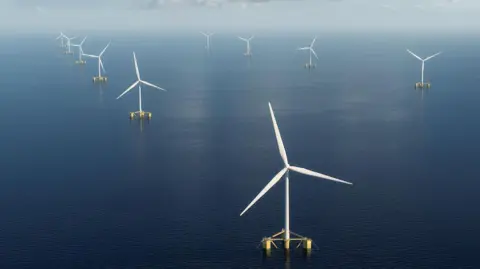 Cerulean Winds
Two sites on Scotland's coast - both recently derelict and neglected, now with huge potential as industrial hubs for the new economy - are now looking to two Chinese companies for their survival.
At least one of them is entangled in questions of national security.
And ever more dependence on Chinese technology is a sign of the times when Britain no longer feels obliged to follow the lead of the United States under President Trump, and Sir Keir Starmer edges towards better relations with Beijing.
One of the sites is Hunterston on the Ayrshire coast where a vast former coalyard is being prepared for a subsea power cable factory, its drying tower designed to soar into the Firth of Clyde skyline.
The other is Ardersier, on the Moray Firth coast near Inverness, where an even bigger former fabrication yard has had an upgrade costing hundreds of millions of pounds, a sizeable chunk of that in public investment.
Its future hangs in the balance as it awaits work in the offshore energy industry - work which is being delayed by global economic pressures.
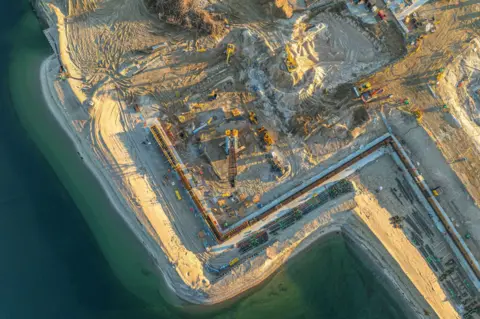 Haventus
That future hinges on approval for Chinese engineering giant Mingyang to build a turbine factory on the site, investing up to £1.5bn.
The plan was announced by Mingyang in October. The only remaining obstacle, according to the Chinese firm, was Britain's national security vetting.
By November, approval looked unlikely. But now there is more positive mood music in relations with China.
Last week saw the huge planned Chinese embassy in London given UK government approval, after delays due to security concerns.
This week sees Sir Keir Starmer in China. Approval for Mingyang could be just the kind of announcement that helps lubricate a summit meeting between Sir Keir Starmer and China's premier.
But the delay is proving to be a blockage on other investment, according to Scotland's Deputy First Minister and business secretary Kate Forbes. Asked about it on Radio Scotland Breakfast, she said: "The fact they're taking so long to reach a conclusion is freezing a lot of the other decisions developers and investors are making. And it's been really damaging to the sector at large how long it's taking.
"Whatever the outcome is, processes like this should not take this long. Because other investors might not make decisions, [and] might wait to see what the outcome is. Developers who want to work with that manufacturer are also having to wait. So it's really damaging and we need an answer soon."
There appear to be no such objections to Orient Cables, also known as NingBo Orient and as NBO, a company listed on the Shanghai Stock Exchange, which has laid 12,000 kilometres of subsea cable, a lot of that in the rapid expansion of China's offshore wind sector.
Now, it's looking to Hunterston.
Maybe it's less high-tech and vulnerable to espionage. Maybe it did its homework with the UK authorities. Either way, Orient Cable is not facing obstacles with its investment in a Scottish firm, and will supply it with cable for laying in the waters around Scotland.
What the firm needs now is around £250m to buy a cable-laying vessel from Asia, for which there is considerable demand as Europe rapidly develops offshore wind.
The name of that firm was XLCC until Monday, when it rebranded to Aquora.
The former name was linked to an ambitious plan, put forward by a sister company called Xlinks, to lay subsea power cables which would bring solar power from North Africa to the Bristol Channel.
Planning permission was secured from North Ayrshire Council to build the XLCC factory, expected to cost around £650m, with an initial order of nearly 8,000 kilometres of the cable required.
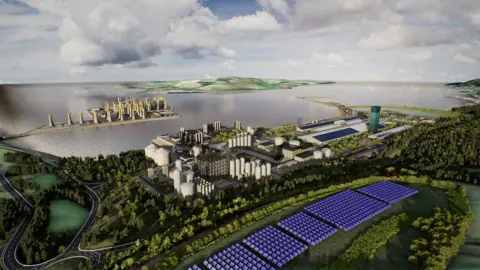 Peel Ports
While most of the factory design sees it rise to 45m in height, the drying tower would be 185m high.
Last August, the UK government quietly announced it won't back the private sector plan for a link between Morocco and north Devon. Without that support, the Xlink plan is dead - and not in the water.
So XLCC had to find another plan, or else it faced the same fate as the old coalyard business. Its rebirth as Aquora comes with an injection of new capital and new management.
The new executive chairman is Lewis Gillies, the Hebridean who spent 20 years at BP before turning entrepreneur, to build up Ardersier under the corporate name Haventus.
He left it late last year rather than be locked in for several years to a redrawn and less ambitious business plan for Haventus and Ardersier.
Yet he was also the figure who forced XLCC at Hunterston to face up to its own limitations and the need to cut costs radically.
The plan now is to hire out the cable-laying vessel, carrying Orient Cable's product, until it has built up the momentum to raise finance and develop the Hunterston factory.
Phase one could mean up to 200 jobs, claim the new bosses. Phase two, with the factory, could bring around 800 more.
Both projects are living riskily, and have been staring at some tough figures in recent months, as big plans came adrift and new plans were required. A lot rests on winning contracts and making those Chinese connections work.
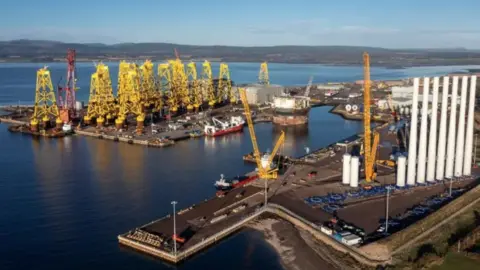 Port of Nigg
Near Ardersier on the Cromarty Firth, Japanese money has become the dominant factor.
A subsea cable factory is being built there for Sumitomo, with a £350m investment. The engineering conglomerate Mitsui has bought out local firm Global Energy to take over the neighbouring Nigg fabrication yard.
It's currently the site for assembling turbines, shipped in from afar, to be taken out by barge to a wind farm being developed off East Anglia.
Berwick Bank, the huge array of turbines planned for an area east of the Firth of Forth should bring more work, having secured a grid connection and the guarantee of a minimum floor price, through the recent A7 UK government auction.
New quayside capacity in Leith could bring Edinburgh's port a slice of that work, helped by this month's formal signing of the inter-government deal to support the Firth of Forth green freeport.
But there remains doubt about other projects.
North of the Sutherland coast and west of Orkney, the floating turbine plan which also won a so-called Contract for Difference in the A7 auction, is dependent on a change to the price for connecting into the mainland power grid.
At present, the north of Scotland is at a significant disadvantage through higher prices for feeding in.
That is a challenge to the British regulator Ofgem and those who oversee it at the UK government.
But these decisions are also caught up in global issues of energy and IT security.
Europe, with the UK, have just signed up to developing a North Sea network where national sea boundaries could be erased by interconnectors from UK windfarms to other countries.
But China can hold the key to investment and the supply chain.
And the Trump administration is telling offshore wind developers to stop work. It's citing national security concerns, though it looks more like the President's whim - a dislike of "windmills" that arose with his objections to the ones close to his Aberdeenshire golf course.
"Windmills are losers," he told the World Economic Forum in Davos last week.
The potential cost of billions of dollars in investment has upended parts of the global industry, tanking the share price of European developers active in the US, and adding to uncertainty and delay.
