Contract secured for one of world's largest offshore wind farms

 Getty Images
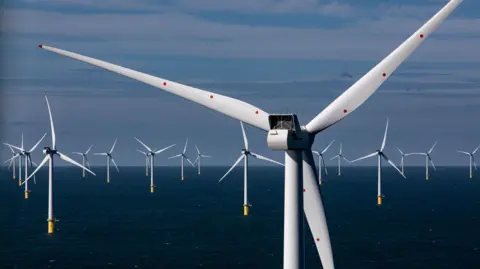
One of the largest offshore wind farms in the world is set to be built off the coast of East Lothian after being awarded a key UK government contract.
SSE will construct the Berwick Bank wind farm in the outer Firth of Forth with up to 307 turbines generating enough electricity to power up to six million homes.
The 4.1 gigawatt (GW) development is one of two offshore wind projects in Scotland awarded a Contract for Difference out of 12 across the UK - these agreements guarantee a minimum price for electricity.
Berwick Bank's will cover the first phase of the wind farm's development which will deliver about 1.4 GW.
The Scottish government welcomed the development but suggested that more Scottish projects should have been awarded contracts.
Meanwhile conservation groups have opposed Berwick Bank because of its potential impact on seabirds in the area.
SSE's chief executive Martin Pibworth said the contract enabled the company to advance the project "towards a final investment decision" and "reinforces our commitment at SSE to delivering sustainable growth and long-term value for society, for consumers and for our shareholders".
He added: "If built to its full projected capacity of more than 4GW, Berwick Bank wind farm can rank among the largest offshore wind projects globally.
"It would represent the single most significant contribution toward achieving the Scottish and UK governments' offshore wind targets and can accelerate the delivery of homegrown, affordable, and secure clean energy to UK consumers from excellent Scottish offshore wind resources."
The contracts are seen as an important step in achieving the UK government's commitment to lower bills by delivering clean power by 2030.
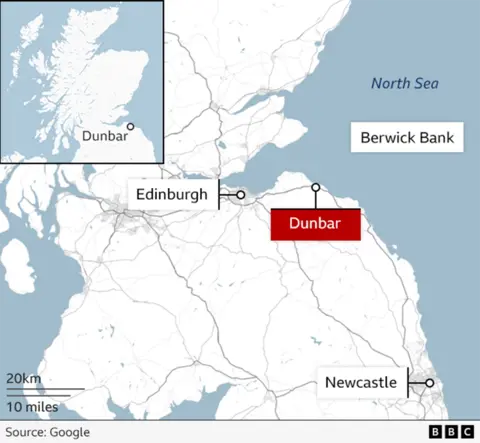
The turbines will be built about 24 miles offshore alongside the existing Seagreen wind farm which began generating in 2022, three years after it was awarded a similar contract.
Seagreen is Scotland's current largest offshore wind farms with 115 turbines and the capacity to power up to 1.6 million homes.
Cables from Berwick Bank will bring the power ashore to substations at Dunbar in East Lothian and at Blyth in Northumberland.
SSE estimates its construction will be worth up to £6bn to the UK economy.
It is the first fixed offshore wind farm to be awarded a contract since 2022.
Five charities, led by RSPB Scotland, previously wrote to First Minister John Swinney expressing concerns about the plans.
Anne McCall, Director of RSPB Scotland said it is a "disgrace" to use public money to construct what she described as "one of the world's most harmful wind farms for birds".
She said: "Efforts to tackle climate change must be delivered with nature in mind, not at its expense.
"A development that will kill tens of thousands of seabirds over its lifetime and push species like Kittiwakes and Puffins closer to extinction in Scotland is unsupportable on every level."
 PA Media
A contract has also been awarded for the much smaller Pentland floating offshore wind farm off Dounreay.
The government says the contracts it has awarded will deliver enough electricity to power 12 million homes.
It describes that as the single largest procurement of offshore wind energy in British and European history.
UK Energy Minister Michael Shanks said it was a "monumental result" that put the government on track to meet its clean power targets and support thousands of jobs.
He added: "It also shows the kind of energy system we want to build for Scotland.
"By agreeing a price for offshore wind that is far lower than the cost of building new gas. Clean power is the right choice to get bills down for good."
On the impact on seabirds, Shanks told BBC Radio Scotland Breakfast that there was "a whole process for planning" to balance any harm caused.
"Developers have to put in place measures to mitigate the impact," he said.
"Where it's not possible to mitigate direct harm that might be caused, they have to mitigate it somewhere else in the system.
"So for rare bird species, they'll have to demonstrate that that they are able to protect those somewhere else in our ecosystem."
'Unfair charges'
Scottish Energy Secretary Gillian Martin said the UK government could have achieved more in awarding contracts in Scotland and this was a "missed opportunity".
She said that the UK's budget for the projects was limited and that "unfair" transmission charges put Scottish projects at a competitive disadvantage.
She added that there were a number of Scottish projects eligible for this round of contracts allocated and called on the UK government to support Scottish projects in the next round.
Jess Ralston, energy analyst at the Energy and Climate Intelligence Unit (ECIU), said: "This is set to be a breakthrough moment in the UK's energy independence and for stabilising household and industry's energy bills.
"Every wind turbine we build means we need less gas from abroad as the North Sea continues its inevitable decline, so we'll be less reliant on the actions of foreign actors like Putin."
