Met DNA database missing nearly half of officers

 Getty Image
The Metropolitan Police is still missing nearly half of its officers' DNA from its database, and more than a fifth of their fingerprints.
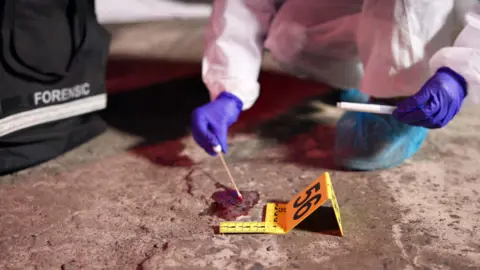
Elimination databases are used to exclude police officers' DNA or fingerprints from crime scene samples, helping to prevent contamination from being mistaken for a suspect's profile.
However, the missing data could potentially hamper the force's ability to catch criminals in their own ranks.
The Met has been asked to comment. The force has previously said it aimed to get every serving officer's DNA and fingerprints on its databases by the end of March 2028.
Of the 32,431 Met Police officers, 17,458 have their DNA on the force's elimination database, which is 53.8%, while 25,802 have their fingerprints on the elimination database - 79.6%.
In November 2024, the London Standard reported that around half of the Met's officers could be missing from its own DNA and fingerprint databases..
A Met Police spokesperson said at the time: "We're in the process of assessing those samples we don't currently hold and ensuring our processes to collect them are robust and effective.
"We expect this work to conclude in the next 12 months."
It is understood a new database has been established to track the career lifecycle of biometric data samples associated with serving officers to ensure continuity and the Met is "confident" its processes have been assured.
The Met also says it has developed a more reliable data process to identify individuals whose data is missing, addressing legacy records and data quality issues, including identifying duplicate records for the same person.
That said, the percentage of officers with their DNA on file has risen very little in the 15 months since November 2024.
 Getty Images
The collection of DNA samples for elimination databases has been mandatory for new police recruits in England and Wales since 2003.
In the aftermath of of former constable Wayne Couzen's murder of Sarah Everard in 2021, gaps were found in the Met's sample collection as part of wider vetting and recruitment failings.
The issue of DNA and fingerprint elimination databases on serving police officers was not specifically mentioned in either the Casey Review or the Angiolini inquiries.
However Labour former minister Dawn Butler raised this issue on social media in 2023, asking whether officers should have their DNA on a database, arguing it was needed for crime elimination, transparency and accountability.
After learning of the latest figures, she said it was "deeply disappointing" that progress remained slow on ensuring that biometric data of all officers is recorded.
She also said these checks were an "essential safeguard to help restore confidence in our police service".
"I have long pushed for the Met Police to ensure that the DNA and fingerprints of every single serving officer are properly recorded on the database, so it is deeply disappointing to learn that progress has been slow," the Brent MP said.
"There can be no more delay - the Met must now act with urgency to ensure every officer is included."
Scotland Yard says it aims to ensure that the DNA and fingerprints for every serving police officer in the Metropolitan Police and Met Special Constabulary are collected, recorded and uploaded to the elimination database by 31 March, 2028.
Listen to the best of BBC Radio London on Sounds and follow BBC London on Facebook, X and Instagram. Send your story ideas to hello.bbclondon@bbc.co.uk
