Action urged over violence against transport staff

 Getty Images
Violence on London's transport network has left staff with broken noses and bones, sending some to A&E, an investigation into the assaults has heard.
Almost 10,500 cases of work‑related violence and aggression were recorded in the latest year of available data, though many incidents are believed to go unreported.
The London Assembly's Transport Committee heard from transport workers as part of its investigation into the assaults and told Transport for London (TfL) and British Transport Police (BTP) they must do more to protect workers.
Siwan Hayward, TfL's director of security, policing and enforcement, said tackling the issue was an "absolute priority".
Luke Banks, a revenue control officer on the London Underground, told the committee he was assaulted at King's Cross Station last year after stepping in to defend a colleague who was being threatened.
"The customer turned on me, shoved us both in the chest and started screaming death threats," he said.
"We didn't hear anything from British Transport Police (BTP) for two hours.
"At a major station you'd expect BTP to come out fairly quickly, but I had to rely on colleagues to keep me safe and keep the person away from me."
Banks said he had seen colleagues suffer "broken bones, noses, people ending up in A&E" and described the job as a challenging environment.
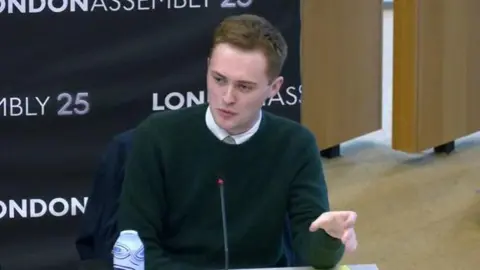 London Assembly
The committee also heard from bus driver Selington Rock Santan Fernande, who said his cabin door was broken after he announced a diversion.
"He then pulled my hair and started hammering – I couldn't see right or left and was taken to the hospital. I couldn't sleep the whole night," he said.
Paul Feakes, a revenue control inspector on the Underground, told the committee he was punched twice by a member of the public and "dragged across the ticket hall floor" during one incident.
He said BTP officers were slow to respond and arrived half an hour after Met Police.
In the subsequent case against the suspect, Feakes said he felt he had to chase updates as he was worried the case would "fall by the wayside".
He added that many staff did not report incidents because "nothing gets done" and "managers are likely to question my own actions as to why we were hit".
'Underreported'
The testimonies come as figures show there were 200 violent incidents against transport staff in London every week in 2023-24 – the latest data available – with 10,493 reports of work‑related violence and aggression recorded that year.
Assaults on rail staff increased by 161% between 2020 and 2024, while attacks on bus drivers rose by 18.5% over the same period.
Hayward said more recent figures suggested the overall rate of attacks at TfL had remained stable, but that physical incidents had fallen.
She also told the committee TfL was concerned that workplace violence was underreported.
"We want every incident to be reported," she added.
"Discussing and promoting how seriously we take workplace violence is a constant theme when we have internal meetings."
But Banks said the process for reporting incidents needed to be more streamlined and that the current system was too slow.
Emma Croxall, work‑related violence and aggression strategy manager at the network, said a new reporting system would be piloted in June and expanded further in September for some staff.
A British Transport Police spokesperson said the force would continue working with TfL to tackle offences.
"No person on the rail network should ever be subjected to violence or abuse, especially rail staff who are simply doing their job," they added.
Listen to the best of BBC Radio London on Sounds and follow BBC London on Facebook, X and Instagram. Send your story ideas to hello.bbclondon@bbc.co.uk
