Oxford Street pedestrianisation plans approved

 AVR London/Mayor of London
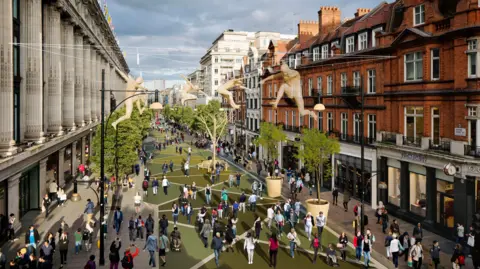
The pedestrianisation of London's Oxford Street has been given official final approval by Sir Sadiq Khan.
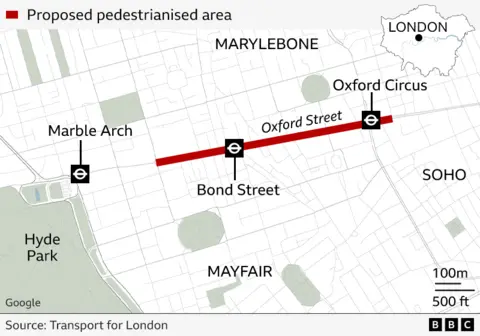
London's mayor has instructed Transport for London (TfL) to implement the proposals to remove traffic from Oxford Street between Great Portland Street and Orchard Street, City Hall said.
The decision follows the results of a second consultation on local traffic diversions in which 2,700 people responded. City Hall said the majority agreed with the plans.
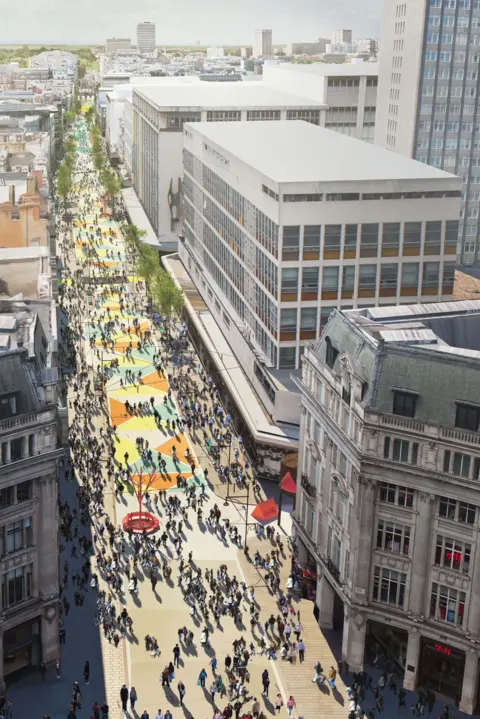
It is hoped vehicles will be stopped from using the road by September, with further work to make the street more welcoming to pedestrians to follow, the governing body said.
The mayor of London says pedestrianisation will make Oxford Street safer and more enjoyable for visitors, as well as making it "a global leader for shopping, leisure and outdoor events," competing with cities such as Paris and New York.
An initial consultation on pedestrianisation of Oxford Street, which ended last summer, showed 63% of Londoners were in favour of the regeneration.
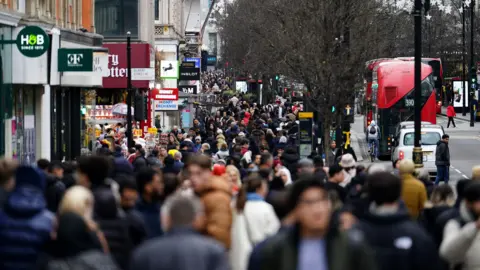
However, some local residents previously told the BBC they did not support the changes, citing concerns over displacement of traffic and buses, as well as disability access.
TfL said the pedestrianisation would go ahead as originally planned, with no changes being made to the plans previously consulted on.
For the stretch of Oxford Street between Orchard Street and Great Portland Street, this means:
- Closure to private motorised vehicles, buses, taxis and private-hire vehicles, cycles, scooters and pedicabs
- Service and delivery vehicles allowed to access the traffic-free area from midnight to 07:00
- General traffic to continue using alternative routes (general traffic is already banned between 07:00 and 19:00 Monday to Saturday)
- Installation of new and wider pedestrian crossings
- Buses that currently serve Oxford Street to be rerouted along Wigmore Street and Henrietta Place, with new bus stops and shelters to be installed. Increased journey times calculated to be "less than a minute"
- Provision of other new bus stops, taxi ranks and drop-off locations as close to the pedestrianised area as possible
- Possibility of increased blue-badge parking bays in the area
- Creation of new cycle routes, as cycling would not be permitted in the new stretch.
It added it would continue to monitor the impact of the changes as they are made and would "consider whether any further revisions are appropriate".
 PA Media
The mayor said: "I am delighted to be moving forward with my bold vision to transform Oxford Street into a world-leading urban space for shopping, leisure and outdoor events."
He added: "We will outline more details in the coming days, as we continue building a better more prosperous London for everyone."
Alex Williams, chief customer and strategy officer at TfL, said they would work closely with Westminster City Council to implement the changes.
 PA Media
The council, which has previously opposed plans to pedestrianise Oxford Street, said its role was now to ensure the transformation worked for local communities as well as for London.
Its leader, Adam Hug, said: "Westminster Council's view on Oxford Street pedestrianisation is a matter of longstanding public record.
"Over the last 18 months we have secured a number of key improvements from the mayor of London's original plans to ensure that the proposals for Oxford Street are more deliverable and better meet the needs of local residents, businesses, and wider London.
"These include ensuring that Oxford Street East transformation will be delivered in line with Westminster's previous plans that retain bus access, and the council's retention of strategic development funding."
Listen to the best of BBC Radio London on Sounds and follow BBC London on Facebook, X and Instagram. Send your story ideas to hello.bbclondon@bbc.co.uk
