Rare turtle leaves rescue centre's quarantine tank

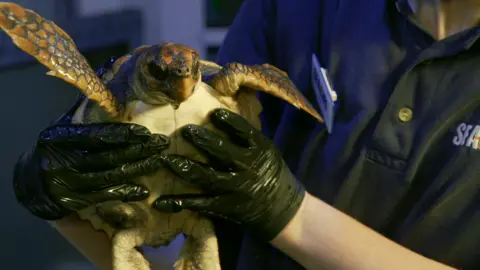 Simon Cotter / This is Influential
A rare turtle that was flown to the UK after being rescued in Jersey has begun the next stage of its rehabilitation at a rescue centre.
Crush, the loggerhead turtle, has been in a 2,000-litre (440-gallon) quarantine tank since being brought to Weymouth Sea Life on 10 February.
Staff said they were "thrilled" with her progress since she was found washed up and apparently lifeless on a beach on 19 January.
On Monday, she was transferred to a 17,000-litre (3,740-gallon) tank and, once acclimatised, will be introduced to another loggerhead turtle.
When Crush was found by a dog walker, she was cold-stunned - a hypothermia-like condition that causes the turtle's body to shut down.
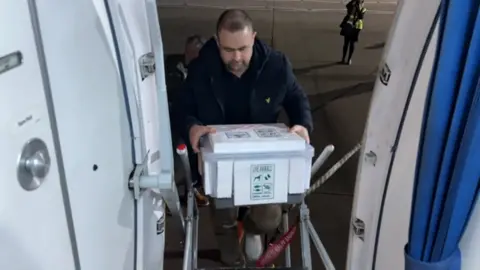
She was initially cared for by New Era Veterinary Hospital in Jersey, including two weeks at clinical director Peter Hawarth's family home, before he flew to Southampton, carrying her in a box.
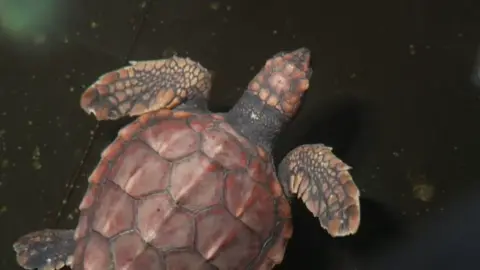
Speaking to BBC Radio Solent's Dorset breakfast show, Weymouth Sea Life general manager Seb Webster said: "We are absolutely thrilled with how crush is getting on.
"She's settled in really well, taken to food pretty much on day one, which is always a good sign.
"And we are pleased she's going to be moving into a much larger tank now to build up her strength ready for being re-released."
Webster said Crush had been kept in the smaller quarantine tank to enable staff to check her more regularly in the early stages but was ready to be transferred into the larger tank by the specialist animal care team.
"We are hoping after a couple of days after acclimatising there, we will be able to introduce one of our other loggerhead turtles into the tank so she's then got a bit of company," he said.
The plan is for the turtles to eventually be released back into warmer seas.
Loggerhead turtles can be found in the subtropical waters off north Africa and it is believed Crush was swept north by storms and currents.
Others have been found in Sussex, Suffolk and as far north as Tyree in Scotland.
The species is classed as "vulnerable" on the IUCN Red List. There are an estimated 2,000 breeding females worldwide and out of every 1,000 hatchlings, on average, only one makes it to adulthood.
It is not known if Crush is female but rescuers have called her "she" because, like other females, she has a larger tail.
