Inside Number 39: Through the doors of an unlikely architectural treasure

 Clare Worden/BBC
At first glance, it might not look like much.
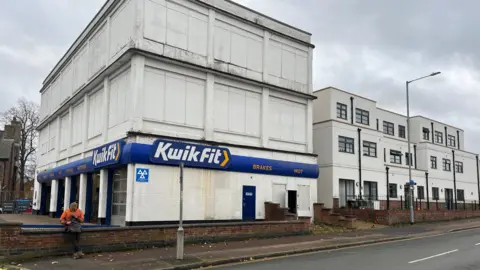
Few passers-by would suspect the building now part-occupied by a Kwik Fit garage is the work of an architectural pioneer.
Not only is Number 33-39 St James Street in King's Lynn, Norfolk, Grade II-listed, it is an "extraordinary early example" of modernist design and on The Victorian Society's top 10 endangered buildings list for 2025.
"King's Lynn is a wondrous town, and this is a truly exciting building," says Griff Rhys Jones, the society's president.
When I first heard of it in the summer, I was intrigued.
Why was the charity charged with protecting the country's finest Victorian and Edwardian heritage concerned about a Kwik Fit garage?
 Clare Worden/BBC
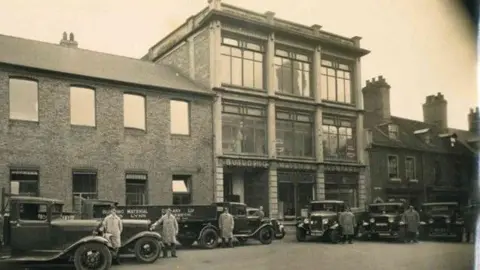
It is special because it was ahead of its time. Designed by Norfolk architect AF Scott, it dates from 1908 and was built from concrete at a time when very few buildings were.
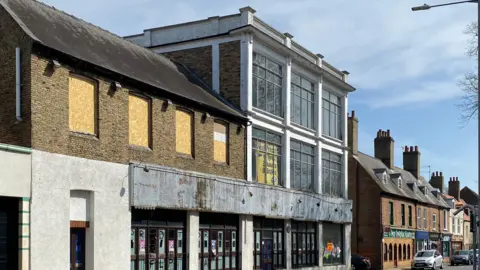
Originally an office, showroom and warehouse for a building materials firm, it has fluted pillars, unusually large windows and is fringed by a scalloped facade that has largely broken away from the sills.
Only the ground floor is still in use. The remaining two were closed in 2010 when the restaurant occupying the site shut down.
I wanted to see inside.
 Gerald Dover Thomas Green
My battle to gain access began. Dozens of emails to the managing agent and The Victorian Society followed.
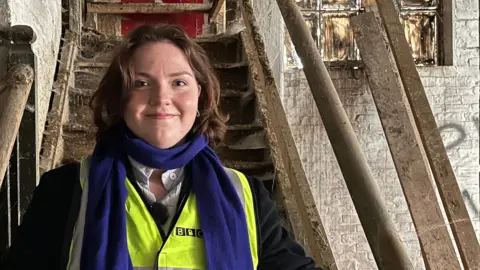
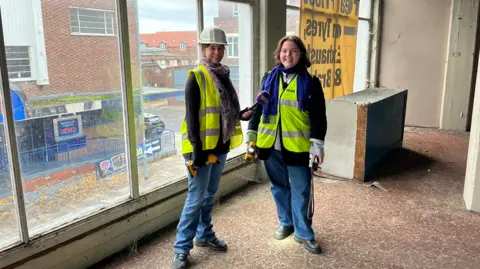
After months of negotiations and safety checks, I am finally inside.
But standing at the bottom of a ladder more than 10ft (3m) high, my enthusiasm is wavering, and my vertigo kicks in.
Doug, tasked with opening the building and getting us safely onto the first floor, takes my recording equipment so I can grip the ladder with both hands.
Following me up is Morgan Ellis Leah from the society. Unfazed, she tells me this does not really count as working at height.
"You should go up Canterbury Cathedral," she smiles.
 Connor McNeill
This building is of European importance, Morgan tells me.
"This is the precursor to the tall high-rises we have in London... to the modernist buildings we have in France by [renowned architect] Le Corbusier," she explains.
"This building is at the epicentre; a very important start of a different form of architecture; a practical form of expression that you don't really get anywhere else in the UK until much later, mostly post-war.
"So this predates that by a good 30 to 40 years, which is so exciting."
 Judith Merrill
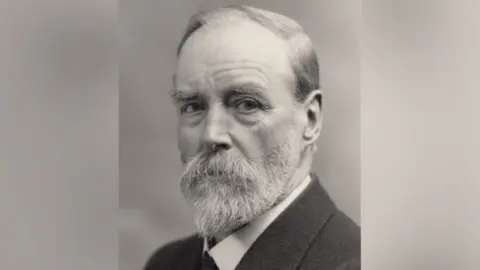
On Scott, she says: "He was a really kooky guy.
"He was a vegetarian; he was a keen cyclist; he was teetotal, all before these were really things.
"He built the building in the way that he did because he thought, 'This is practical. It works.'"
 Clare Worden/BBC
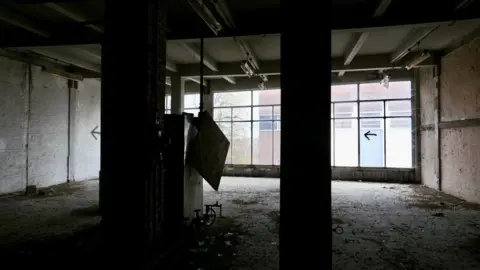
Torches help guide us through the large, dark, sparse room towards the building's massive windows.
Morgan is surprised the original glass has survived and, as we dodge bird skeletons, she spots the staircase.
"What an amazing feature", she enthuses.
"It is quite traditional late Victorian, and the building we're standing in is obviously quite a modernist building. To have the contrast between the two is lovely".
 Getty Images
Following two more flights of stairs, we finally make it to a dead end.
In the gloom I spot a small handle and give it an exploratory push.
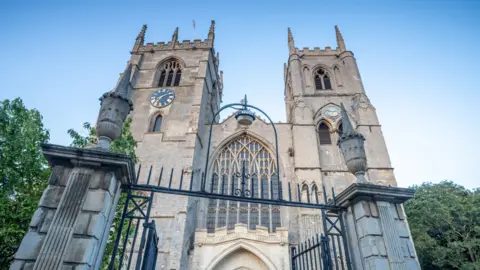
With a satisfying clunk, a door opens, letting light in and us out onto the roof. From here, where we can see the Minster's towers and the tops of several of the historic buildings King's Lynn is much better known for.
As we descend, I get lost on the third floor, investigating some graffiti suggesting 1986 was a good year for parties in derelict buildings.
Morgan steers us back on course, saying: "I think that speaks to the sheer scale of it.
"You could reasonably be subletting on each floor to a different business. What an amazing thing that would be for King's Lynn's economy."
 Clare Worden/BBC
She advises on planning applications made for Victorian or Edwardian buildings that are in conservation areas or listed.
"I don't want people to be scared off using older buildings because they think they can't make changes to them, but there is an appropriate way to make those changes and that is where we come in," she says.
What she looks for is the "bare bones."
"If we've got a good structure, it is something we can build upon."
On this building, she says: "The fact that it still has the original openings – the original beams and pillars – is fantastic.
"What you've got is a complete building. It's actually in really good condition."
Back on the ground floor, Doug puts the ladder away and I wonder how long it will be before anyone else makes it inside.
So what of the building's future? "I can see why it is on the 'at risk' register but I don't think it is a building at immediate risk of loss," says Morgan.
"There's a general feeling that this is an easy fix.
"It just needs one, maybe two, people who want to take it on, and it's whether or not the current occupiers want to work with others to make it into that venture."
The building's owner, Ridgeview Investments, tells me it is open to inquiries from other businesses.
Kwik Fit says it has received a number of initial inquiries from potential tenants of the building's unoccupied areas, but that these have never developed into firm commitments.
"The company would be happy to hear from anyone who believes they have a viable proposal to use the space which would be permitted under the terms of the building's lease," it adds.
Follow Norfolk news on BBC Sounds, Facebook, Instagram and X.
