Frogs could be reintroduced to West Acre pingos

 Getty Images
A plan to reintroduce three tiny frog species to the UK has been given £15,000 by a rewilding charity.
The hope is that the amphibians will thrive at the West Acre estate, near King's Lynn, Norfolk and a potential release could happen by summer of 2027.
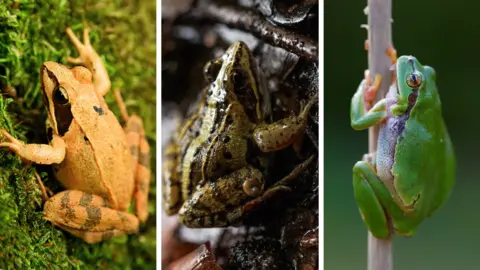
Celtic Rewilding wants to bring back the agile frog (Rana dalmatina), the moor frog (R. arvalis), and the European tree frog (Hyla arborea) - which were common in the UK 500 years ago.
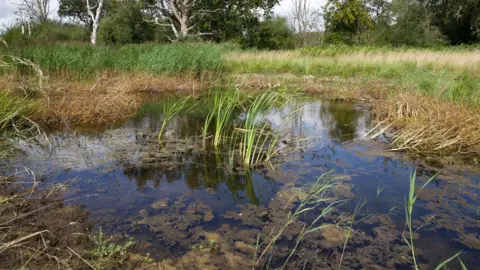
West Acre has 250 "pingos" - small ponds which formed when Ice Age mounds melted - that will provide homes for the tiny frogs.
The national charity, Rewilding Britain, offers financial support to sites considering species reintroduction, supporting acquiring animals and managing their release.
The grant will explore the feasibility of a release which could involve the captive breeding of 1,000 frogs, the smallest of which is no bigger than a 50 pence piece.
 Clare Worden/BBC
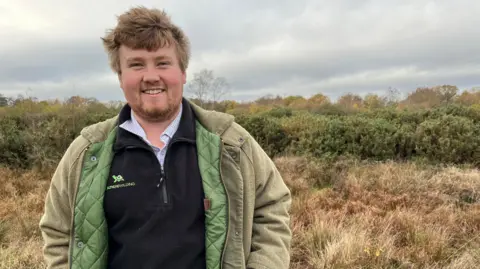
Harvey Tweats, director of Celtic Rewilding, said the West Acre site had ancient characteristics which made it ideal for amphibians.
"It's got a really rare glacial feature, called pingos," he said.
"Pingos are a relic from the end of the Ice Age when wedges of the glacier were stuck underground and then melted when the temperatures rose.
"When they melted, these mounds collapsed and then filled with water and created incredible ponds."
 Jimmy King/NWT
'Blueprint project'
Mr Tweats said the frogs disappeared from the UK largely due to human behaviour.
"We think [the reason they] are not here now is probably a mixture of land drainage but also collection for medicine," he said.
"We look back in old historic texts and people would use tree frogs to cure various different ailments.
"There's one particular recipe that comes from London which called for tree frogs to be boiled up and then smeared on a sore tooth."
The natural history of these species and their loss from Britain has been described by Mr Tweats in a Churchill Fellowship report.
The three frog species being considered for reintroduction are very different.
The brown coloured moor frog lives in heathland environments.
The agile frog has very long strong legs and can jump up to two metres (6.5 ft) - more than twice the distance of a common frog.
Mr Tweats described the third species, the European tree frog, as "everyone's favourite".
It is a bright emerald green colour and it loves to bask in the sun.
 Clare Worden/BBC
Sara King, rewilding manager at Rewilding Britain, said: "I think the project in Norfolk could be a real leading project that provides us with a blueprint of how we can not just restore tree frogs and other frog species into Britain, but also show us how we can reconnect with nature and go and explore these areas and try and find a tree frog."
But the potential reintroduction has not been welcomed by all conservation groups.
Dr Alice Pawlik, a trustee of the Amphibian and Reptile Groups of the UK, has concerns about the reintroduction of non-native species and the associated disease risks.
She said: "We can all help conserve our native amphibians through habitat creation and restoration."
Follow Norfolk news on BBC Sounds, Facebook, Instagram and X.
