NHS budget plans rely on ambitious efficiency savings, warns think tank

 Getty Images
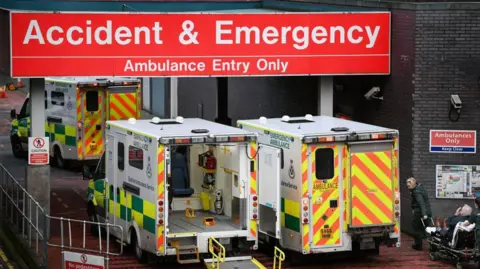
Scotland's health boards - which fund hospitals and ambulances - will have to make "big increases in efficiency" to avoid services suffering, a think tank has warned.
The Institute for Fiscal Studies (IFS) report said the Scottish government's spending plans implied a big shift of resources towards community services such as GPs and social care.
But it calculated that health boards would receive average annual increases of only 0.4% a year for the three years from 2027 onwards.
The IFS said these boards may "struggle" financially unless they could achieve ambitious efficiency savings targets of 3% annually.
Health Secretary Neil Gray said "tough choices, reform and efficiencies" were essential to ensure investment made the greatest impact.
The IFS analysis said day-to-day spending on health and social care showed "effectively no real terms growth" this financial year but would be followed by two years of 2.4% increases.
The way the money is divided up will see a big reduction in the share that goes to regional and national health boards, which will only get small real terms increases.
By contrast, remaining parts of the health and social care budget will increase by almost 12% a year, representing a "major shift" from hospitals to community.
The IFS said the government's strategy rested on health boards being able to maintain services by meeting efficiency targets.
Research economist Martin Brogaard said: "For day-to-day spending, it is banking on big improvements in hospital and ambulance service productivity."
The think tank said that, historically, the NHS had struggled to meet savings targets and there was a risk the hoped for efficiencies would be "infeasible".
Brogaard said another assumption behind the plan was that by refocusing on community-based services, ill-health could be prevented to "enable health funding to stretch further".
 Scottish government
The IFS also scrutinised the government's capital spending plans on long-term projects such as buildings, roads and ferries.
It said spending would rise by 3% in real terms this financial year but would then fall by 5% over the course of the following three years.
However, the think tank said the overall picture was "less bad than the headline figures suggest".
Much of this money is currently being spent on new prisons in Glasgow and Inverness, and once completed, spending areas outside justice will start to get a bigger share.
The IFS added that investment in housing was set to increase by 23% in real terms by 2030, and transport was also getting sustained real terms increases.
'Essential' reform
Neil Gray said the draft budget included £22.5bn for health and social care, and that long waits for treatment were coming down.
"While challenges remain, we will continue to reform, focusing on prevention, improving access and shifting the balance of care to communities," he said.
Gray added that financial pressures remained challenging, which was why greater efficiency and reform was essential.
"Tough choices, reform and efficiencies are all needed to balance the demands for public spending within our funding constraints," he said.
"We must ensure that our investments are efficient, effective and targeted to make the greatest impact."
