What's so special about the find of a Roman panther?

 The Trustees of the British Museum
The discovery of a gruesome Roman carriage fitting was one of three major treasure finds showcased at a British Museum event this week.
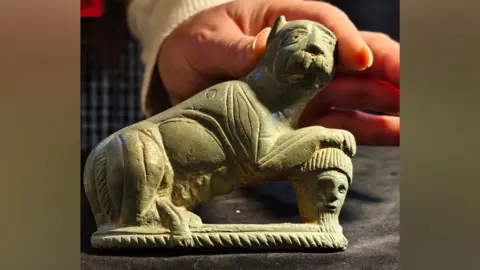
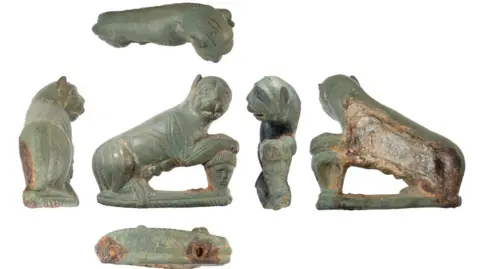
A copper-alloy ornament of a panther resting its paws on a severed head dates from AD43-200 and was found in Essex in 2024.
It was one of 79,616 finds reported that year to the Portable Antiquities Scheme, which is run by the museum.
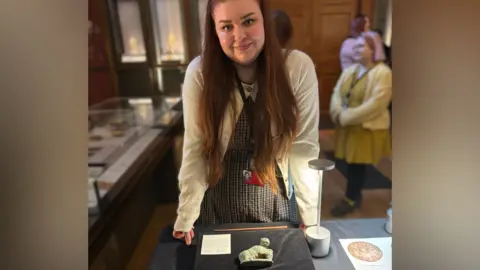
"The fittingwill quickly become one of Essex's most iconic archaeological objects," said Lori Rogerson, the county's finds liaison officer.
The BBC has been finding out why the experts think it such a special discovery.
 Colchester and Ipswich Museums
"When it was made, before it oxidised in the earth, it would have been a bright yellowy-orange," said archaeologist Dr John Pearce, from King's College London.
"You could see it gleaming and you'd know whose carriage it was coming towards you."
He suspects the fitting was one of a pair that would have decorated the "elaborate, fashionable" vehicle of a reasonably wealthy farmer or merchant - the Roman equivalent of someone who would nowadays drive a BMW or Audi, rather than a Rolls-Royce or Ferrari.
"When we think of the Romans, we often think of their straight roads as the archetypal Roman object - but what does their traffic look like?" he asked.
Effective transport, whether for farmers travelling to their villas or moving essentials like food to border garrisons, was essential for the smooth-running of the empire.
 Getty
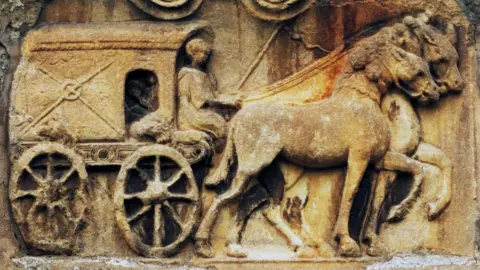
GettyRoman carriages were essentially sheds on wheels, so there is little evidence left of what they looked like, because wood decays and bronze fittings were melted down making this a "pretty rare find".
The big cat was a symbol of the party god Bacchus, an emblem of someone enjoying the good life, while the severed head, with its long straggling beard, was most likely depicting a defeated barbarian.
Pearce said images of victory were popular in Rome, but this particular design was a "striking example of a Romano-British design", fusing pre-conquest Iron Age geometric patterns with Roman imagery.
"There's nothing quite like it in Romano-Britain and that helps us to a better understanding of Roman life... how they travelled, how they lived," he added.
 British Museum Service
To comply with the Treasure Act 1996, finders - most of whom are metal detectorists - have to report their discoveries to the British Museum-managed Portable Antiquities Scheme (PAS) if they are more than 300 years old and made from precious metals.
A coroner then determines whether they are treasure, giving a museum the option of acquiring them, which Epping Forest District Museum in Waltham Abbey hopes to in this case.
The PAS values the object, and money is usually split between the finder and the landowner.
About three years ago, the government amended the act in an attempt to get more artefacts on public display.
Rogerson said: "The object was discovered the year following the amendment to the Treasure Act 1996 to include the most significant finds and it typifies why this change was so important for protecting our heritage so we can understand our origins, but more importantly, ourselves better."
Follow Essex news on BBC Sounds, Facebook, Instagram and X.