Gold rings and marble found underneath Roman city

 Colchester Archaeological Trust
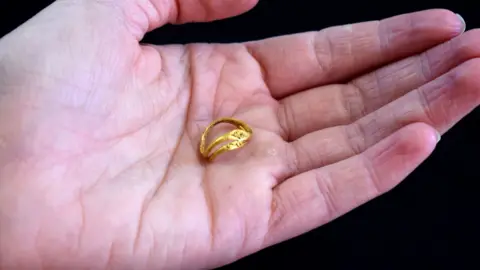
An "eye-catching" pair of conjoined Roman gold rings - as well as nearly 100 pieces of marble - have been discovered during excavation work in Britain's oldest recorded city.
Archaeologists working in Colchester also uncovered a large fragment of Roman flue tile, used in bathhouses or other high-status buildings, as well as "substantial" Roman building foundations.
The Colchester Archaeological Trust described the finds underneath St Nicholas Square as "just the tip of the iceberg".
"It's kind of like keyhole surgery - we get these small opportunities to get down deep and have a look at these early buildings," Adam Wightman from the trust said.
'Status and grandeur'
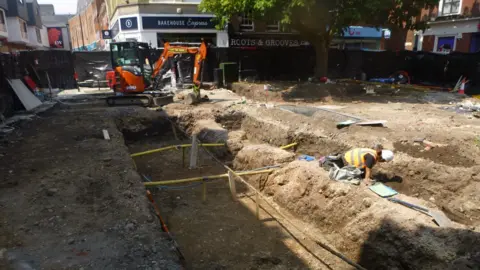
Archaeological investigations were carried out between October 2023 and June 2025, ahead of the redevelopment of St Nicholas Square.
Colchester Archaeological Trust - which carried out the work on behalf of Colchester City Council - said the area was last excavated in the mid-1950s.
Wightman told the BBC the latest excavation helped to confirm there had been "very large [Roman] substantial buildings" that would have been "multiple storeys in height".
 Colchester Archaeological Trust
The trust said the discoveries showed the "status and grandeur" of some of the buildings.
Wightman said the large fragment of flue tile unearthed had an inscribed surface with a "distinctive pattern" created using a roller stamp.
"This stamped design matches exactly examples that were recovered from the Roman bath house in Billingsgate in London," he told the BBC.
"Although it might not be a definite indicator that there was a bathhouse on site, it definitely supports the concept that these buildings were high status and had this underfloor heating that percolated up through the walls and heated the buildings.".
'Intimate find'
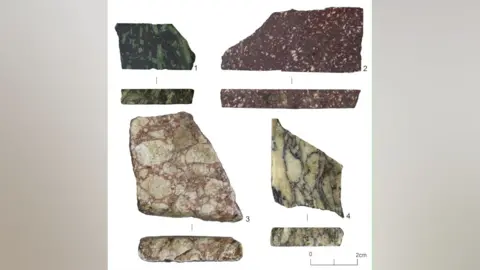
Also found were 98 pieces of marble, including some which had been imported from Greece, Egypt and Turkey.
"If we were to do a full excavation on the site, we'd come away with thousands and thousands and thousands of pieces [of marble]," Wightman said, adding that 2,000 pieces of marble were found during the dig in the 1950s.
"What we have found is really just the tip of an iceberg," he told the BBC.
"I think it's all pointing to there being quite an interesting, much larger story about the buildings of Roman Colchester that are tied into the evidence in this area."
 Colchester Archaeological Trust
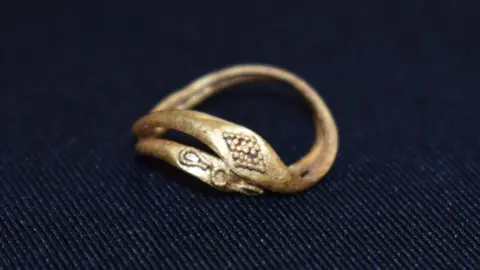
The trust said the discovery of the conjoined rings - owned by people of "considerable status" - was a rare one, reinforcing the idea that this part of Colchester was "a wealthy and important part of the city".
The rings - most likely made for a child, given their size - dated to between the 1st and 3rd centuries AD.
The trust said one was decorated with 25 tiny gold pellets arranged in a diamond-shaped pattern, with the other having a flat, elongated bezel decorated with fine strands of gold wire forming a central circle with drop-shaped motifs on either side, possibly representing a flower.
They were an "intimate find", the trust said, adding it was a reminder that Roman Colchester "was not just made up of buildings, but of people and families who lived within them".
 Colchester Archaeological Trust
Councillor Julie Young, deputy leader and portfolio holder for housing at Colchester City Council, said she was "delighted" with the finds, saying they highlighted "the city's importance across centuries and add new depth to our story as Britain's First City".
"I'd like to thank the Colchester Archaeological Trust for their meticulous work and care throughout this process," she added.
"Their expertise ensures that our heritage is respected and recorded while creating a dynamic public space for everyone to enjoy."
The council said that the newly-redeveloped St Nicholas Square was "already… a hugely popular space", having hosted a Ferris wheel over Christmas and with monthly Sunday markets to come.
Follow Essex news on BBC Sounds, Facebook, Instagram and X.
