Why do 'horrific' funeral scandals keep happening?

 BBC
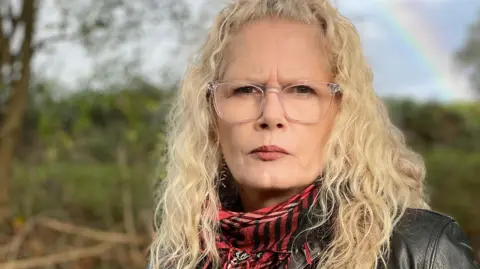
BBC"I was so shocked that you didn't have to have some sort of qualification to handle dead bodies," said embalmer Sammi Davenport when she recalled first joining the funeral industry.
Dame Caroline Dinenage MP said the actions of "a tiny minority" undermines trust in the whole sector and the lack of laws "beggars belief".
Many in the funeral industry agree new laws should be at the "top of our political agenda", while the government said it recognised the "urgency" of the issue and is "committed to taking action".
Davenport, from Oxfordshire, has worked in the funeral industry since 1996, primarily as a self-employed embalmer.
Despite not needing any qualifications, she applied directly to the British Institute of Embalmers, paid for an official course and passed the subsequent examination.
She said the vast majority of funeral directors she has worked with carried out their duties to a high standard and are "respectful to the deceased" they look after.
But she confessed to having seen "a lot of bad practice" over the years by a "handful" of individuals "who didn't care".
 PA Media
Warning: This article contains distressing content
When Davenport first qualified she remembered: "What really surprised me was that anyone in the industry could easily get access to dead bodies.
"I was left to my own devices after nine embalmings with my tutor and then sometimes I was left on the premises on my own, working into the evening, so I could have done absolutely anything."
She worries about the possibility of people taking photographs of the deceased without anyone's knowledge: "It'd be so easy to film or take photos because everyone's got a camera on them."
She recalled being shown photographs, taken in a mortuary, of two famous people after their deaths.
Davenport also cited a case in Aylesbury, Buckinghamshire, in 2012 when two children discovered a lost mobile phone and found photographs on it of an embalmer. He was smiling at the camera while holding the head of a man who had been decapitated.
She said people "need to know" what happens to their loved ones behind closed doors: "When, for example, the family might be paying to have their [deceased] mum's hair and makeup done and it's actually [being done by] Joe Bloggs from Anytown.
"He's got no qualifications, he's been taught by the bloke next to him how to stitch someone's mouth [closed], it's unbelievable and misleading.
"I've seen places where bodies are piling up and staff were getting upset and saying 'we haven't got the capacity, why are they still taking bodies in?'.
"But it's money isn't it? That's what it boils down to. I get so worked up over this whole subject."
She stressed reputable funeral directors will break prices down clearly and she knew many who go "out of their way" to make a funeral work, if families are struggling financially.
Davenport shared that her biggest frustration is "people don't know their rights" and advised the bereaved to be clear, ask questions and spell out exactly what they want.
She said many families had helped her dress their loved ones and explained "it's not for everyone, but if it's something you want to do, it can be really special and cathartic" and added if you "do it yourself" it can keep costs down.
 CPS
CPSConservative Gosport MP Dame Caroline Dinenage said she was "absolutely flabbergasted" when she realised the funeral industry was unregulated and feared recent scandals - including one in her constituency - may be the beginning of a "pattern".
She said: "It could be happening in a whole number of places.
"We know there are many businesses who do their job with enormous compassion and professional integrity, but how is the public to know who they can trust at a time of enormous vulnerability?"
She is not alone in calling for legislation to be put in place.
Fellow Conservative, North Dorset MP Simon Hoare, said many of his colleagues are "united" in believing that "doing nothing is not an option".
He said he was "appalled" to find there is a "greater requirement on a farmer moving livestock" and "absolutely nothing" about "how we deal with our dead".
What laws are currently used?
In Hull, in October 2025, Robert Bush, 47, pleaded guilty to 36 charges of fraud after a major investigation into human remains found at Legacy Independent Funeral Directors.
He pleaded not guilty to 30 counts of preventing lawful and decent burials and one one theft charge. He is due to stand trial in October 2026.
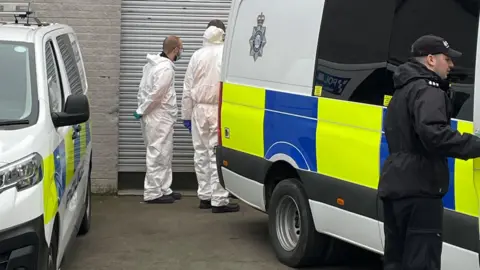
On Thursday, two funeral directors from Gosport, Hampshire, who kept 46 bodies in unrefrigerated conditions, were jailed for four years.
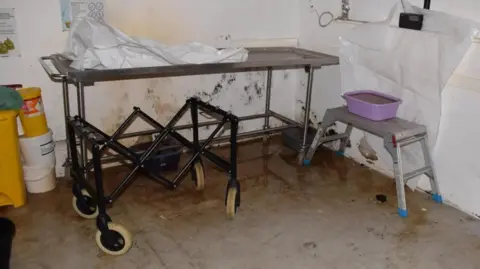
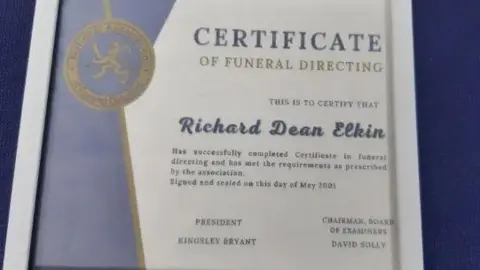
The case of Richard Elkin, 49, and Hayley Bell, 42, represents one of the worst physical‑care scandals in recent English funeral history, marked by deeply unethical treatment of the deceased.
But both the police and prosecutors had to work hard to "traverse the complexity of the available legislation" to be able to "push" for convictions.
Hampshire and Isle of Wight Constabulary Assistant Chief Constable, Tony Rowlinson, described his "shock" at "the complete lack of regulation".
He said: "Something needs to be done to stop this type of case ever coming up again."
Rowlinson praised the Crown Prosecution Service for investing early in King's counsel so they could make the "best possible case" in court.
Leading prosecution counsel, John Price KC, said while there is Health and Safety Executive "guidance" relating to handling the deceased, its focus is on keeping people safe in the workplace and it "wasn't, in fact, enforceable regulation".
He said: "What our case did include, which I know has also been used in the Hull case, is the common law offence of preventing a lawful burial."
However, neither he, nor the police, believed it captured the "breadth" of "criminal wrongdoing", so they looked at "general criminal law to identify another statute or part of the common law" which could be argued to have been breached.
They found what they were looking for, as Price explained: "We prosecuted them for an offence of statutory public nuisance which is a new law that came into force in June 2022.
"That law has, up until now, been used to deal with protest cases, where Just Stop Oil shut the M25, but the statute is not drafted in terms to make it clear that its use is confined to such matters, it's drafted in general terms."
It is thought to be the first time this law has been used to prosecute anyone other than protest‑related defendants.
Price's team had to show Elkin and Bell committed an "act that creates a risk of, or causes, serious harm to the public or a section of the public" and did so "intentionally or recklessly."
He conceded the issue "may well be tested in the Court of Appeal".
Elkin has already lodged an appeal against his conviction.
Price noted, aside from the obvious "serious distress" to bereaved families and undertaking staff who encountered severely decomposed bodies, the other harm caused was the "collateral damage caused to reputable undertakers" and the public's trust in them.
Rowlinson added that Elkin and Bell's successful prosecution should be a "shot across the bows" to anyone in the industry engaged in malpractice.
A prosecution is by no means guaranteed though, as demonstrated in Leeds when a mother was left "screaming" after finding her dead son in a baby bouncer "watching cartoons" in a funeral directors living room and another [dead] baby on the sofa.
While the owner of Florrie's Army was banned from local NHS maternity wards and mortuaries, West Yorkshire Police said it had investigated and after "extensive enquiries... no potential crimes were identified".
What do funeral directors think?
The National Association of Funeral Directors (NAFD) warned the "travesty" in Gosport exposes "a glaring truth most people don't realise - anyone can call themselves a funeral director" in England, Wales and Northern Ireland.
Its Chief Executive Officer (CEO), Andrew Judd, said "even one failure in a system without oversight is one too many," although he stressed the "vast majority" of trade association affiliated funeral directors act with professionalism and care.
He called for a "complete overhaul" of the death to funeral journey, including new laws to protect the dead and believes part of the problem lies in "our uneasy relationship with death", describing paying for a funeral as the "ultimate distress purchase" because there is only one chance to get it right.
Judd added the situation is becoming more pressing, because of a lengthening gap between death and funerals - sometimes up to six weeks - and families need to know exactly how their loved one will be cared for and their dignity upheld.
 CPS
CPSThe National Society of Allied and Independent Funeral Directors (SAIF) said it agreed "unequivocally" that new laws are needed to shut down "a small minority of rogue operators".
SAIF CEO, Terry Tennens, said he favoured "co-regulation" and industry-led inspections with "the statutory teeth needed" to prosecute bad actors.
This "proportionate" approach, he added, would "not impose crippling costs that would force small, family-run funeral directors out of business".
In partnership, SAIF and NAFD have developed a new UK Funeral Director Code which they said they hope the government will require the industry to abide by.
Both associations have codes of conduct and carry out inspections of members' premises.
The Institute of Cemetery and Crematorium Management renewed its calls for "urgent, statutory regulation of the funeral sector" to address "critical shortfalls".
What can local authorities do?
Following Humberside Police's investigation into Legacy Independent Funeral Directors, the government wrote to councils encouraging their Environmental Health teams to inspect funeral homes.
Its letter stated its concerns were "not limited to Hull and East Riding".
The Local Government Association (LGA) said councils took the responsibility "incredibly seriously".
While it acknowledged the "great majority of funeral homes are well run", the LGA said the inspections revealed a lack of "proper regulatory framework" through which councils could take action "if funeral directors fail to meet standards".
A spokesperson said: "A new regulatory scheme needs to be introduced at a national level to better ensure the security and dignity of the deceased, and for it to be fully funded.
"Consideration should also be given to transferring coronial responsibilities and their support to the Ministry of Justice, rather than leaving them at a local level."
In Gosport, environmental health officers had visited Elkin and Bell's premises a number of times after concerns were raised by families, a coroner's office and a hospital which carried out post mortem examinations.
In 2021 a report noted the officers found the mortuary "in a poor state of repair", with "no means of refrigeration" and an "overpowering" smell.
It served improvement notices and the business bought a "cooling unit", but there was evidence it was inadequate and other bodies were later found in a "pronounced state of decomposition".
A spokesperson for the Fareham and Gosport Environmental Health Partnership said: "Our thoughts are with the families affected by this deeply distressing case.
"We join them and the many other voices in urging the government to introduce proper and robust regulation for the funeral industry, where currently there's very little, to prevent this type of criminal activity from happening."
How could things change?
Many believe England, Wales and Northern Ireland should follow Scotland's lead, after it introduced the UK's first legally regulated funeral standards on 1 March 2025.
Rules around fees in the sector changed in 2020 when the Competition and Marketing Authority (CMA) ruled funeral directors and crematoriums must make prices clearer and provide upfront cost breakdowns.
A 2025 CMA review found while availability of pricing information had improved, there had been little change in how consumers "shop around" or compare costs and the industry's "quality" issues remain a concern.
 Kent Police
An independent inquiry was set up after killer and serial necrophiliac, David Fuller, was convicted in 2022 of abusing more than 100 women in two hospital mortuaries.
Hospital mortuaries are governed by NHS standards and a strict statutory licensing regime governed by the Human Tissue Authority.
However, the inquiry concluded a future repeat of such offences was "entirely possible" and the government "must introduce statutory regulations" to protect the "security and dignity" of people after death.
A government spokesperson said: "We are committed to taking action to ensure the highest standards are always met by funeral directors, and are now considering the full range of options to improve standards."
In December 2025 the government accepted 11 of the Fuller inquiry's phase two recommendations, agreed to 43 others "in principle" and is still considering 21 proposals.
Ministers have committed to publishing a full response to the recommendations in summer 2026.
How do I make sure my 'loved-one' is safe?
Advice from the funeral industry:
- Take as much care over choosing a funeral director as you would a care home
- Look for trade association logos and "quality" kitemark
- Check trade association membership on NAFD or SAIF websites
- Ask the funeral director what facilities they have
- Check they have a refrigeration system
- Ask who will have access to the deceased
- If worried, ask to view the facilities
- Be specific about your wishes
- Ask questions about cost breakdowns before committing
- If money is an issue, ask how to keep costs down
- Find out if you are eligible for financial help
- If prices are unusually low, ask yourself why?
- If you are in "any doubt at all", go somewhere else
You can follow BBC Hampshire & Isle of Wight on Facebook, X, or Instagram.
