Target 'divisive' Reform in 2026, Keir Starmer tells ministers

 PA
PAThe prime minister has drawn a series of sharp dividing lines with Nigel Farage's Reform UK, in an attempt to begin reviving Labour's and his own political fortunes in the new year.
Sir Keir Starmer told his political cabinet he wanted to make clear to voters that the choice was between his party "renewing the country" and Reform, who he accused of feeding on "grievance, decline and division".
Labour and the PM's own personal ratings have plummeted in opinion polls since the party's landslide victory in the 2024 general election.
Reform has consistently led the polls, and is hoping to make further gains in May's council elections in England, and parliamentary ones in Scotland and Wales.
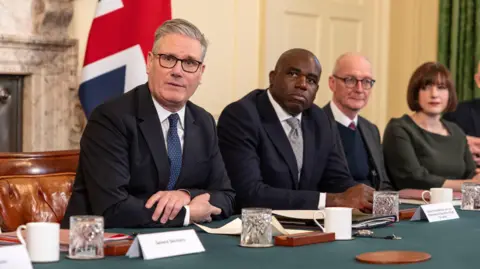
Sir Keir told a meeting of his political cabinet - which took place without civil servants, while including deputy Labour leader Lucy Powell - the government should be "relentless" in focusing on the cost of living and delivering "change people can feel".
He defined the choice as being between "a Labour government renewing the country or a Reform movement that feeds on grievance, decline and division".
"They want a weaker state, they want to inject bile into our communities, they want to appease [Russian President Vladimir] Putin. This is the fight of our political lives and one that we must relish," he said.
A Reform UK spokesman said the prime minister was continuing to show an "obsession" with the party because he knew how much of a threat it posed to his "failing government".
"Two years ago Labour promised to get the cost of living under control. Since then they have failed on nearly every count as household bills have soared, taxes have skyrocketed, and economic growth has flatlined.
"They simply cannot be trusted," the spokesman added.
Sir Keir also told ministers: "I do not underestimate the scale of the task. But I have no doubt about this team.
"Governments do not lose because polls go down. They lose when they lose belief or nerve. We will do neither."
Ahead of a difficult set of elections for Labour in May, there has been plenty of speculation about the prime minister's own future, with suggestions he will face a leadership challenge if the party fares badly in those polls.
Speaking earlier, Conservative leader Kemi Badenoch said Labour had "no plan, no agenda" and was led by a "weak prime minister who doesn't know if he is going to be in the job for much longer".
She said the country needed a government that focused on economic security. "Right now, our economy is in freefall," she added.
The political part of the meeting at Downing Street took place after an official cabinet meeting, with civil servants present, which lasted less than 10 minutes.
During the first meeting, Sir Keir told his senior ministers their main challenge for 2026 was to show "hard work, focus and determination" in helping to ease the financial burden on households.
His renewed emphasis on cost-of-living issues came as he prepared to join world leaders in Paris for a meeting of Ukraine's allies.
Sir Keir's latest reset has been overshadowed by President Trump's capture of Venezuelan leader Nicolas Maduro and the US president's continued ambitions to take over Greenland.
At the end of 2025, Sir Keir told Parliament's Liaison Committee he was frustrated at the slow pace of change.
"My experience as prime minister is of frustration that every time I go to pull a lever, there are a whole bunch of regulations, consultations and arm's length bodies that mean the action from pulling the lever to delivery is longer than I think it ought to be, which is among the reasons I want to cut down on regulation generally and within government."
At the cabinet meeting on Tuesday he said: "There's a world of uncertainty and upheaval, but tackling the cost of living remains and must remain our focus."
He added that voters would judge the government at the next election on whether they had delivered improvements to public services and the NHS.
Sir Keir argued the government's policies were already paying off, with increases in the minimum wage, the Bank of England's reductions in interest rates, and help with household energy bills.
