Macron hosts Ukraine and allies to try to cement security guarantees

 EPA
EPAFrench President Emmanuel Macron is hosting Ukraine's leader Volodymyr Zelensky and other key allies of the country as efforts intensify to agree security guarantees for Kyiv in the event of a ceasefire with Russia.
Heads of state and top officials from more than 30 countries - part of the so-called Coalition of the Willing - are meeting in Paris, including US mediators in peace talks Steve Witkoff and Jared Kushner, President Donald Trump's son-in-law.
Zelensky met Trump recently and said his plan to end the war with Russia was 90% agreed.
However, the proposals have yet to be presented to Russia, whose response so far has been far from encouraging.
The outstanding 10% of the agreement that's yet to be decided concerns territorial concessions Kyiv is being asked to agree to.
Moscow currently controls about 75% of the Donetsk region, and some 99% of the neighbouring Luhansk. The two regions form the industrial region of Donbas.
Russia launched its full-scale invasion of Ukraine in February 2022 and has been making slow progress on the ground recently and, therefore, is unwilling to compromise on its aim to seize full control of Donbas.
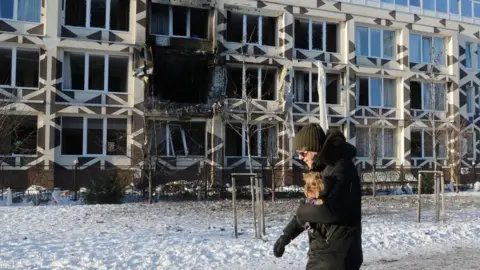
Russia has also consistently opposed any idea of a temporary ceasefire and has intensified its attacks in Ukraine, particularly aimed at paralysing its power supplies in the middle of a harsh winter.
Ukraine has also hit back with drones - the latest target being an oil depot in the Lipetsk region of western Russia.
UK Prime Minister Keir Starmer and Nato Secretary General Mark Rutte are among the participants at the Paris meeting.
Leaders are expected to seek agreement on details that include a multi-national force to reassure Ukraine after a peace deal, what security guarantees to offer Ukraine in the event of a renewed Russian attack - as well as helping Ukraine's armed forces and its economy.
For months, the so-called "backstop" has been on the agenda - the desire among Ukraine's European allies to secure a pledge from the US that it will be involved in responding to Russia should it violate the terms of a peace deal.
Following talks between Zelensky and Trump in Florida last month, the Ukrainian leader said Washington had offered security guarantees for 15 years - but a time frame for their implementation is not yet clear.
The talks in Paris are being overshadowed by the aftermath of the US's military action in Venezuela, where elite troops went in to seize the country's President Nicolás Maduro and take him to face drugs and weapons charges in New York.
Following the raid, Trump said the US would "run" Venezuela for an unspecified period of time.
He also said the US was returning to last century's policy of US supremacy in its sphere of influence in the Western hemisphere.
Looming larger over the Paris talks is Trump's subsequent insistence that the US wants to annex Greenland - the semi-autonomous territory that is part of Denmark, a Nato ally.
The repeated threat prompted Danish Prime Minister Mette Frederiksen to sayany such move from the USwould be the end of the trans-Atlantic alliance.
European leaders have been reluctant to criticise Trump's intervention in Venezuela and its perceived implications for the world order.
But many, including Starmer and Macron, have sided with Denmark over Greenland.
As host of the talks, Macron will be keen not to have the issue derail the focus on Ukraine.
