US captures Maduro after strikes on Venezuelan capital Caracas

 AFP via Getty Images
Venezuela's President Nicolas Maduro and his wife has been captured by the US in "large-scale" strikes on the South American nation, Donald Trump has said.
Maduro and Cilia Flores were flown out of the country by US forces. The pair will be charged with with drug and weapons offences in New York, US officials say.
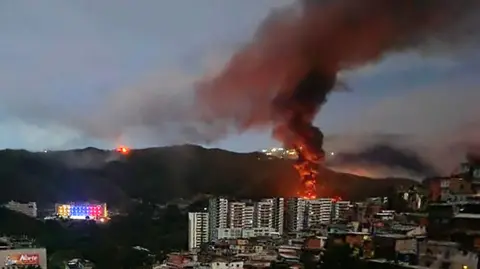
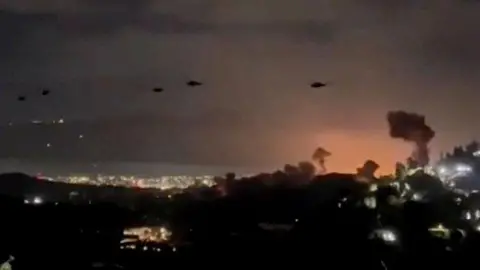
Details of the unprecedented strikes remain sparse, but video from the country's capital Caracas shows helicopters flying overhead after explosions rocked the city.
Trump accused Maduro of being a "narco-terrorist" and illegitimate leader, while Venezuela has accused the US president of using the "war on drugs" as an excuse to try to depose him and take control of its vast oil reserves.
The taking of Maduro is the culmination of an escalating pressure campaign against his government by the Trump administration that has included targeted suspected drug-smuggling boats and placing a large naval force in the region.
The US army's elite Delta Force carried out the operation to capture Maduro and his wife, officials told the BBC's US partner CBS News.
Trump told Fox News television that there were "a few injuries but no deaths on our side" during the strikes.
Describing the when they captured Maduro, he said the Venezuelan president was "in a house that was more like a fortress" with "solid steel all around".
He said the pair were being taken to New York by ship.
"They killed a lot of people and a lot of American people, even people in their own country," Trump added.
After the raid, the Venezuelan government declared a national emergency and demanded proof Maduro and Flores were alive.
Venezuelan defence minister, Vladimir Padrino, has said the armed forces would defend the country's sovereignty.
However, US Secretary of State Marco Rubio anticipates no further action against Venezuela, according to Republican Senator Mike Lee.
BBC Verify has identifiedsites hit in the strikes early on Saturday morning, including La Carlota military airfield in the centre of the capital and the main military base of Fuerte Tiuna.
 Reuters
Journalist Vanessa Silva, who lives in Caracas, told the BBC that she heard a huge explosion "stronger than thunder", causing her home to vibrate.
"My heart was pumping and legs were shaking," she said.
The Venezuelan government said the states of Miranda, Aragua and La Guaira were also hit, and that the strikes aimed to seize Venezuela's oil and minerals.
It said in astatement that it "rejects, repudiates and denounces before the international community the extremely serious military aggression perpetrated by the current Government of the United States of America".
Cuba and Colombia have also denounced the attacks.
Trump has repeatedly raised the prospect of ground strikes in Venezuela following months of targeting vessels in international waters the US suspects were being used for drug trafficking.
But Saturday's operation is unlike anything seen before. When US forces captured Panamanian leader Manuel Noriega exactly 35 years ago, it was following a short war between the two nations.
The US president blames Maduro for an influx of migrants and drugs into in the US, his administration accusing the Venezuelan leader of being the head of a drug cartel - something Maduro denies.
US Senator Mike Lee said he had spoken to Rubio, who he said had told him that the strikes were to "protect and defend those executing the arrest warrant" against Maduro, and that the action "likely falls within the president's inherent authority" under the US constitution.
Attorney General Pam Bondi said Maduro would "face the full wrath of American justice on American soil in American courts".
While the Trump administration has said its military actions were motivated by combatting drug trafficking and illegal migration, Maduro has said they were an attempt to seek regime change and gain access to the world's largest proven crude oil reserves.
He has pointed to the seizure of several oil tankers the US said were transporting sanctioned oil, which Trump has suggested the US may keep.
On Monday, Trump said the US had carried out a strike on a "dock area" linked to alleged Venezuelan drug boats, causing a "major explosion".
It followed more than 30 strikes on vessels the US says were being used for drug trafficking in the Caribbean and the Pacific, killing more than 110 people.
The Trump administration argues that it is involved in a non-international armed conflict with the alleged drug traffickers, but legal experts say the strikes are not against "lawful military targets".
The US has deployed 15,000 troops and a range of aircraft carriers, destroyers and assault ships to the region.
It is a sign of the Trump administration growing increasingly muscular in the region - supporting right-wing governments and punishing left-leaning ones.
Maduro rose to prominence under the leadership of left-wing President Hugo Chávez and his United Socialist Party of Venezuela.
A former bus driver and union leader, Maduro succeeded Chávez and has been president since 2013.The results of last year's presidential election were widely dismissed on the international stage.
