Summary

  • This live coverage has finished - follow this link for the latest updates

  • US Secretary of State Marco Rubio says America is not at war with Venezuela, a day after US strikes on the country

  • Venezuelan President Nicolás Maduro and his wife Cilia Flores, who were captured by the US, are set to appear in court on Monday, according to a spokesperson

  • Venezuela's Defence Minister Vladimir Padrino says a large part of Maduro's security team and "innocent civilians" were killed in the US operation

  • Venezuela has denounced the "military aggression", and the army says it backs interim President Delcy Rodríguez

  • This is important because it is a confirmation that - despite Donald Trump saying the US will now run the country - Maduro's allies are still in charge, writes our South America correspondent

  • Donald Trump tells The Atlantic that Rodríguez will "pay a big price" if she "does not do what is right". The president also told reporters aboard Air Force One that Venezuela was "our area" invoking the Monroe Doctrine

  • Venezuelans have been sharing their worries about the uncertainty and prospects for a peaceful transition of power with the BBC

  1. Venezuela: What we learned todaypublished at 02:00 GMT 5 January

    Here's a recap of what happened in the last 24 hours, one day after the US ordered a military attack in Venezuela and captured President Nicolas Maduro and his wife, taking them to New York to face drug and weapons charges.

    • Early Sunday morning, we saw the first images and videos of the destruction in Venezuela from the US attacks. It still remains unclear exactly how many people may have been injured or killed
    • Secretary of State Marco Rubio spoke to multiple media outlets this morning and was asked if the US is running Venezuela, responding that the US is "running the direction" that makes things move forward
    • He was also asked if he thinks Interim President Delcy Rodríguez is now the legitimate president of Venezuela, and avoided a direct response by saying "this is not about the legitimate president" as the US does not believe the regime in place is legitimate
    • In a different interview, the secretary of state was asked why the US didn't arrest other members of Maduro's regime: "It's very simple," Rubio replies. "You're not going to go in and wrap up", affirming that they "got the top priority"
    • Venezuelan Defence Minister Vladimir Padrino said on national television that the army gave its backing to Vice President Delcy Rodríguez to act as interim president
    • Meanwhile, Maduro and his wife Cilia Flores are due to appear in federal Manhattan court on Monday, a court spokesperson said on Sunday. They are currently detained in Brooklyn's Metropolitan Detention Center
    • Trump spoke with reporters on his way home late Sunday night from Florida and said Rodriguez is now going to lead the country, but if she does not listen to US guidance, she will face a fate similar to Maduro's

    We are pausing our live coverage now. You can read more about what's happened today here: Trump warns new Venezuelan leader as Maduro set to appear in court
  2. Cuban nationals killed in Maduro raidpublished at 01:47 GMT 5 January

    Two days of mourning have been declared in Cuba, after the government confirmed that 32 Cuban nationals had been killed during the US military operation in Venezuela.

    Trump had referenced Cuban deaths as a result of the operation in an interview on Sunday, telling the New York Post that "many Cubans lost their lives".

    He added: "They were protecting Maduro. That was not a good move."

  3. Trump says Colombia's leader won't be in charge for longpublished at 01:42 GMT 5 January

    While speaking to reporters, Trump was asked about the status of Colombia, Venezuela's neighbour.

    "Colombia is very sick too, run by a sick man who likes making cocaine and selling it to the US," he says, referring to Colombia's president Gustavo Petro.

    "He's not going to be doing it very long," he added. Pressed as to whether there might be a US operation in Colombia against "cocaine mills", the president said "sounds good to me".

    Trump has not been a fan of Petro, who was sanctioned by the US president in the autumn after Trump said the leader failed to curb drug trafficking and allowed cartels to "flourish".

    Colombia has become a refuge to Venezuelans fleeing Maduro's rule in recent years.

  4. Trump: Operation Absolute Resolve was about 'peace on earth'published at 01:36 GMT 5 January

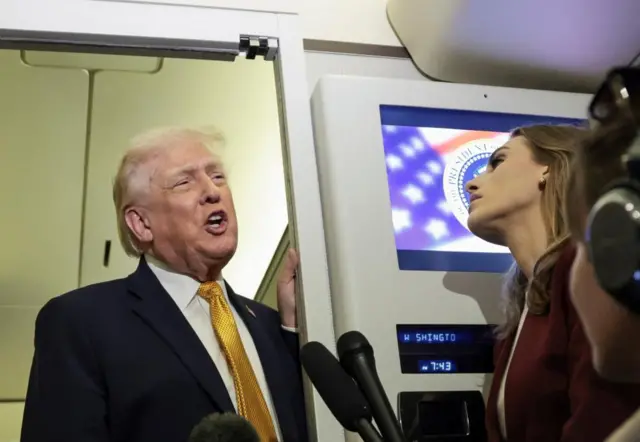
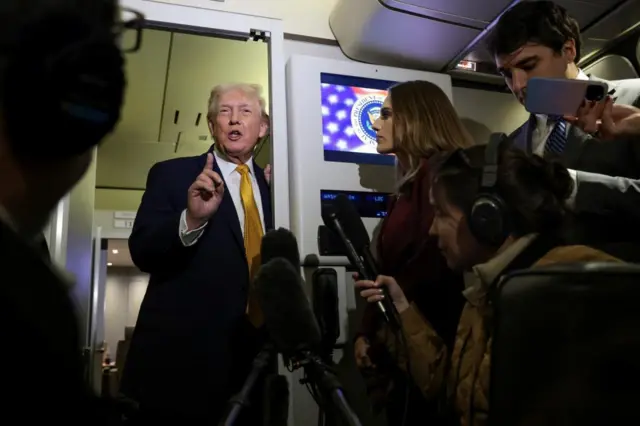
    Donald Trump speaks with journalists on Air Force OneImage source, Reuters

    Still speaking from Air Force One, a reporter has asked the president what the operation in Venezuela was actually about: oil or regime change?

    In response, Trump says it is about "peace on earth".

    "The Monroe Doctrine was very important when it was done, and other presidents, a lot of them, they lost sight of it," he says.

    "I didn't, I didn't lose sight."

    As a reminder, the Monroe Doctrine was an early 19th Century American foreign policy that asserted the Western Hemisphere should be free from influence by European powers.

    President Theodore Roosevelt later expanded the doctrine, allowing the US to step in if the countries could not manage their own stability.

  5. Trump critic Bolton thinks capturing Maduro was the right thing to dopublished at 01:30 GMT 5 January

    Daniel Bush
    US reporter

    John Bolton, who was Trump’s national security adviser in his first term before becoming a prominent critic of the president, tells the BBC that overthrowing Maduro was the right thing to do.

    "It's what we tried to do in 2018 and 2019 unsuccessfully. [Now], we've extracted Maduro, but we haven't overturned the regime.”

    Bolton says he thinks it’s highly unlikely that Delcy Rodriguez, the newly sworn-in acting president in Caracas, will “bend the knee to the United States”. But he acknowledges that the massive US military presence off Venezuela gives Trump leverage.

    "The rational thing to do here is bring down what's left of the Maduro regime and put the opposition in power pending free and fair elections. They have people capable of running an interim administration while elections are set up."

    President Trump ruled that out at his Mar-a-Lago press conference, saying Nobel winner Maria Corino Machado didn’t have the “support or respect” to lead the country.

    Bolton says when he was working in the White House, a lot of planning was done on the “day after” scenario for Venezuela’s economy. According to Bolton, the planning at the time was to reintegrate Venezuela into the global economy, in part by unfreezing Venezuelan assets in the US and having EU countries do the same.

    He thinks there’s one key thing to watch out for in the coming days. “The big question is what will Russia, Cuba, China and Iran do to prop up the regime."

  6. More from Trump on Air Force Onepublished at 01:22 GMT 5 January

    We're still listening to Trump, who is currently flying from Florida to Washington, DC.

    A reporter asks Trump whether the interim president of Venezuela Delcy Rodriguez is now going to lead the country

    He says his people are in contact with her, but if she does not listen to US guidance, she will face a fate similar to Maduro's.

    The president is later asked about threats being made against Cuba and whether or not the US plans to make a similar move in that Caribbean nation, and he says the country will fall on its own.

    Lindsey Graham, a US senator and ally of the president, also on the flight, backed the president's actions and said no other military would have been able to capture Maduro alive.

    "You just wait for Cuba," he said. "Cuba is a communist dictatorship that's killed priests and nuns. They preyed on their own people. Their days are numbered."

  7. Delcy Rodríguez to be sworn in as president of Venezuelapublished at 01:16 GMT 5 January

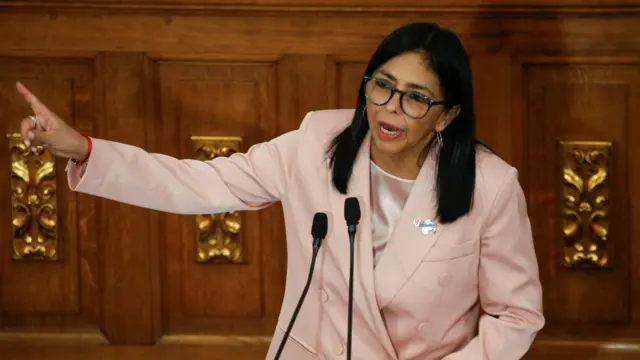
    Venezuela's Vice President Delcy Rodriguez presents the government's 2026 budget proposal to the National Assembly in December 2025.Image source, Reuters

    The former vice president of Venezuela, Delcy Rodríguez, will be sworn in as president tomorrow in Caracas, at 08:00 local time (12:00 GMT).

    Rodríguez has been acting as interim president of Venezuela since Saturday, when Nicolas Maduro and his wife were captured by US military personnel.

    Following his removal from the country, Rodríguez denounced Maduro's detention as a kidnapping and stressed that Venezuela would not become a colony of the US.

    The former vice president was also the minister for oil in Venezuela, which is home to the world's largest proven oil reserves.

    She's already secured the support all judicial and political institutions within the South American nation, as well as the Venezuelan army.

    Speaking to US news outlet The Atlantic earlier today, US President Donald Trump has already threatened action against Rodríguez.

    "If she doesn’t do what’s right, she is going to pay a very big price, probably bigger than Maduro," he told the magazine.

  8. Trump calls Venezuela 'our area'published at 00:57 GMT 5 January

    Donald Trump speaks with a female journalist aboard Air Force OneImage source, Reuters

    Trump is on Air Force One, flying back from his golf course, Mar-a-Lago to Washington and taking questions from reporters

    He was asked about his past statements against regime change and nation building, and said, "It's in our area, the Don-roe doctrine.

    "We're in the business of having countries around us that are viable and successful and where the oil is allowed to freely come out."

    The president says the US has to "bring" Venezuela "back" and described the country as "dead".

    "And we would have to have big investments by the oil companies to bring back the infrastructure," he says.

    He later says the US will not invest "anything" and the US will "take care of the country" and "the people, including Venezuelans, and living in our country that were forced to leave their country".

  9. Trump is speaking on Air Force Onepublished at 00:55 GMT 5 January

    President Donald Trump is speaking on Air Force One as he returns to the White House from his Mar-a-Lago home in Palm Beach, Florida.

    Stick with us and we'll let you know what he has to say.

  10. Stocks and gold rise while oil dipspublished at 00:40 GMT 5 January

    Osmond Chia
    Business reporter

    Asia stocks opened higher on Monday during the first trading window since President Donald Trump vowed to revive Venezuela's crude output after seizing President Nicolás Maduro.

    In early trade, South Korea's Kospi was up by more than 2.4%, while Japan's Nikkei gained by more than 2%.

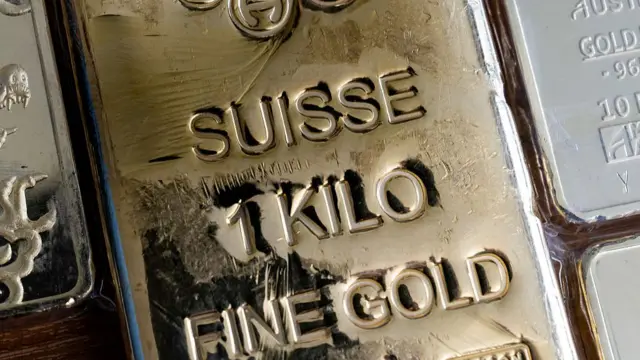
    Precious metals gold and silver, which are often seen by investors as "safe haven" investments in times of uncertainty, also gained by more than 1.4%.

    Oil prices, meanwhile, are down slightly following the US military operation in Caracas.

    Though Trump has said he would tap Venezuela's oil reserves - the world's largest - doing so will take "tens of billions of dollars" and at least a decade of major investment from Western oil giants, said analyst Peter McNally from research firm Third Bridge.

    He said it is unlikely that the weekend's events will immediately impact oil prices that drivers see at the pump.

    "There are no quick fixes in Venezuela as the country lacks a lot of necessary infrastructure - not just for the oil industry, but for all industries."

    A close up image of a 1kg bar of goldImage source, Getty Images
  11. Venezuelan opposition leader speaks outpublished at 00:28 GMT 5 January

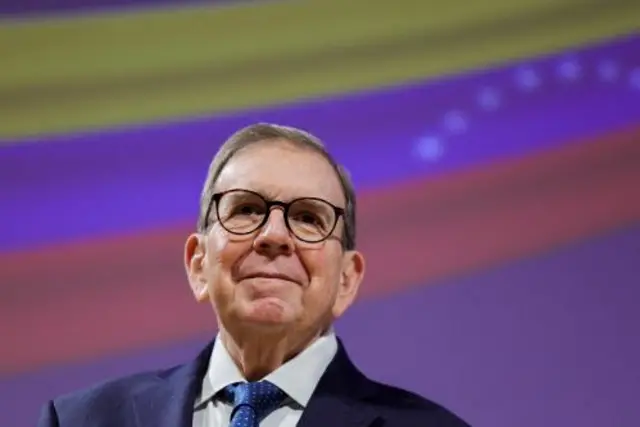
    Edmundo Gonzalez against a backdrop of a Venezuelan flagImage source, Reuters
    Image caption,

    Venezuela's opposition leader Edmundo Gonzalez

    Opposition politician Edmundo González called for Venezuela's military to bring him to power in the wake of the US military attack in the South American country over the weekend.

    "The events of the last few days have marked an inflection point in the recent history of Venezuela," he said. "This moment marks an important step, but it is not enough."

    The remarks, which came in a video posted on González's social media, are the first from the man many consider the real winner of the 2024 presidential election in Venezuela.

    "Today, the one who usurped power is no longer in power and is facing justice," he said. "This fact creates a new political scenario, but does not substitute the fundamental work we have ahead."

    He said the military should uphold the mandate given during the July 2024 election.

    González also reminded Venezuelans that their loyalty is to the constitution and the republic.

    "Venezuela needs truth, justice and reconciliation, without impunity," he said.

  12. Trump officials to brief some lawmakers on Mondaypublished at 00:18 GMT 5 January

    Secretary of State Marco Rubio, Defence Secretary Pete Hegseth, Attorney General Pam Bondi, CIA Director John Ratcliffe and General Dan Caine, the nation's highest-ranking military officer, will reportedly brief some US lawmakers on Venezuela on Monday, according to US media.

    Certain House and Senate committees will receive those briefings when Congress returns to Washington following its holiday break.

    The rest of Congress is expected to receive its briefing sometime next week.

  13. Maduro has the same legal protections as any other defendant, but his participation is another matterpublished at 00:09 GMT 5 January

    Sean Dilley
    North America Correspondent, in Washington

    Nicolás Maduro's arraignment has been scheduled for midday on Monday in Manhattan.

    Attendance in person is generally required in New York.

    On paper, it will be a routine appearance that effectively kicks off a case in a criminal court here in the US.

    A judge will read the charges against Nicolás Maduro out loud, and we expect he’ll be held in federal custody while the case continues.

    His appearance may look like any other on the face of it, at least, but the security operation to deliver him around nine miles from the Metropolitan Detention Center will be significant.

    As the case continues, like any defendant in a criminal trial, Maduro will be entitled to all of the protections you’d expect, including the right to silence and the right to choose whether he wishes to testify at any future trial.

    What we don’t yet know is how willing Maduro and his wife will be to participate in proceedings.

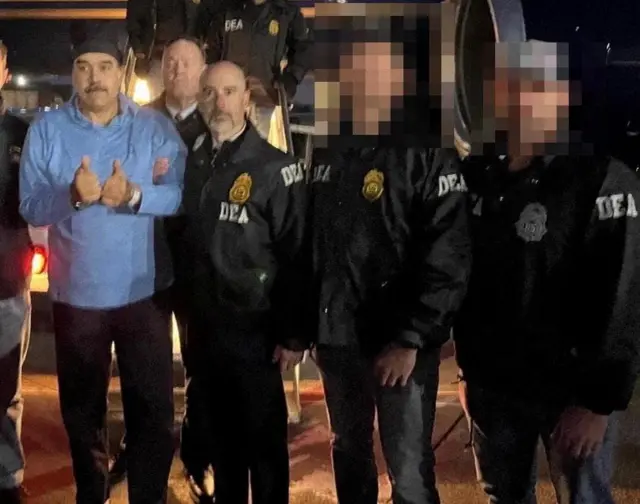
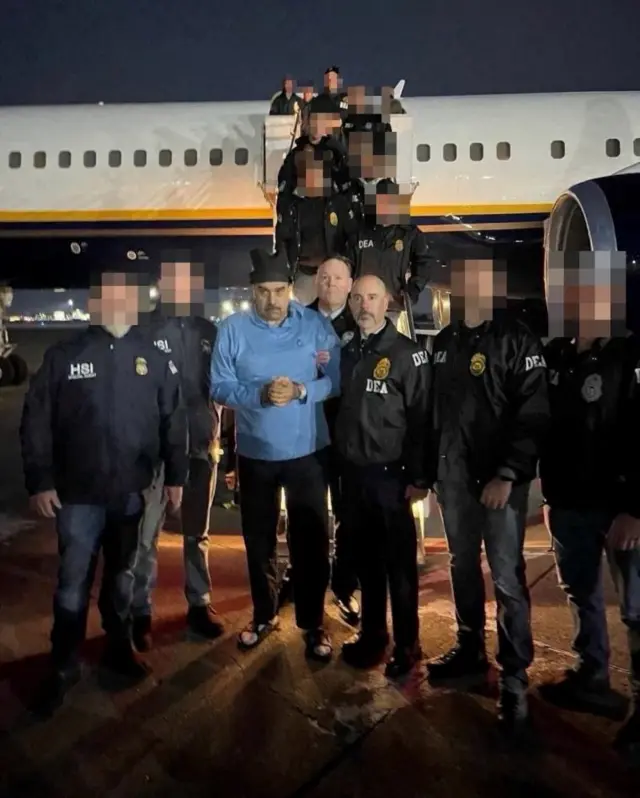
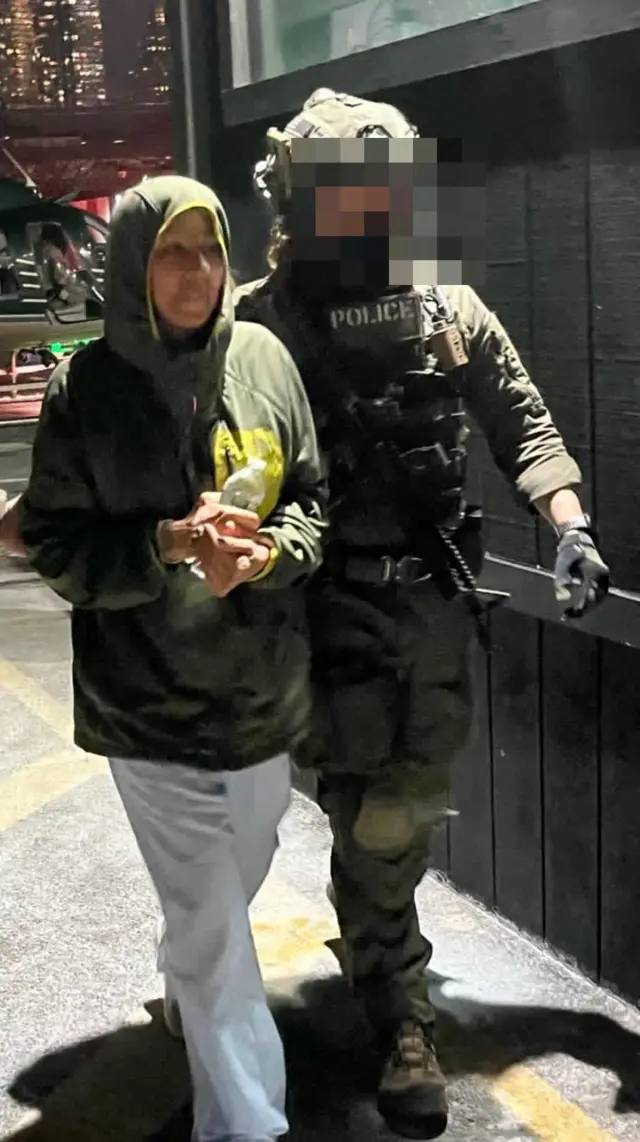
  14. New images of Maduro on US soil releasedpublished at 23:56 GMT 4 January

    We're seeing new images via Reuters of Nicolas Maduro and his wife, Cilia Flores, after they landed in New York on Saturday evening.

    The couple was flown to Stewart Air Force Base in New York and then taken by helicopter into Manhattan to the Drug Enforcement Agency's office. They were then transferred to the Metropolitan Detention Center in Brooklyn, also by helicopter and then by police convoy.

    They will appear in federal court on Monday at 12:00 ET (17:00 GMT).

    Maduro alongisde DEA officialsImage source, Reuters
    Maduro alongside DEA officialsImage source, Reuters
    Cilia Flores with a police escortImage source, Reuters
  15. Former CIA deputy director warns 'not clear' what the plan is going forwardpublished at 23:36 GMT 4 January

    Daniel Bush
    US reporter

    John McLaughlin, who was deputy director of the CIA between 2000 and 2004, says the US operation in Venezuela highlights the close collaboration between intelligence agencies and the military.

    “Public reporting suggests that somehow intelligence officers were able to be clandestinely present without detection and provide the kind of info needed for special ops forces to do their work,” he tells the BBC. “This is something we have practised for years. It was not well developed before 9/11 but in the post 9/11 period the partnership between civilian intelligence and military ops became very tight."

    But McLaughlin, who was acting director of the agency in 2004, warned that it’s very hard to predict what will happen next.

    "Generally, as a rule in military and clandestine operations, if you inflict violence you don’t really know where it’s going after that - even if you have a plan, an analysis, and assumptions.

    "In this case one of the big question marks is, where does Rodriguez, the acting president, really stand?”

    And McClaughlin says the most important thing after any operation is to know your plan for day after. “In this case it’s not clear."

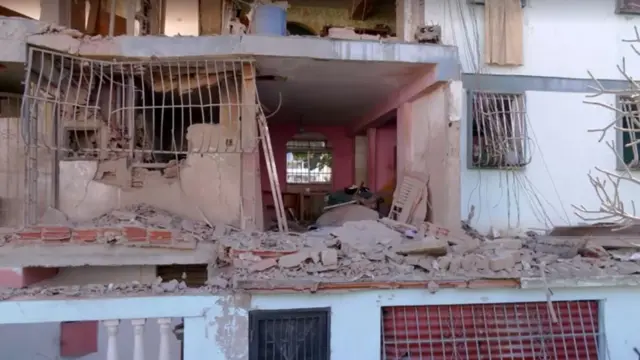
  16. Venezuelans face damaged homes after US attackspublished at 23:19 GMT 4 January

    Damaged buildingImage source, Reuters

    It’s still not clear exactly how many people were injured or killed when the US carried out its military operation in Venezuela in the early hours of Saturday.

    But the aftermath is obvious to residents one day later.

    Homes in the town of Catia La Mar, near Caracas - Venezuela’s capital - are damaged and destroyed, according to Reuters news agency.

    Jonatan Mallora, a motorcycle taxi driver, and his neighbour Angel Alvarez, a street vendor, tell Reuters they woke up on Saturday when explosions began in their community.

    “It’s sheer luck they didn’t kill my kids,” Mallora says. He and his two adult children escaped unharmed.

    Meanwhile, Alvarez tells Reuters he wasn’t sure what to do when he heard the deafening noise of the explosions.

    “We’re alive by a miracle,” he says.

    Media caption,

    Venezuelans left displaced after homes destroyed in US attack

  17. Colombian guerrilla group vows to resist Washington's 'imperial plans'published at 23:02 GMT 4 January

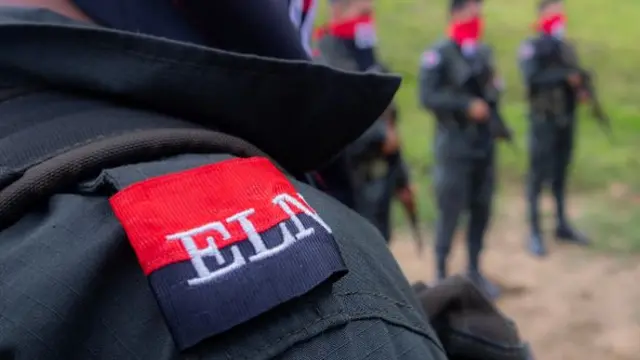
    A close up of someone's shoulder, they're wearing a canvas coat with a patch sewn on showing the ELN logo.Image source, AFP via Getty Images

    Among the complex landscape of groups holding power in Venezuela is the National Liberation Army (Ejército de Liberación Nacional, ELN) - a Colombian guerrilla group.

    The armed group runs cocaine trafficking routes along Colombia's border with Venezuela. It has traditionally enjoyed protection from the Maduro government.

    The group - which is designated a terrorist organisation by the United States and European Union - has posted a new statement on Telegram, vowing to resist Washington's "imperial plans".

    ELN "salute" calls from the Venezuelan government to resist the "brutal military intervention", the group says.

  18. Son of Maduro urges people to take to the streets - CBSpublished at 22:31 GMT 4 January

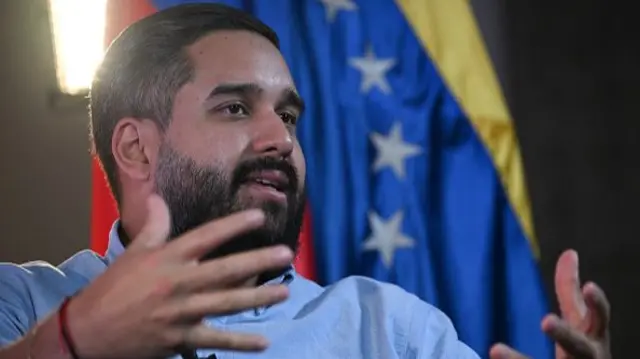
    Maduro Guerra sits in front of a Venezuelan flagImage source, AFP via Getty Images

    As we've just mentioned, Nicolás Maduro and his wife will appear in court on Monday.

    Nicolás Maduro's son, Nicolás Maduro Guerra, is also charged with drug trafficking. The court indictment filed by the US government refers to him as "the prince".

    He was not captured by the US, and has commented on his father's capture in a video on social media seen by our US partner, CBS News.

    "You will see us on the streets" of Venezuela, says Nicolás Maduro Guerra in the video.

    "History will tell who the traitors were," he also says.

  19. Maduro's court appearance on Monday expected to be proceduralpublished at 22:16 GMT 4 January

    As we've been reporting, Maduro and his wife are expected to make their first appearance in federal court on Monday.

    The appearance will mainly be procedural and marks the start of what could be a legal battle lasting years.

    The proceeding is set to begin at 12:00 EST (17:00 GMT) in the US District Court in Manhattan.

    The pair will appear before US District Judge Alvin K Hellerstein, a Clinton appointee.

    Maduro has been indicted as part of a criminal drug-trafficking case the US federal government has been pursuing for 15 years, with Maduro named as a defendant for six of those.

    Hellerstein has overseen the case for more than a decade and has handled other high-profile cases.

  20. Analysis

    We're seeing the 'gunboat diplomacy' of the previous centurypublished at 22:01 GMT 4 January

    Joe Inwood
    World news correspondent

    Generally, client governments are established with at least the illusion of independence, no matter how implausible.

    We don't normally see the leader of the dominant power holding a news conference to declare they now run the country. But that's exactly what happened yesterday, as Donald Trump addressed the cameras.

    True, it's too soon to say for certain that a client Venezuelan government is the eventual US endgame - or that Caracas would comply.

    But given a full-scale military invasion looking unlikely, control from afar seems the most obvious way for Trump to make good on his controversial - and as yet unfulfilled - claim to run Venezuela.

    Historically, the US approach was to secretly back - and then later recognise as legitimate - right wing groups, especially in Latin America, couching their involvement in terms like “liberation from Communism”.

    The first example was Guatemala’s President Arbenz, who was labelled a communist - and eventually overthrown in 1954 by right-wing rebels backed by the CIA.

    It was the first of several similar incidents, leading to the long-term suspicion of US interference.

    Returning to the present day, far from being an ideological ally, Delcy Rodriguez was deputy to the socialist president just removed by Washington.

    She's publicly rejected any attempts at what she called “American imperialism”.

    But the preferred method of attempted control here is not patronage, but the threat of going the same way as her predecessor. The vast US naval presence remains in the Caribbean - and President Trump has said a "second and much larger attack” remains an option.

    In that sense, what we're seeing here isn't a return to the coups of the Cold War, but the "Gunboat Diplomacy" of the previous century.

    It's a sign of a rapidly changing world, that 19th century realpolitik is now being espoused on prime-time television.