Starmer seeks to carve out distinct UK approach to this conflict

 PA Media
"Engaging in armed conflict in breach of international law is a precarious business."
So wrote Keir Starmer QC, as he then was, in The Guardian in March 2003 as Britain was on the cusp of joining the Iraq War.
Almost a quarter of a century on, Sir Keir Starmer KC faces his own dilemma about how to approach American military action in the Middle East.
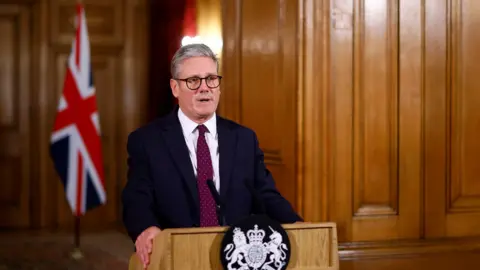
In the speech recorded and released by Downing Street on Sunday night, it was notable that even Sir Keir - who campaigned against British involvement in Iraq and was years away from becoming an MP, let alone prime minister - felt the need to stress: "We all remember the mistakes of Iraq. And we have learned those lessons."
It was notable, too, that Sir Keir emphasised the national interest - closing his speech by invoking Britain three times in one sentence: "This is the British government, protecting British interests and British lives."
That may sound obvious. But this was the prime minister seeking to carve out the British approach to this conflict from the broader aspirations for regime change claimed by the US and Israel.
To some extent, he had already done that by not participating in or assisting the original wave of strikes - even though government ministers have resisted articulating what many see as the logical corollary of that position, which is that the strikes were wrong and potentially unlawful.
It was especially important for Sir Keir to make clear in his statement what is guiding his actions because he was announcing a new position. The prime minister said that the UK would still not join "offensive action" against Iran.
But he said that because of the "scorched earth strategy" with which Iran had responded to the US and Israel, the UK would now permit the US to use joint UK-US bases to strike Iran.
The specific and limited purpose for which these strikes can be used, the UK government says, is to degrade Iran's capacity to launch missile and drone attacks across the region, including in Gulf countries where there are many British citizens.
This is different, those in government argue, from the previous US request, which Sir Keir resisted, to use British bases for broader strikes on Iran.
That distinction has come under strain in the House of Commons from all sides.
From one side, the government has been criticised for allowing the US to use British bases to strike Iran at all. There are MPs who fear that having allowed some strikes, it is inevitable that the UK will only become further enmeshed in this war.
On the other side, there are those who question why the government is not doing more to support strikes which could topple a regime in Iran which has menaced the region and threatened British citizens here in the UK too.
As it stands, the first group of positions are represented in the Commons by the Greens and the Liberal Democrats, and the second by the Conservatives and Reform UK.
When it comes to the offensive strikes, the prime minister has sided with the critics of the US president, telling MPs: "This government does not believe in regime change from the skies."
The problem for Sir Keir is that the full spectrum of positions is represented among Labour MPs too. Partly that is the inevitable reality of having such a large parliamentary party. But it also reflects a party that is divided on foreign policy and has only grown more so since 7 October 2023.
As a result, this is delicate terrain for the prime minister, especially days after the Gorton and Denton by-election where the Green victory demonstrated, at least in part, that foreign policy and specifically foreign policy towards the Middle East can affect British politics.
Add onto that that the general assumption since Iraq has been that British involvement in military action in the Middle East is unpopular.
The politics of Britain's international alliances is delicate here too. The prime minister is moving in concert here with the other leaders of the E3 - the Christian Democrat chancellor of Germany, Friedrich Merz, and the centrist president of France, Emmanuel Macron.
But his two closest global political lodestars are Anthony Albanese and Mark Carney, the centre-left prime ministers of Australia and Canada respectively. A month ago it was hard to move for Labour MPs hailing the speech Carney gave in Davos about the "rupture in the world order" and urging Sir Keir to adopt a similar mindset.
But Sir Keir has taken the opportunity in the Commons to reiterate his belief in the importance of international law.
It is striking that Carney and Albanese have both backed the US action in Iran.
Even in the case of Merz, there appear to be important differences with Sir Keir. The German chancellor said yesterday that "international law classifications will have little effect" on what happens now.
All this is complicated enough for Sir Keir before even getting onto the consular issue of how the government helps the more than 300,000 British citizens currently in the Gulf.
Those involved in the work are eager to downplay the sense that organising a government evacuation is inevitable, but acknowledge that if this war continues for much longer then there will be a clamour for government assistance.
And then there are the impacts a prolonged war would have on fuel prices, on inflation here in the UK, and on the debate about whether the UK is increasing the amount it spends on defence by enough and at a fast enough pace.
There are almost no conundrums faced by Sir Keir and his government that this war does not make even harder.

Sign up for our Politics Essential newsletter to keep up with the inner workings of Westminster and beyond.
