The saga of a £165m rail line that keeps causing travel chaos

 Steve Briers
Train departure boards were littered with cancellations when Storm Ingrid battered the South West of England last month - and for many, it all felt quite familiar.
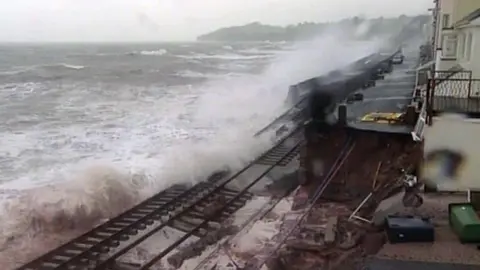
It certainly felt familiar to those who use the section of railway around the coastal town of Dawlish in Devon, where the only line connecting Plymouth and Cornwall with the rest of the UK was left hanging "like a Peruvian rope bridge" during ferocious storms in February 2014.
For some, that description by Plymouth City Council leader Tudor Evans and the images of the collapse 12 years ago came to embody Britain's crumbling Victorian railways.
Cornwall and most of Devon were cut off from the rest of the railway network for eight weeks, causing travel chaos.
Since then, £165m of public money has been spent to try to prevent it happening again. So why, in January 2026, was the same line closed once more, bringing train cancellations for thousands of people during Storm Ingrid?
It raises a question: is something more fundamental going wrong that could plague people across the UK travelling here for work, to see family or for holidays, for years to come?
Anger down the line
Roads to this region are increasingly choked, and flights are few and far between. So many choose to travel by rail - and this section of line in Dawlish, just along from the Jurassic Coast, holds the key to trains arriving on time, or at all.
The frustration about that not always being the case is clear among commuters at Plymouth rail station.
"A lot of people like myself rely on these trains, and to be honest we feel let down," says Jess, from Totnes.
Commuter Sienna Brewer says "it's affecting everyone with work and university as well as college - people are having longer days out the house because of delays".
"It sometimes gives you the feeling of being cut off from the rest of the country," she adds.
This beautiful but fragile line - which opened in 1846 and runs alongside the sea - remains at the centre of a furious debate about whether it can really withstand the elements.
It is a saga that stretches back more than a decade.
 Getty Images
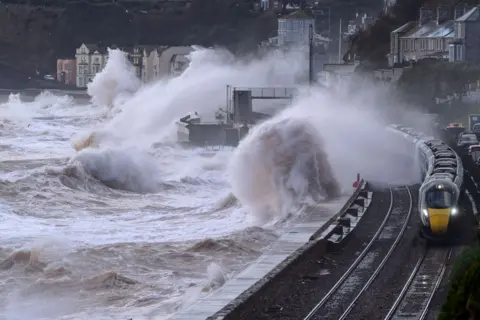
The storms that tore through Dawlish in 2014 prompted a five-phase project to build a new sea wall in the town, and a large rock shelter just down the line. Four phases were completed under several Conservative governments until 2024, costing taxpayers £165m.
Much like trains south of Exeter in the recent storm, the project appears to have hit the buffers.
The fifth and final phase was "paused" last summer by the Labour government, with rail minister Lord Peter Hendy warning it "was expected to cost substantially more than the other four phases combined".
As a result, the threat of travel chaos still looms large in one important way.
 BBC/Johnny Rutherford
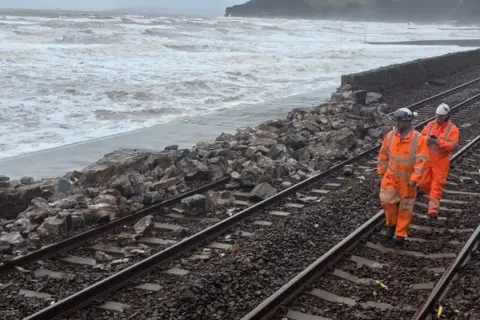
The disastrous two-month closure in 2014 was caused not only by a breach of the sea wall in Dawlish, but by a serious landslip down the line near the neighbouring coastal town of Teignmouth.
It is this stretch of cliffs that phase five would have addressed.
"All ideas have been rejected by Department for Transport (DfT) as too expensive," says local Liberal Democrat MP Martin Wrigley.
Among the ideas floated were moving the railway out to sea or re-profiling the cliffs, he explains.
"We remain with some simple pins and netting trying to prevent a repeat of the mudslide that closed the line... it is rainwater, not waves, that is the risk.
"Until we have a full fix for the phase five cliffs, we run the risk of another sudden catastrophic slip as we had in 2014," he adds.
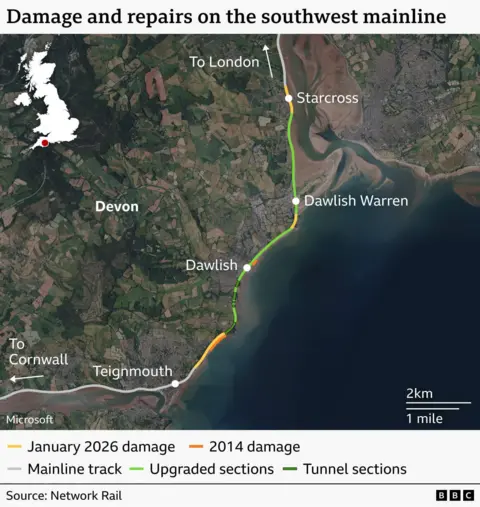
When forecasters predicted Storm Ingrid would bring 60mph (96km/h) winds last month, the Paddington to Penzance line was closed at Dawlish on the night of 23 January as a precaution, and remained shut for two days.
That was down to a section of old sea wall - not part of the recent improvement works - collapsing in the storm.
The line was closed again overnight three days later, thanks to a large hole at the base of the cliffs between Dawlish and Teignmouth - in the middle of the section of cliffs waiting to be dealt with in the paused phase five works.
It was not quite an eight-week closure this time, but it has set alarm bells ringing.
With an estimated 14 million day trips and four million overnight stays annually in Cornwall, this sort of unpredictable closure would have a huge impact if it coincided with winter school holidays or any wet weather in the summer months.
Back at Plymouth station, Frances Parker says she has not been impacted so far "but it's always a worry about what happens if the line goes down".
"They need to sort it really because everyone is going to worry every time there is a storm."
Jayne Kirkham, Labour MP for Truro and Falmouth, saw first-hand on an early morning train back from Westminster last month how "our train was stopped at Dawlish as waves crashed over the track".
"One of the two lines had been closed by the sea - we had to wait in a queue of trains all relying on the remaining track and eventually crawled forward, after a delay," she adds.

The 2014 closure cost the South West economy an estimated £1.2bn, Wrigley says, and the latest problems will have put another dent in business confidence.
Local lobbying groups have long hoped for more trains which take less than three hours to run between Plymouth and London. According to Great Western Railway (GWR), the average time is currently three hours and 15 minutes. By comparison, trains between Paris and Marseille in France cover double that distance in the same time.
Disruption set to continue?
And that brings us to another issue - the lack of a plan B if the line crumbles again.
A study carried out by Network Rail into alternative routes, commissioned by David Cameron when he was prime minister, found it came down to a choice between reopening the long-abandoned line linking Plymouth with Exeter via the Dartmoor national park, or several variants on an inland route in South Devon.
 Great Western Railway
All were judged poor value for money so none were ultimately taken forward – though many are still pushing for the Dartmoor route.
Inland rural routes can come with their own issues, as shown by a key branch line connecting Exeter with Barnstaple in north Devon shutting for three weeks - and remaining shut now - due to damage from Storm Chandra in January.
For now, at Dawlish, we are stuck with this vulnerable line along the coast.
For its part, Network Rail says the new sea wall in the town faced its "biggest test" yet during Storm Ingrid and "performed as designed by deflecting waves back to into the sea", which meant the line was reopened quickly.
DfT tells us it "will continue to work in partnership with Network Rail to ensure the line remains resilient and is fit for purpose for the communities it serves".
But some think the remaining uncertainty of further closures on this arterial rail line shows the South West is being sidelined.
"I'm not blaming this government, it's been successive governments and they've all failed to invest down here in the South West - but if they want to see growth, then we need to have that infrastructure in place," says Julian Brazil, leader of Devon County Council.
"We're not talking about, 'Oh, can you shave a couple of minutes off the journey time', we just want a line that's reliable and resilient."
Additional reporting by Archie Farmer.
