Charity launches legal action over poultry farm river pollution concerns

 BBC
BBCAn environmental charity has launched a legal challenge against Natural Resources Wales (NRW) over its decision to approve the expansion of three poultry farms.
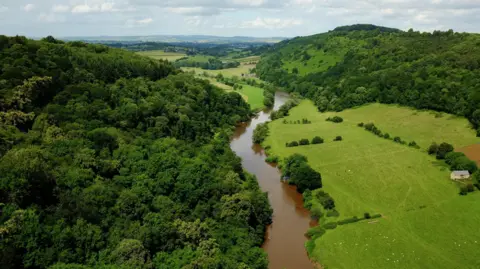
The River Action charity has accused NRW of not stopping chicken manure from polluting the River Wye.
It claims the environmental watchdog's decision to allow the three poultry units in Powys the permits in November 2025 was "a serious misunderstanding of the law".
NRW said it was aware of the proceedings and would not be commenting further.
According to River Action, NRW say it has no powers to assess or regulate manure once it leaves a site, and that such matters fall to local planning authorities.
But the charity has argued the law requires NRW to assess and prevent potential pollution impacts that could arise from off-site pollution.
River Action's legal co-ordinator Christian Fuller accused NRW of "washing its hands" of intensive poultry pollution.
He claimed the legal action was "ultimately about correcting unlawful decision-making", and alleged NRW had "wrongly told itself that it lacked power to regulate farm pollution beyond the farm boundary".
Fuller added where pollution was a predictable result of a permit, the law required for it to be assessed and controlled.
"Ultimately we are just asking NRW to do its job properly as the environmental regulator in Wales."
Fuller said environmental permits existed to stop unacceptable environmental pollution before the damage was done, with NRW given that responsibility by the UK government.
"This case is about making sure it uses its powers to protect sensitive rivers like the Wye and Severn," he said.
 Getty Images
Kim Waters from the Welsh Rivers Union, a campaign group addressing pollution in rivers, said: "The regulator NRW needs to pull its finger out and start taking its responsibilities very seriously, to restore our rivers to what they once were, some of the best in Europe, alas no longer."
She described Welsh rivers as "collapsing", with the main reasons being "agriculture, sewage pollution and a mix of old industrial activities, but the key ones being agriculture and sewage".
Waters said the River Action case with NRW was "very much a test case, to show that NRW have the powers, and must act on those powers to make sure that farming is done correctly".
Where is the River Wye?
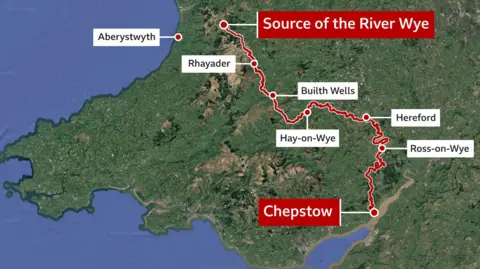
The three poultry units in Powys are located within river catchments including the River Wye and the River Severn.
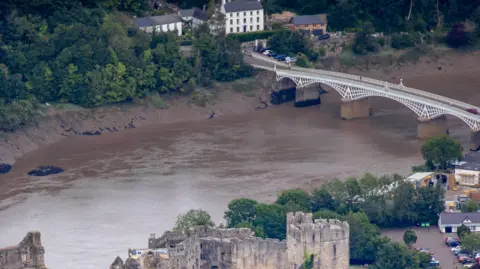
Ongoing concerns have been expressed about water quality in both rivers, and in 2023, the status of the River Wye was downgraded to "unfavourable – declining" by Natural England.
There are many different sources of pollution that have contributed to the decline of the Wye, which is classified as a Site of Special Scientific Interest and is home to protected species such as otters, kingfishers, white-clawed crayfish and the Atlantic Salmon.
Food production 'only part of the story'
Farming representatives have argued that many producers operate within existing regulations and say agriculture is being unfairly singled out for broader environmental pressures.
A National Farmers' Union (NFU) Cymru spokesperson said: "Welsh farmers produce food to some of the world's highest standards and the industry is one of the most highly regulated sectors in the country.
"NFU Cymru is not in a position to comment on reports of legal action related to other groups or bodies."
Sarah James, from the Country Land and Business Association Cymru (CLA), described the legal challenge as a "red herring" which risked creating "more of a gap between the industry and environmental groups and the communities that live around the rivers".
She said if the focus remained on farmers alone and the nutrient management that those industries produce, "we are never going to fix the bigger problem of water quality".
"There are a lot of other issues that come into the mix, when you look at the holistic view of a catchment like the Wye. It's highly populated, everyone living in that catchment contributes to the nutrients in that catchment. Food production is only part of that story," she said.
A Natural Resources Wales spokesperson said it was aware River Action had started proceedings for judicial review and was "awaiting the sealed documents".
"As the legal process is now formally under way, we will not be providing any further comment at this time," they added.
