The landmark that could have ended up 20 miles away

 Arqiva
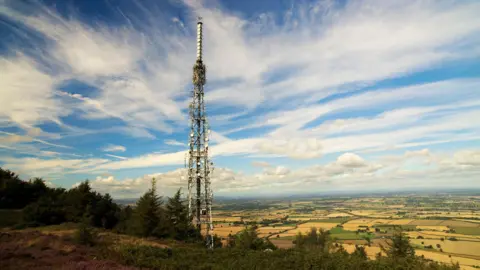
For half a century, the transmitting station on top of the Wrekin has broadcast TV and radio to much of Shropshire and parts of the West Midlands beyond.
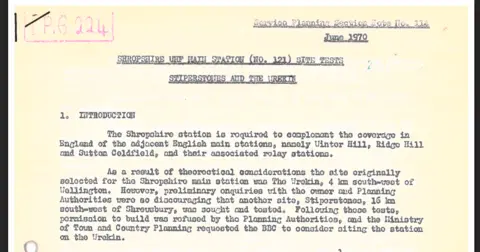
However, the mast could have ended up across the county on Stiperstones, had a dispute over protecting the county's natural assets gone a different way.
Transmitter firm Arqiva marked the landmark's 50th birthday this month with chief of operations Mark Steele saying it had become a "trusted part of life in Shropshire".
The eventual opening on 5 December 1975 came after a protracted planning row which was raised in Parliament on several occasions and subject to ministerial intervention.
The BBC had identified the need for additional transmission sites in the area before the launch of its colour TV service, which first came to BBC Two in 1967.
The modern, higher-definition service, with 625 lines on the screen rather than 405, was broadcast on higher frequencies which travelled shorter distances.
Signals from other Midlands transmitters like Sutton Coldfield in Birmingham and Ridge Hill in Herefordshire struggled to reach parts of the region, and many households in the dark spots turned their antennae to pick up broadcasts from north-west England or Wales.
Identifying the need and meeting it were two different things, however.
The BBC had tested transmissions from the Wrekin as far back as 1964, provoking condemnation from those opposed.
Seven years later, Shrewsbury MP Sir John Langford-Holt asked in Parliament what was going on in the, by then long-running, saga of a new transmitter for Shropshire.
Environment minister Graham Page detailed how the first planning application for the alternative site on Stiperstones had been made four years earlier, with two more for different spots on the Wrekin in 1969 followed by public inquiries.
Highlighting the environmental issues, he added that ministers were in "consultation with the corporation (BBC) and the local planning authority about ways of overcoming the difficulties".
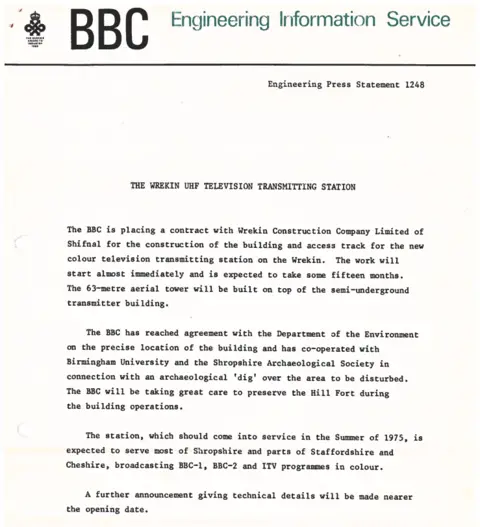
From the archives: BBC versus the planners
 BBC Written Archives
 BBC Written Archives
Campaigners remained set against constructing the mast and associated building on the Wrekin, site of an Iron Age hill fort.
Decades later, Wellington historian George Evans told the BBC: "We did the English thing and we formed a committee called the Wrekin Preservation Committee."
"We told each other how dreadful it was and wondered what to do about it."
Eventually, a compromise to move the planned development outside the hill fort tipped the balance in favour of building it there rather than Stiperstones, and government approval was finally given in 1972.
Since opening in 1975, many more additions have been made to the tower, carrying everything from extra radio and TV channels to mobile signals.
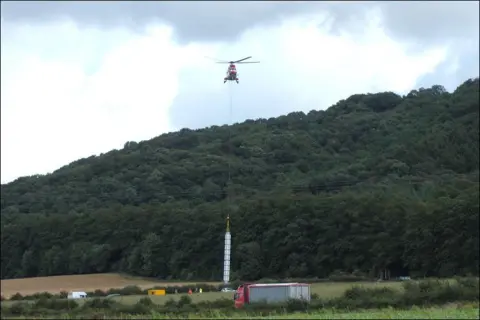
In 2009, a new top section of the mast was lifted into position by helicopter, in preparation for the switch to digital television.
Some opponents continued to argue that it should not be a permanent fixture but as the station passes its 50th birthday, it is transmitting more data than ever.
Mr Steele said: "It connects communities, carries vital information, and continues to stand as a symbol of progress.
"The engineers who built it could hardly have imagined the technologies it supports today, but its purpose remains the same, to keep people informed, entertained and connected."
Follow BBC Shropshire on BBC Sounds, Facebook, X and Instagram.
