Here, BBC Radio Shropshire's Ed Mitson looks at the history of the transmitter - and talks to those who want it pulled down. |
Shropshire's tv transmitter may sit at the on the Wrekin, but it could have found a home on top of the Stiperstones. Back in 1964 the BBC carried out transmission tests on the Wrekin, only to be told by local politicians that they wouldn't allow anything to be built on the landmark. They were forced to look elsewhere and in 1967 came up with new plans for a transmitter on the Stiperstones. 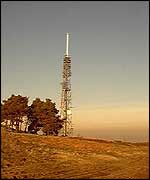 | The very existence of a transmitter on the Wrekin has always been controversial |
When the first public inquiry into the proposals came up in 1968 there were few objections. But the plans were called in by the Minister for Housing and Local Government, the 60s version of John Prescott, who told the BBC to apply to put the transmitter on the Wrekin. Wellington historian, George Evans, remembers the uproar: "We read them (the proposals) in the paper and we heard about them and we got a bit upset. "So we did the English thing and we formed a committee called the Wrekin Preservation Committee. "We told each other how dreadful it was and wondered what to do about it." In the summer of 1970 the second public inquiry in three years took place. Retired judge Michael Mander was a solicitor in Wellington at the time. He told us: "I do remember feeling a sense of moral blackmail because we were told that if it didn't go on the Wrekin, it would go on the Stiperstones." By October 1971, in a bid to pacify opposition, the plans had been altered to site the transmitter outside the Wrekin's hill fort. The final go-ahead was given by the government in 1972 and the transmitter started broadcasting to more than 100,000 homes in December 1975.  | See some great views of Shropshire's best-known landmark in our Wrekin gallery |
Retired BBC engineer, Barry Taylor, told us it was one of the longest-running and most expensive planning applications in the history of the corporation. Now, almost 30 years later, campaigners for the landmark say the transmitter should be pulled down. They argue conditions imposed when it was given the go-ahead means it should be dismantled because it's no longer needed for broadcasting purposes. They say the introduction of digital and satellite broadcasting means the transmitter's time has come. 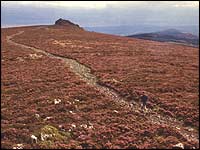 | The Wrekin transmitter could have been here on the Stiperstones. Click here to see our panoramic image taken on the Stiperstones |
Tom Bolger lives at Halfway House on the Wrekin He said: "The original planning permission said that when satellite technology came out the mast should be removed and the site restored to its former glory but of course times have changed. "We've got mobile phone stations up there, we've got all sorts of things on it." Deep in Shropshire's archives, papers show that local politicians did want the transmitter removed when it was no longer needed. But International Crown Castle, the company which runs the transmitter, says it's already broadcasting digital signals. From his home at the foot of the Wrekin, Michael Mander accepts it's unlikely to ever be demolished: "I shall be surprised if its ever demolished in my lifetime. "I can't frankly ever see that happening not least because it's primarily a television transmitter, but it's now used for all sorts of purposes." But others like George Evans still want to see it demolished: "That's what they're supposed to do. "It's just a matter of whether I can live long enough to see it happen. I'd like to. I'm going to try."
|