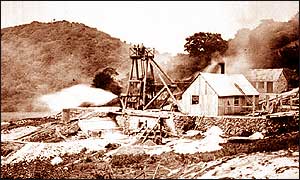
Along with the mines were huge engine houses, chimneys, a whole range of buildings, spoil tips, railways and overhead ropeways, most of which have long since been cleared or have disappeared as nature took the sites over. Today there are no working mines left in Shropshire, and most of the mine sites were abandoned long ago. They appear as little more than humps and bumps in the landscape, but if you look closely, there are remains. And as the remains begin to decay, there are more and more people who want to save what there is for future generations to at least have an indication of what happened at these often remote sites. 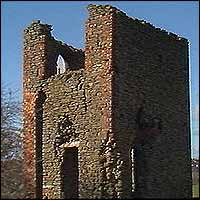 | Abandoned mine buildings dot the Shropshire countryside. This engine house once served Ladywell Mine and was erected in 1875 |
Although coal was by far the most-mined substance in the county, metals such as lead, copper, zinc and iron were mined, along with clay, limestone and barite. Mining in Shropshire goes back an awfully long way - back to the Romans in fact, and maybe even further. There are signs that Bronze Age man may have mined copper at Llanymynech, while the Romans mined lead in the Shropshire hills more than 1,500 years ago. There then followed centuries of inactivity until the middle ages, when mining began in earnest and gradually mineral and coal deposits at the surface and in natural caves were exhausted. Even in the 13th Century mining had begun underground, with miners accessing coal or minerals via shafts dug into hillsides called adits, or bell pits. Bell pits are shallow shafts with short passages at the bottom, which were abandoned as soon as problems with ventilation or stability were encountered. The miners would then dig another bell pit next to the original one until that, too was abandoned, and so on. On Clee Hill, this method continued until the 18th Century, and bell pits can still clearly be seen in the area, especially on Titterstone and Whatsill. In the mid 18th Century, mineshafts had become deeper and deeper in search of ore and coal - but the age of industry was about to revolutionise mining. In came steam engines to pump the water out of the lower levels, operate winding gear or cruch ore for processing, followed by explosive to blast ore out of the underground rock. Intensive, industrialised mining flourished for 150-odd years and changed the character of the county for ever. Many of the villages and towns in Shropshire grew up around new mines and began to thrive. The mines not only provided jobs for the miners, but also for whole communities - not least the local innkeepers. 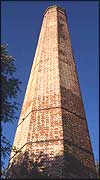 | Lordshill Chimney at Snailbeach Mine |
Much as specialist workers move around today following their work, people moved into Shropshire to work in the mines. But occasionally when the mines closed down the local community would be devastated, and sometimes when it did the entire population of the village would move elsewhere, leaving ghost towns, the remains of which can often be seen as rubble in the remotest of spots. When mines closed they did so suddenly. For example, when Snailbeach mine, now Shropshire's best-preserved site, closed down completely in the 1950s, it was as if the workers just walked off the site at the end of the shift. Underground all the ore-carrying wagons were left as they were, and are today rusted to the rails, and the miners seemingly downed tools and left. Above ground the manager's office was full of plans and documents and his desk still had glass ink pots on it, giving the impression he was coming back any moment. Elsewhere on the site, tools, equipment, machinery and even locomotives were left exactly as they were. The same went for the mine entrances, and no effort was made to make them safe. |