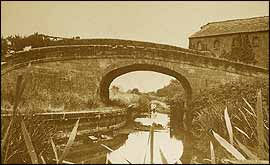
But in the last 30 years or so, many have been re-opened and have taken on a new life as leisure areas for boating enthusiasts and practically anyone who likes a walk in the country. Shrewsbury & Newport Canal | | | | |
In Shropshire, the Shropshire Union Canal connects Ellesmere Port (on The Mersey) with Wolverhampton, as well as linking up to the Llangollen and Montgomery Canals. We're told that Britain is entering a new age of canals. British Waterways is pumping £500 million into restoring the canal network - and even building new ones. And now a campaign has been launched to re-open one of Shropshire's forgotten canals, the Shrewsbury & Newport. This canal was one of many built in the mid to late 18th Century in order to move large quantities of raw materials and coal from one place to another. The area now occupied by Telford was criss-crossed with several canals linking the many coal pits in the area with the ironworks that needed the coal. Donnington Wood Canal was the first, opening in 1768, and by 1793 it was decided to build a canal linking up the industrial network with Shrewsbury. These canals were designed to carry tub boats rather than the narrowboats we see on today's canals. Tub boats were, as the name suggests, simply tubs filled with cargo and then put together in 'trains' that were hauled by horses.  | The canal once ran behind this pub in Shrewsbury on its way to the terminus at The Buttermarket. Today this part of the route is choked with weeds. |
One Josiah Clowes was appointed chief engineer, but when he died half way through the project he was replaced by his assistant - Thomas Telford, who at that time was just making his name. One of his first tasks was to rebuild the stone aqueduct over the River Tern at Longden which had been swept away in floods. It was rebuilt using a 62 yard trough made of iron cast in Ketley, and this aqueduct still stands today - marooned in the middle of a field. The eastern end of the canal was to be linked up with the Wombridge Canal in the Telford area - and this presented a problem. The Wombridge Canal was 75 feet higher up than the Shrewsbury one, so an inclined plane - a slope with rail tracks on it - was built to allow the boats to be transferred from one canal to another. The Shrewsbury Canal was finally finished in 1797, although it operated in isolation from the rest of the British canal network. |