| SEE ALSO |  | Great Salopians: Thomas Telford
Builder of the Shrewsbury Canal, Telford was responsible for the creation of a whole new profession. Canals were built in response to the growing industry in Shropshire, including the mines in the county. To find out more, see our feature on mining in Shropshire. Memory Lane Gallery
Take a look at our photography gallery showing Shrewsbury in the 1950's and 60's.
A Shrewsbury gallery has just opened a new exhibition of photographs of old Shropshire. See our feature about it. Day Star Theatre Company write and perform their own plays on the banks of the Shropshire Union Canal, using their narrowboat, the Angry Bull. Mystery of Ironbridge Historians have finally uncovered the great mystery of Ironbridge - how it was built. | | | WEBLINKS | | Shropshire Union Canal Society was formed in the 1960s to restore the 'Shroppie' and its feeder canals, including the Shrewsbury and Newport. Shrewsbury & Atcham Borough Council's walk along the route of the old Shrewsbury Canal and guide to its wildlife, which include kingfishers and great crested newts. The old canals of Telford is another well-illustrated website that explores the history of the route.
Oakengates.com has a history of the Shrewsbury Canal, with plenty of 'then and now' pictures of the industrial canal and the inclined plane at Trench.
The BBC is not responsible for the content of external websites. | | | FACTS | | Obviously, canals must be level in order to work, but there were two ways of getting around this, and the Shrewsbury and Newport Canal employed both. The link from the Shropshire Union Canal at Norbury to Wappenshall had to cope with a large change in elevation and so used locks to cope - there were 17 just between Forton and Norbury. Inclined planes were another way of getting over the problem. Boats were put in tanks of water on rails and then hauled up an incline (or lowered down one). Although there is little left other than the slope of the Trench inclined plane, another largely intact one can be seen at Blist's Hill Victorian Town in the Ironbridge Gorge. | |
|  | Gradually, as at Uffington in the picture, parts of the canal were filled in and bridges over it removed and the land levelled. Shrewsbury & Newport Canal | | | What remains today | |
By the 1960s the first efforts to restore it were made by the Shropshire Union Canal Society, but these met with little enthusiasm from the authorities, who were dead against any restoration plan. In fact, much of the route of the canal was sold off just as enthusiasts were looking at preserving it. The society turned its attention to saving the the Mongomeryshire Canal from a new road scheme instead. Meanwhile, much of the Shrewsbury route was being reclaimed. The sections on either side of the Longden upon Tern aqueduct were filled in and became part of the surrounding fields. Other sections, too, were filled in and bridges removed. 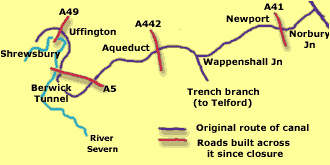 | The route of the canal from Shrewsbury to the Shropshire Union canal at Norbury Junction has been criss-crossed by several new roads which will prove a problem for the restorers |
In Shrewsbury nearly every trace of the canal has disappeared. It can barely be seen at the back of the Canal Tavern in Castlefields, and then all trace of it disappears on its route in front of the Maltings and then out towards Telford Way. From Telford Way the route of the canal can be followed as it's a footpath and nature reserve today, although the canal itself has been filled in. A couple of pools, used by wildlife, remain at Sundorne, but the canal is mostly filled in all the way to Uffington, where part of it is a cycle track.  | Weeds grow where the canal was once |
From there on the canal can largely be seen, although it's choked with weeds, until it passes under the A5 bypass - unfortunately at water level. From there it goes on to the Berwick Tunnel, which is bricked up but still in water, before curving back through the village of Berwick Wharf (which owes its existence to the canal) and back under the A5 near Upton Magna. From there on much of the canal route is dry and some of it has been filled in. Several aqueducts that used to take the canal over roads and the River Roden have also been demolished. Newport is the only place where large sections of the canal remain in water and as they were 50 years ago - it was bought with preservation in mind by the local council. Beyond Newport most of the canal has been filled in all the way to Norbury Junction on the Shropshire Union Canal, but all along the route listed structures, such as bridges and canal buildings, also survive. |