How knitting can help you kick harmful habits

 Getty Images
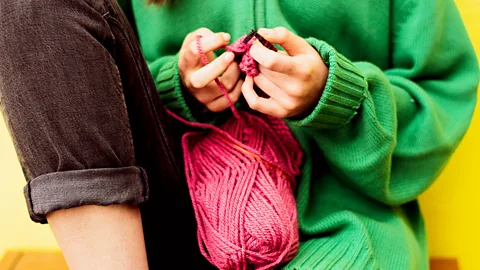
Cheap and easy to pick up, knitting can help to fight addictive behaviours, from nail-biting and doomscrolling all the way up to helping people struggling with street drugs. The only side-effect? Too many scarves and hats.
Amanda Wilson struggled with painful sensory-seeking habits for as long as she can remember. "I used to pick my skin to the point of creating scabs and bite my nails down so short that they'd get infected," says Wilson, a finance worker from Mississauga, in Canada, who suffers from obsessive compulsive disorder (OCD). Then she picked up yarn and needles. "I now have beautiful nails and a healthy scalp since I began obsessively knitting," says Wilson.
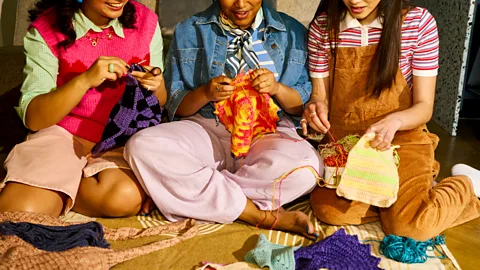
While it's long been considered a hobby for the elderly, there's a growing respect for knitting as a legitimate healthcare intervention for people of any age. Personal testimonies and preliminary scientific studies suggest that knitting (and its sister, crochet) can improve emotional regulation and help people kick harmful habits, from nail-biting and doomscrolling all the way up to street drugs.
"There's a little bit of a leap of faith that people have to take to think that knitting is going to make a difference" for major traumas such as PTSD and severe eating disorders, says Carl Birmingham, a professor of psychiatry at the University of British Columbia, in Canada. But for many, as Wilson found, that leap is well worth taking. Knitting is cheap, portable and its only side effect is an excess of hats.
What's the evidence?
Knitting has had something of a public relations problem in the scientific world. Betsan Corkhill, a wellbeing coach and trained physiotherapist who has authored several studies on the therapeutic benefits of knitting, says she's found that scientists and clinicians are always eager to entertain a "bilateral, rhythmic, psychosocial intervention" as a new mental health treatment – but once she mentions the "k-word", knitting, their enthusiasm evaporates. Mia Hobbs, a clinical psychologist in London, UK who runs a podcast on the mental health benefits of knitting, says she suspects it's because knitting has historically been an activity for women.
As a result, there are only a handful of scientific studies about the health impacts of knitting and crochet. Most are surveys that ask experienced knitters how they feel knitting helps them. These surveys are compelling – for example, 90% of respondents said crochet makes them calmerin one 2020 study – but what we're lacking are studies "introducing knitting to a group of non-knitters" in a way comparable to clinical trials for drugs, Hobbs says. And the respondents to these surveys are "almost exclusively white females", she adds.
So far, the closest we've got are studies on knitting in residential treatment centres – healthcare facilities where patients live full-time as they receive treatment for conditions such as eating disorders or addiction. Although sample sizes are small, it's a helpful setup to study knitting, says Birmingham, since the study participants have time to devote to getting through the craft's learning curve and are motivated to learn a healthy new coping mechanism.
 Getty Images
Emotional regulation
Birmingham, the professor of psychiatry at the University of British Columbia, says he's been a knitting evangelist since 2009, when he conducted a study on knitting in a treatment centre for young women with severe eating disorders, including anorexia and bulimia. "They were following a strict protocol, including eating more, so it was very anxiety-provoking for them," says Birmingham. But the impact of knitting on their levels of distress was "remarkable", he says – about 75% of participants said knitting helped dispel food-centred worry.
But how could knitting have such a dramatic effect? Birmingham likens the repetitive, two-handed movements of knitting to EMDR (eye movement desensitisation and reprocessing), a form of treatment for anxiety and PTSD that uses light movement going rhythmically from left to right to activate both sides of the brain. (Not because the left hemisphere is "analytical" and the right hemisphere is "creative" – that's a pop science myth, but because the left hemisphere controls movements on the right side of the body and vice versa.)
"We know that repetitive movements can activate the parasympathetic nervous system" – a network that helps the body wind down after periods of danger – "and calm the mind", says Hobbs.
Birmingham says he's also looked at the impact of knitting on brain activity using EEG, electrodes placed on a patient's head to measure electrical signals inside the brain. Although he hasn't published the results in a peer-reviewed scientific study, he believes the initial tests suggest knitting could decrease activity in the insula and the amygdala, both areas of the brain associated with stress response.
And you don't have to be an accomplished knitter to achieve this soothing effect. "You could be a terrible knitter, as long as you're using both sides of your brain," says Birmingham.
Knit to quit
If you're looking to kick an addiction, knitting packs a one-two punch, Hobbs says – it can help you process the negative emotions that act as triggers for the habit and keep your hands otherwise occupied. "Lots of knitters describe knitting as being a way of sitting with the feeling", says Hobbs, without it becoming unbearable, a way of "getting out of your head and into your hands."
Knitting can be used as part of habit replacement therapy, subbing in a healthy self-soothing activity for a harmful one. A famous success story is Loes Veenstra, from the Netherlands, who knitted more than 550 jumpers to keep her addiction to cigarettes at bay.
Casey, 60, a technology manager in California who asked us not to use her full name, tells the BBC she was a pack-a-day smoker with a 46-year cigarette addiction before knitting helped her quit.
Casey says she spent ten years trying everything – "cold turkey, Wellbutrin, the patch, meditation, acupuncture, classes from my healthcare provider" – all to no avail. "I knew I didn't want to go out like my mom did, literally smoking through a tracheotomy," she says. So she took a knitting class through her local elementary school's lifelong education programme. She started small – her first project, supposed to be a potholder, turned out as "the world's ugliest rhomboid" – but soon graduated to long scarves. Casey found knitting was a good substitute for the "ritual and the repetitiveness" of smoking, she says. "It scratched that itch."
"Three weeks into having quit, I had gotten off a really stressful work call, and my immediate thought was, 'I need to smoke a cigarette to decompress'," says Casey. "Instead, I grabbed my knitting and did like four rows, and the thought was gone. The need [for a cigarette] was gone. That's when I knew this is for real. And I cried." Now, she's more than two years cigarette-free and is knitting and purling away on a pair of socks, a hat, and a blanket.
Similarly, the studies conducted in substance abuse centres so far are promising, if not conclusive. One study in 2024 found that women in substance abuse treatment centres smoked fewer cigarettes after participating in a "knit to quit" program. But since the group also listened to talks about the health risks of smoking during their meetings, "we can't say for sure that knitting was the causal influence", says Allison West, an associate professor of public health at John Hopkins University in the US and lead author of the study.
Another study from 2007 introduced knitting to women in a residential treatment for chemical dependency, including alcohol abuse, heroin, and prescription drugs. While some of the new knitters were initially discouraged by the learning curve, many said it became an essential coping tool as they juggled withdrawal symptoms, court appointments, and family obligations. Knitting "keeps me here when I want to run", one participant told researchers.
 Getty Images
Keeping your hands busy can also help with compulsive habits from hair-plucking and skin-picking to mindless social media scrolling and boredom-snacking, though there don't seem to be any formal studies to date on these applications.
Not ready for prime time
You've likely seen claims that knitting can lower heart rate and blood pressure. While there's a good chance that's true, it hasn't been scientifically proven, says Hobbs. Many social media posts and online articles cite a scientific study allegedly conducted by Herbert Benson, a researcher at Massachusetts General Hospital who wrote about the "relaxation response", a flow state he conceptualised as the opposite of the fight-or-flight response. But the Benson-Henry Institute for Mind Body Medicine at the hospital confirms to the BBC that no such study on knitting, heart rate, and blood pressure was ever conducted or published.
Another frequent claim is that knitting can help ward off cognitive decline, such as Alzheimer's or dementia. One oft-cited study from 2011 suggests that older people who knit are less likely to be experiencing cognitive decline, but Hobbs says this is another chicken-and-egg problem – it may be that they're still knitting because they haven't experienced cognitive decline, not the other way around.
One stitch at a time
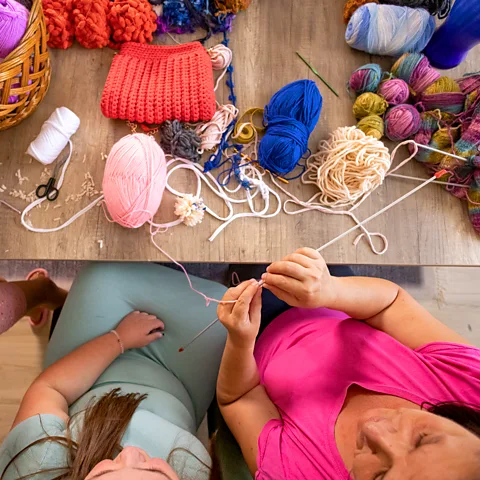
It's important to understand that knitting and learning to knit are very different activities. While the former may get you to the nirvana-like flow state that Benson promised, the latter requires a fair amount of under-your-breath cursing and fibre surgery to save stitches dropped several rows ago. To get through this awkward stage, experienced knitters recommend swinging by your local knitting group (affectionally called a "knit and natter" or "stitch and bitch" depending on which side of the pond you find yourself). "My local [yarn shop] has a specific 'clinic' you can book into with your knitting problems," Hobbs adds.
However, the experts agree knitting isn't the answer for absolutely everyone – some people don't have the manual dexterity or simply find it too fiddly. For a similar effect without the headache, Birmingham suggests worry beads, a centuries-old fidget toy where sliding beads along a string is used to occupy the hands and mind. But Birmingham says you have to use both hands consistently to get the full benefit.
Before knitting can become a mainstream prescription, even the most ardent knitting advocates agree there is a need for large-scale clinical trials with control groups and thorough investigation, as in pharmaceutical studies. Step it up, Big Yarn!
--
For trusted insights on health and wellbeing, sign up to the Health Fix newsletter by senior health correspondent Melissa Hogenboom who also writes the Live Well For Longer and Six Steps to Calm courses.
For more science, technology, environment and health stories from the BBC, follow us on Facebookand Instagram.
