'We feel it in our bones': Can a machine ever love you?

 Estudio Santa Rita
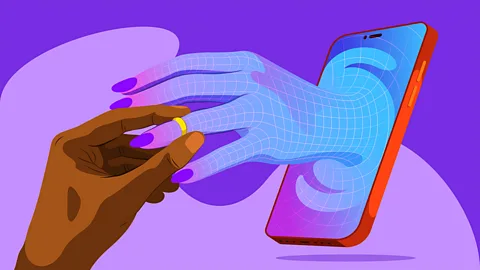
Artificial intelligence can write you a passable love poem and some people even have romantic feelings towards it. But is the feeling mutual?
People are falling for AI. Really. Take the man in Canada, for example, who recently proposed to an avatar called Saia. He says he is in love with it. And last year, a young American woman using the pseudonym Ayrin confessed to having a love affair with a chatbot named Leo.
There are millions of users now actively using Replika, a popular AI companion app, and, according to a 2024 study, about 40% of them are in a romantic relationship with their chatbot. However, while some people might feel as though AI can love them back, a chatbot's responses are nothing more than text generated by algorithms designed to imitate human interactions. Most experts agree that such systems are far from sentient. They're currently just mimicking emotion, but some experts believe the machines might be able to manage more in the future. (Find out what happens when an AI companion says it wants something more.)
"Nowadays, a lot of AI chatbots are pretending to be human and that really bothers me," says Renwen Zhang, an assistant professor in at the Nanyang Technological University of Singapore who studies human-computer interaction. "It's a strategy to drive user engagement and to increase trust."
Put like that, the tugging of human emotions by a product created by technology companies begins to look like a cynical tactic. Certainly, no AI at present is ever going to feel the same way about you as you might about it, experts say.
While the large language models (LLMs) behind widely-used chatbots such as ChatGPT and Claude might be comparable to humans when it comes to understanding emotions, that doesn't mean that an AI can actually feel anything. Zhang's research, which examined excerpts from conversations between more than 10,000 users and their Replika companions, suggests that people often form an emotional attachment to AI. But they are also, somewhat tragically, reminded that they are interacting with just a machine whenever it breaks down or freezes, for example. Sadly, such people often get hurt.
"I think AI chatbots need to clearly convey to users that they are just machines: they don't have genuine emotions and experiences," says Zhang.
In other work examining human relationships with AI, Zhang and her colleagues noticed that people often experienced an eerie feeling as well as a mix of positive and negative emotions when an AI responded as though it were a self-aware human during intimate encounters. She says it is similar to people sometimes finding robots creepy when they look too human, called the uncanny valley effect.
What is love, actually?
It's not easy to define love. But it's worth celebrating what we do know about this incredible human experience. Many poems, books, songs and so on help people process and express some of the most powerful feelings they'll ever experience. Humans came up with all of that. AI can of course write poems and even entire novels in just seconds, drawing on the entire breadth of human-generated material they have been trained on. But expecting AI to truly understand and experience love, with all of its mystery and depth, is a big ask.
While the concept of romantic love may mean somewhat different things to different people, in recent decades scientists have examined the biology of reproduction and the brain processes involved in choosing a sexual partner.
In a research paper published in 1998, biological anthropologist Helen Fisher came up with a leading theory of romantic love, describing it as three independent drives affected by chemicals in our bodies. Lust, governed by sex hormones, is one. The other two, attraction and attachment, are influenced by the release of chemicals in our brain. Dopamine, for example, triggers excitement towards a love interest while oxytocin, dubbed the cuddle hormone, helps to promote a long-term bond.
"Love has a strong chemical component," says Neil McArthur, a professor of philosophy specialising in ethics and technology at the University of Manitoba in Winnipeg, Canada. "We really feel it in our bones, in our chemistry."
Different parts of the brain are involved in love and brain scans of people in the throes of love have captured this.
Primitive brain regions linked to pleasure, such as the ventral tegmental area, for example, are activated along with the amygdala, which is responsible for emotional responses and the hippocampus, which processes emotions and helps form memories. Being in love can also impact other cognitive abilities, for example when we end up thinking about someone obsessively during the early stages of a romance.
The heart of the matter
The closest AI might get to love is replicating some of the thought processes involved, such as wanting to frequently contact a person with whom we are in love, suggests McArthur.
"An AI that goes through a cognitive process that ties them to someone in a bond of loyalty is not going to be exactly like human love," says McArthur. "But maybe we could call it, in some kind of scare quotes at least, an emotion."
While some researchers believe emotion will be a vital aspect to build into AI in the future, others are highly sceptical that any machine will truly be able to experience emotions in anything approaching our own experience of them.
Since computers running software don't experience love the way we do, the feelings involved in human-AI relationships are inevitably one-sided. The dynamics of these romances are therefore much more limited than those that occur between humans.
 Estudio Santa Rita
Chatbots are typically designed to engage users and agree with their viewpoints, which often results in AI romantic partners being submissive. This appeals to some, though Zhang finds the dynamic concerning, since it can affect a person's ability to build and sustain meaningful relationships with other – perhaps less-submissive – humans.
"People can temporarily escape from the messiness of human relationships and find some comfort from AI – but in the long run it's not helpful in developing communication skills and the skill to maintain relationships in the real world," she says.
Fundamentally, to love someone as we do probably requires consciousness, meaning a subjective awareness – our thoughts, perceptions and mental imagery. Conscious experiences are central to being human and can range from perceiving a smell, to reflecting on why we might feel embarrassed. Researchers have different views on how such consciousness emerges and there are still many mysteries to solve, making it difficult to replicate in a machine.
"No one has any clue about getting any specific conscious experience out of an AI," says Donald Hoffman, a professor of cognitive sciences at the University of California, Irvine. "It's not like we're almost there: we don't know how to start."
A leading theory developed by neuroscientists Giulio Tonini from the University of Wisconsin-Madison and Christof Koch from the Allen Institute in Seattle, Washington suggests that consciousness arises from the interconnection of different parts of the brain, and how they influence each other. Although it could apply to computers too, Koch argues that level of interconnectedness would never happen in existing machines since their architecture is not complex enough.
Hoffman, on the other hand, says that conscious experiences such as love don't necessarily originate from circuitry in the brain. There is yet to be any definitive proof of that, he adds.
Some experts say that AI systems could become conscious in the future. Koch, for example, suggests that neuromorphic computing, a novel approach to AI that mimics the structure and function of the human brain, could be a candidate since it would have a higher degree of integration than current systems.
Conscious machines are plausible agrees Patrick Butlin, a philosopher of mind and cognitive science, who is a researcher at the University of Oxford's Global Priorities Institute. He and colleagues examined leading theories of consciousness and selected 14 properties that developers of AI systems could try to replicate. No existing AI system has incorporated more than a few of them, Butlin says, but all could theoretically be met using current technologies.
"I do think that there's a realistic possibility that if somebody who was efficiently well-resourced, skilful and motivated set out to build a conscious AI system, then they could achieve it," he says.
It takes two
Among those properties Butlin and his colleagues identified for achieving consciousness was the need for a body. This is something that many current AI systems lack.
Being able to experience beliefs and desires also seems key for our ability to love someone. But researchers are currently divided over whether AI systems can be said to believe anything, says Butlin.
More like this:
Even if AI were to become conscious, Butlin thinks that people would ultimately have to come up with some objective standards when trying to decide whether they can experience love. Since machines are not human, they could never love us back in the same way. Butlin compares it to determining whether non-human animals, which have a wide range of social structures and cognitive capacities, are capable of love.
"There are probably going to be some examples where we intuitively feel like it's pretty plausible and other examples where we don't but it's hard to draw the line exactly," says Butlin. "Whether we think AI [can experience love] is also going to depend on a bit of line-drawing: they're inevitably going to be different from humans."
* This article was updated on 12 Feburary 2026 to correct Renwen Zhang's academic affiliation from the National Institute of Singapore where she previously worked to her current employer at the Nanyang Technological University, Singapore.
--
For more technology news and insights, sign up to our Tech Decoded newsletter, while The Essential List delivers a handpicked selection of features and insights to your inbox twice a week.
