'The margin of manoeuvre is that much tighter': Why it's becoming harder to compete at the Winter Olympics

 Getty Images
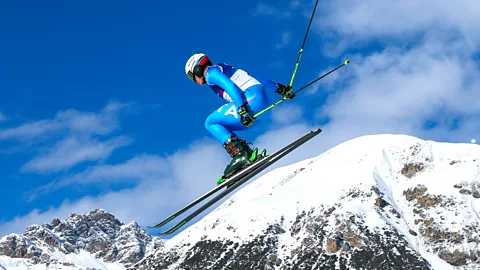
A warming climate and the use of artificial snow is making it more dangerous and difficult to compete at the Winter Olympics.
In the Italian Dolomites, snow machines will pump out a total of 50,000 cubic metres (1.76 million cubic feet) of artificial snow over the next two weeks, to ensure pristine conditions for the skiing and snowboarding events at the 2026 Milan-Cortina Winter Olympics.
Situated at an altitude of 1,816m (5,958ft), Cortina d'Ampezzo in the Dolomites, has plenty of snowfall. Despite this, event organisers tell the BBC that artificial snow will account for 85% of total snow at the Games, "to guarantee athletes the highest-quality surface, ensuring fair and safe competition conditions throughout the entire event".
But coaches, athletes and researchers have expressed concerns about the use of artificial snow, which they say is making snow sports more unpredictable and dangerous, increasing their risk of injury and making training more difficult and expensive.
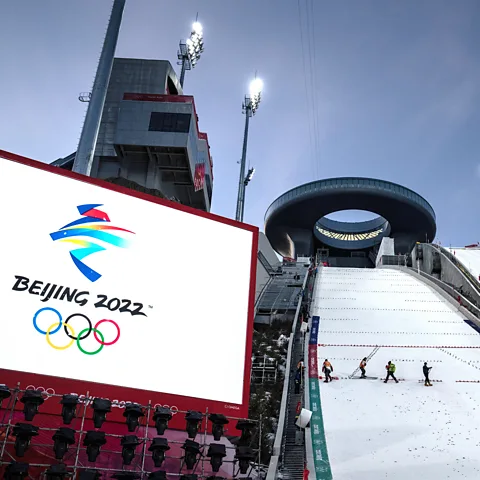
It has been almost 50 years since artificial snow was first used at the Winter Olympics in Lake Placid, New York. In the past decade, event organisers have become increasingly reliant on the technology to maintain conditions as mountain snowfall continues to decline globally and snow seasons have become shorter. The 2022 Winter Olympics in Beijing were the first Games to depend entirely on artificial snow.
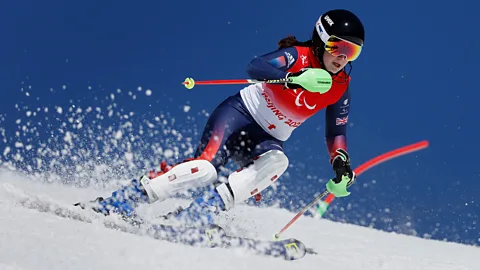
Britain's most decorated Paralympian Menna Fitzpatrick tells the BBC that "with winter conditions changing so much, artificial snow plays a big role in keeping races running and the calendar consistent". The Para-Alpine skier, who has six Paralympic medals, says that "from a racing point of view, that reliability is really important". Fitzpatrick will be competing at the Paralympics in early March after recovering from a serious knee injury in December.
 Getty Images
Falling harder
But reliability comes with risks. Athletes are at greater likelihood of injury when competing on artificial snow, which is harder, icier and denser than natural snow, as it traps less air in its structure, according to a 2022 report by Loughborough University in the UK.
The environmental impact of artificial snow
At this year's Winter Games, roughly 27,000 cubic metres (953,000 cubic feet) of water will be used to make artificial snow, the equivalent of 11 Olympic-size swimming pools. Snowmaking can be a carbon intensive process if the machines run on polluting fossil fuels, though this year's Games are using 100% renewable power for it. Studies have found that artificial snow can also disrupt plant growth. The IOC says that no chemicals will be added to the snow at this year's Games.
"It's the difference between falling on the pavement and falling on grass," says Madeleine Orr, one of the report's authors and an assistant professor of sport ecology at the University of Toronto in Canada and formerly at Loughborough, whose research focuses on how climate change impacts sport. She says she has noticed trends in the data on injury rates. "People aren't falling more on artificial snow, but when they do fall, it's a harder surface, and therefore there is a higher risk of injury."
In the 2022 report, athletes and coaches expressed concern about the increase in injuries and the impact climate change is having on training and competitive events.
When "freestyle super pipes are formed from snow-making machines in a poor [natural snow] season, the walls of the pipe are solid, vertical ice and the pipe floor is solid ice," says Laura Donaldson, a Scottish freestyle skier, who competed at the 2002 Salt Lake City Winter Olympics. "This is dangerous for athletes, some have died."
However not all athletes feel artificial snow use is a significant change. "As athletes we're pretty used to training and racing in all sorts of environments, so artificial snow is just another part of that," says Fitzpatrick. "I grew up skiing on indoor slopes in Britain, so it's never really felt out of the ordinary for me," she adds.
"Ski racing will always come with risks, and that's something we all accept," she says. "Injuries are part of the sport, and while we work hard to reduce the risks, there are so many variables that I don't see artificial snow as a key issue."
The IOC says that "athlete safety is the primary consideration in course preparation".
 Getty Images
Training challenges
The changing snow conditions and weather patterns are also significantly altering training for many athletes, by shortening seasons and making teams travel further. The teams are "chasing the snow and it's getting harder", says Orr. "The amount of time you spend on the slopes matters. You can't push yourself safely [in the competition] if you don't have conditions to train in."
More like this:
The lost Olympic sport of 'distance plungingThe science-backed tips for cold weather exercise
- How climate change threatens to close ski resorts
Canadian freestyle skier Philippe Marquis has witnessed these changes first-hand, as a competitor and a coach.
Marquis competed in the men's mogul events at the Winter Olympics in Sochi, Russia, in 2014 and Pyeongchang, South Korea, in 2018. He says he experienced extreme weather changes during his Olympic career. "One year you'd hit the jackpot with a huge dump of snow and then the next there would be rain or it would be extremely warm or cold," Marquis says.
He currently coaches the Canadian freestyle mogul team and says that in recent years training "has been extremely tough due to the extreme variability of the weather. Athletes and coaches are having to adapt."
The Canadian team has, for example, been unable to train at Whistler Blackcomb during the summer season in the past two years due to declining snowpack and glacial melt, he says. "We have basically lost a month and a half of training on home soil and are having to travel more to chase the snow." The team now trains in South America instead of Whistler. "There are fewer and fewer places around the world that get consistent natural snowfall," he says, adding that the financial burden of having to travel further and more often is "putting a lot of pressure on athletes".
Marquis says he has also noticed more injuries across the board, which he believes could be related to the use of artificial snow, as well as the rapidly changing conditions. "I don't travel anywhere without a physio anymore… in mogul skiing, we are seeing more knee and back injuries." He sees the hardness and iciness of artificial snow as a problem, especially for mogul skiers who are going down at 120km/h [75mph]. "The margin of manoeuvre is that much tighter," he says.
The increased risk of injury and the demanding travel schedule "is taking a toll on a lot of professional athletes", Marquis warns.
The changing conditions may also lead to an "economic downward spiral", Orr says. "If we have fewer skateable or skiable days, then fewer people can compete or participate on those days… which means they are going to be more expensive." Rising ticket prices will lower demand for events and funding for snow sports, she argues, adding that the population that can afford to do these sports is decreasing along with the opportunities to take part.
 Getty Images
Fewer venues
Snow sport opportunities are already declining, with the number of venues able to host the Winter Olympics shrinking rapidly due to rising temperatures and limited snowfall.
Of the 21 venues used for the Winter Olympics since 1924, scientists say just 10 will have the "climate suitability" and natural snowfall levels needed to host an event by 2050.
In a new study, researchers at the University of Waterloo in Canada analysed the climate conditions in the 93 potential host locations where the International Olympic Committee (IOC) has indicated that the necessary winter sports infrastructure is already in place. They found that only 52 of the locations would remain climate-reliable for the Olympics and 22 for the Paralympics if countries continue with current climate policies.
But there are steps the IOC can take to futureproof the Games, the researchers say. By moving the Olympics forward by two weeks or hosting the Olympics and Paralympics simultaneously in February, the number of climate-reliable locations for the Paralympics would increase to 38.
"Another option is to have a rotating model," says Orr, where a small number of snow-secure venues take turns hosting the Games. The IOC has said it is considering this proposal.
The Games "must adapt to the hosts", the IOC spokesperson says. "Hosts should aim to use only existing or temporary venues, and can also move events outside the host city, region or country. Any new construction must be planned with long-term legacy in mind."
One thing is clear: snowmaking is essential to ensure the long-term viability of the Winter Games. "Abandoning snowmaking would result in a major increase in unfair and unsafe conditions for athletes, cancelled competitions, and eventually a Winter Games without any snow sports," says Daniel Scott, the lead author of the new analysis and professor in the department of geography and environmental management at the University of Waterloo.
Without artificial snowmaking, there are only four resorts in the world which could host the Winter Games, according to Orr. These are Niseko in Japan, Terskol in Russia, Val d'Isere and Courchevel in France. "The takeaway is that snowmaking is essential and we must factor it into all future winter sports planning," she says.
"[Artificial] snow guarantees the quality and consistency of the courses," says the IOC spokesperson. Snowmaking, the use of clean energy and low-carbon transport are all solutions that "help the Games and the host communities build resilience".
--
For essential climate news and hopeful developments to your inbox, sign up to the Future Earth newsletter, while The Essential List delivers a handpicked selection of features and insights twice a week.
For more science, technology, environment and health stories from the BBC, follow us on Facebook and Instagram.
