Would you let this car drive you around London?


 Marcello Raeli
Cities like London struggle to deal with record car congestion. One designer’s idea is for a driverless car whose shape echoes some other icons of the city’s transport network.
Tokyo has its bullet trains, Paris has its art nouveau Metro stations, Los Angeles has its freeways. Transport systems are critical and integral parts of the personality of a city.
But perhaps the most famous city transport infrastructure belongs to London, with its black cabs, red double-decker buses, and multi-coloured tube maps.
They may soon have some company. Transport is undergoing a digital revolution, and that will only increase over the next 100 years, as autonomous vehicles take to the streets. Will they replace private cars, cabs, and even public transport? Will they free up space as parking buildings get replaced by other structures? Will they reduce congestion, or add to it as more people take to the streets in their self-driving vehicles?
 Marcello Raeli
Designer Marcello Raeli, who studied at the famous ArtCenter College of Design in Pasadena, California, set out to answer some of those questions.
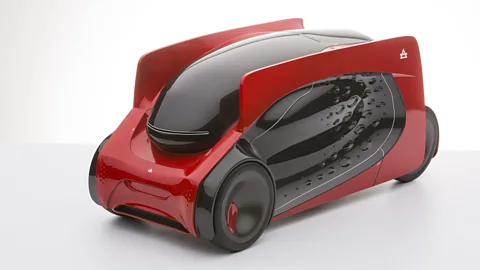
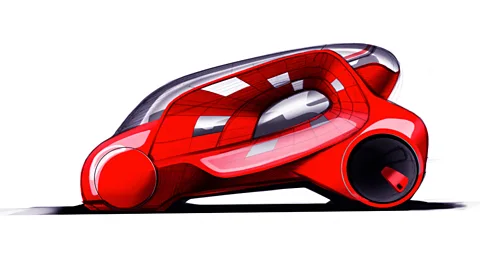
His proposal would see bright red, self-driving pods pick up people wherever they are, and drop them off wherever they want to go, rather than to pre-defined stops. Auto-Mate is a new transport concept designed from scratch, but one that fits with the design aesthetic of England’s capital city, and one that could become synonymous with the city itself in future years. Raeli spent time studying in London, and is a fan of its infrastructure.
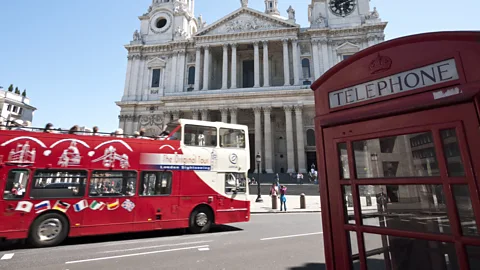
“The city of London has very powerful icons and numerous iconic buildings,” he says of its buses, phone booths, and taxis. “There’s no other city in the world that puts such emphasis on specific objects that portray specific services to people.”
However, Raeli also identified some shortcomings with the existing transport system. Buses can be crowded, difficult for the elderly to use, and as he puts it “drunk young people annoy other users”. The Tube is not available 24 hours per day, and taxis can be uncomfortable and interactions with the drivers can be “creepy”.
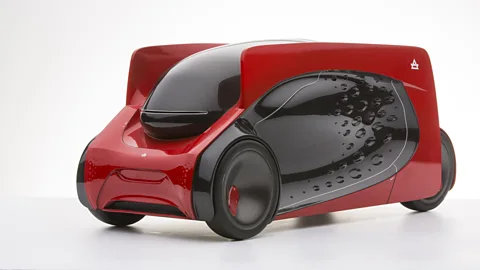
Auto-Mate is a vehicle on four wheels, that fits within the footprint of a black cab, but differs from the London getabout in almost every way. It has no driver. Flat batteries under the floor and small electric motors that fit within wheels mean interior space can be maximised.
“Imagine you're an alien who has come to Earth, and didn't know anything about cars, but knew all about the technology,” he says. “How would they build a car from scratch?”
 Getty Images
Raeli says another source of inspiration is the London Eye, and the Auto-Mate does indeed look like a pod with curved glass surfaces. The front view shows a sleek profile, but from the side it looks like a cube, with the corners stretched out. That design allows a few uses. The tips of the corners would be ideal places to mount sensors for autonomous driving. The flat sides help give that connection to red buses or phone boxes that Raeli wants to echo, and they would also be an ideal place to put logos or advertising.
A city of the future with a fleet of these types of vehicles on the roads could be a much easier place to move around, Raeli believes. A user would simply summon an Auto-Mate from their phone when they wanted to go to work in the morning. A vehicle would pick them up and drop them off, and then do the same all day for other commuters, tourists, the elderly who can no longer drive, and even kids getting to and from school.
Car ownership would change too. People might no longer have to own vehicles, and they would no longer have to keep them parked at home or at work. That means less space taken up by parked cars, as well as reduced costs – there would be no need for 24-hour ownership and insurance for a car that might only be used two hours a day.
 Marcello Raeli
This vision of a future London runabout has plenty of company. BBC Future recently reported on Ford’s plans to allow you to rent your car to a stranger when you are not using it, and earlier this year General Motors announced plans to develop a network of autonomous vehicles with the ride-sharing service Lyft. Google’s self-driving car already has a ‘cute’ new look.
For the moment, Raeli’s vision remains on the drawing board. But with cities like London turning to new ideas to solve chronic congestion, it might not stay two-dimensional for long.
Join 500,000+ Future fans by liking us onFacebook, or follow us onTwitter,Google+,LinkedInand Instagram
This story is a part of BBC Britain – a series focused on exploring this extraordinary island, one story at a time. Readers outside of the UK can see every BBC Britain story by heading to theBritain homepage; you also can see our latest stories by following us onFacebookandTwitter.
If you liked this story, sign up for the weekly bbc.com features newsletter, called “If You Only Read 6 Things This Week”. A handpicked selection of stories from BBC Future, Earth, Culture, Capital, Travel and Autos, delivered to your inbox every Friday.
