How one creature haunts our thoughts

A newly-christened species of giant spider was unveiled this week. Kelly Grovier looks at why these creepy-crawlies have long crouched in the dark corners of our imagination.
In the Frame
Each week Kelly Grovier takes a photo from the news and likens it to a great work of art.
Somewhere, waiting to be discovered in an attic, crypt, or fusty loft, is the extraordinary weave of a mythical spider, whose mystifying brocade can only be reconstructed from the antique testimony of those who marvelled at it, centuries ago. The spider I’m referring to was the visual invention, created in exquisite embroidery, of the Dutch Golden Age artist Katharina Rozee, whose entire body of work has been lost to history in the 335 years since she died in 1682. In one especially mesmerising piece, Rozee is said to have conjured from silken threads a spider’s delicate needlepoint – “finishing its web among the leaves and branches”, according to one witness, of “the trunk of an old tree covered with moss” – with such lifelike precision, that the artist was accused of dabbling in sorcery.
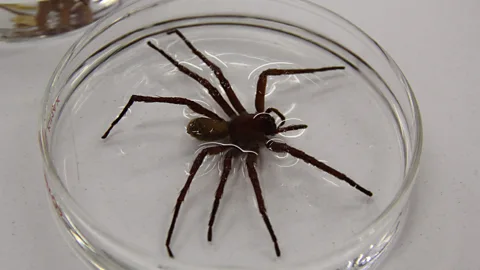
The unveiling this week of a newly-christened species of giant spider, discovered in 2013 by researchers from the San Diego History Museum in an abandoned mine in the Mexican state of Baja California Sur, invites us to reflect upon the exceptional spiders that have loomed large in cultural consciousness and those that crouch in the corners of our imagination. Officially named Califorctenus cacachilensis, after the Sierra de las Cacachilas mountain range in northwestern Mexico where it was first spotted, the spider’s spindly legs stretch to an unsettling four inches (10cm) in length. While not as huge as the Giant Huntsman Spider, found in Asia (whose leg-span can exceed 1 foot, or 30cm), Califorctenus cacachilensis is big enough to make the flesh of even the mildest arachnophobe crawl.
 Ricardo Valenzuela/AFP/Getty Images
On reflection, it is intriguing just how much of art history is stitched together by the fearsome filaments of the spider. Since antiquity, the eight-legged arthropod has stood as an archetypal symbol for weaving and the spinning of fortunes and has crept its way into the iconography of virtually every folkloric tradition, from the Ashanti in North Africa to the Navajo in North America, who attributed the creation of the world to the ‘Spider Grandmother’. In Greco-Roman mythology, Athena, the goddess of wisdom, craft, and war, spitefully turned a young woman, Arachne, into a spider after being challenged to a weaving contest by the gifted mortal.
The Spinners (or ‘Las Hilanderas’) is a painting by the Spanish artist Diego Velázquez, created around the same time that Rozee was needling her stupefying work in the Netherlands. It depicts Athena and Arachne in mid-spin, trying desperately to out-stitch the other. Our foreknowledge of the inevitable fate of Arachne, that her lithe and agile limbs will soon be multiplied and transformed into those of a spider, haunts the scene. Suddenly, the white balls of thread that loll on the floor at Archane’s feet and rest in her hand seem like juddering spider sacs, forever on the verge of exploding with lanky legs.
In the modern era of image-making, the spider has lost none of its tensility. In 1940, the Spanish Surrealist Salvador Dalí reinvented his already iconic dream of time’s fluidity, The Persistence of Memory (1931), by inserting into the heart of his new melting vision, Spider of the Evening, the winnowing pins of a gangly arthropod, whose elongated body anticipates that of the newly announced species discovered in Mexico.
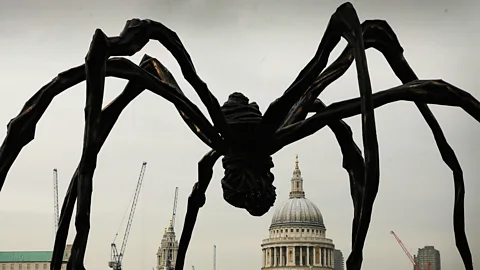
In more recent times, the responsibility of conserving the significance of the spider was assumed by the French-American artist Louise Bourgeois, who glimpsed in its disquieting stature the possibility of a universal emblem fused with deep personal meaning. For Bourgeois, whose drawings, sculptures, and installations were inspired by the spider over a span of 60 years, the creature is a talisman of memory intensified by her affection for her mother (a talented weaver who died when the artist was a student) as well as an indomitable symbol of feminine resilience.
Enormous incarnations of Bourgeois’s spiders, such as her famous 30-foot-high (9m) Maman (or ‘Mommy’), have scurried their way into the permanent collections of art institutions across the globe, from Tokyo to London, Doha to Bilbao. The sheer scale of Bourgeois’s towering bronze legs and dangling sacs of huge marble eggs makes certain that the awesome weave of her imagination will never disappear down the dark shaft of cultural recollection or be lost forever like the forgotten embroideries of Katharina Rozee in an attic, crypt or fusty loft.
If you would like to comment on this story or anything else you have seen on BBC Culture, head over to our Facebook page or message us onTwitter.
And if you liked this story, sign up for the weekly bbc.com features newsletter, called “If You Only Read 6 Things This Week”. A handpicked selection of stories from BBC Future, Earth, Culture, Capital and Travel, delivered to your inbox every Friday.
